
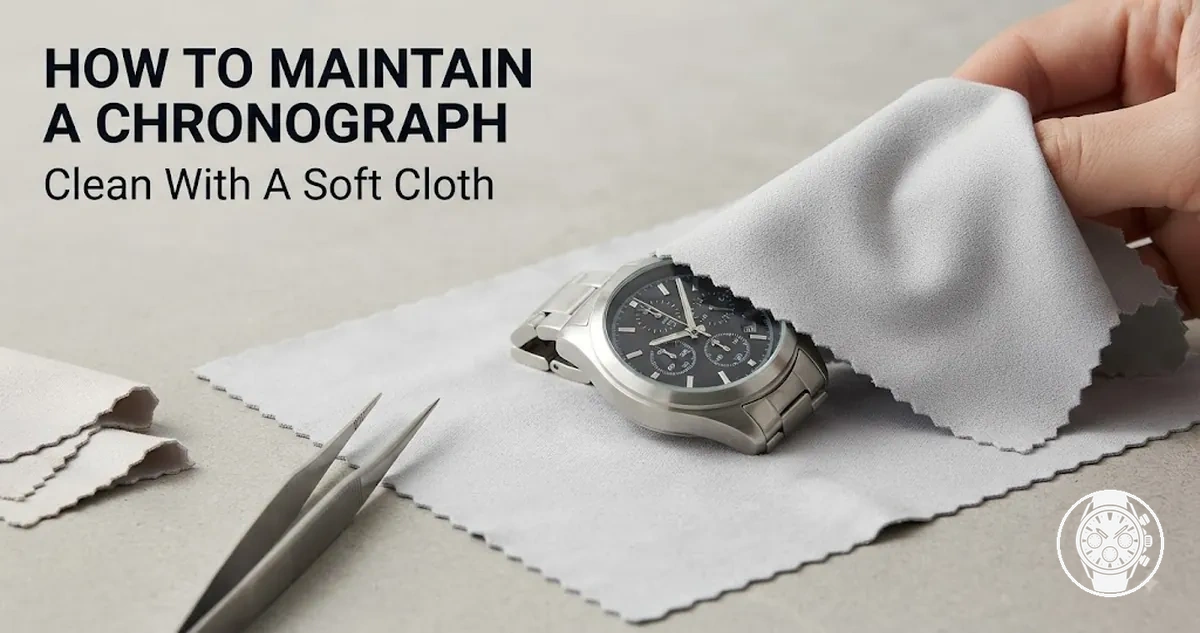
Men’s Quartz Chronograph Watch Maintenance
Men’s quartz chronograph watch maintenance covers owner-safe external cleaning, strap care, water-resistance protection, battery timing, chronograph function checks and storage, with specialist service used for work that requires opening or testing the watch. The maintenance boundary is external care and observation rather than internal repair, because opening the case can affect sealing and expose the movement to dust; Citizen specifically advises against owner battery replacement for these reasons.
Strap material, watch age, condition and the manufacturer's instructions therefore determine the appropriate cleaning and protection routine.
Dirt, perspiration and moisture should be removed from the case, crystal and strap with care, while the crown, pushers and water exposure should follow the instructions and water-resistance rating for the specific watch. Seiko advises wiping moisture, sweat and dirt away with a soft, dry cloth and states that water resistance can deteriorate as gaskets age or watch parts deform after a shock; Citizen recommends periodic maintenance and gasket replacement at least every 2 to 3 years to help maintain water resistance. Strap material, watch age, condition and the manufacturer's instructions therefore determine the appropriate cleaning and protection routine.
Case opening, battery replacement, water-resistance testing and internal faults should move from owner maintenance to appropriate specialist service.
Battery timing and specialist service also require model-specific limits rather than one universal replacement interval: for example, Seiko specifies approximately 3 years of battery life for its quartz 8T63 chronograph models SSB425 and SSB455, while their stated water resistance is 10 bar. Battery life for another men’s quartz chronograph may differ, so its own calibre documentation should control replacement timing; storage should keep the watch protected from avoidable moisture and impacts, while owner checks should confirm that normal timekeeping and chronograph functions still operate as specified. Case opening, battery replacement, water-resistance testing and internal faults should move from owner maintenance to appropriate specialist service.
Table of Contents
Quartz Chronograph Maintenance Basics
Quartz chronograph maintenance is preventive external care and condition monitoring for the case, crystal, crown, pushers, strap or bracelet, battery-related operation, gaskets and storage environment. Routine care keeps exposed surfaces clean and dry, checks components for visible wear or abnormal operation, and uses the watch within its model-specific conditions. Seiko's watch-care guidance states that moisture, sweat and dirt should be wiped away with a soft, dry cloth and that gasket deterioration or deformation after an impact can reduce water resistance, so regular external care helps limit dirt and moisture exposure and identify conditions that need specialist attention.
Routine care keeps exposed surfaces clean and dry, checks components for visible wear or abnormal operation, and uses the watch within its model-specific conditions.
Owner-safe maintenance covers external inspection, gentle cleaning and protected storage; battery replacement, water-resistance testing and internal movement service belong to specialist servicing because case opening affects access to the movement and water-resistant seals, while pressure testing requires appropriate equipment. Citizen's watch-care guidance recommends periodic inspection of water-resistant watches every 2 to 3 years and states that gaskets and other components may require replacement to maintain water resistance; this is a manufacturer maintenance interval, not a universal schedule for every quartz chronograph. For men’s quartz chronograph watches, battery timing, gasket inspection and service requirements should therefore follow the specific model documentation and the watch's condition.
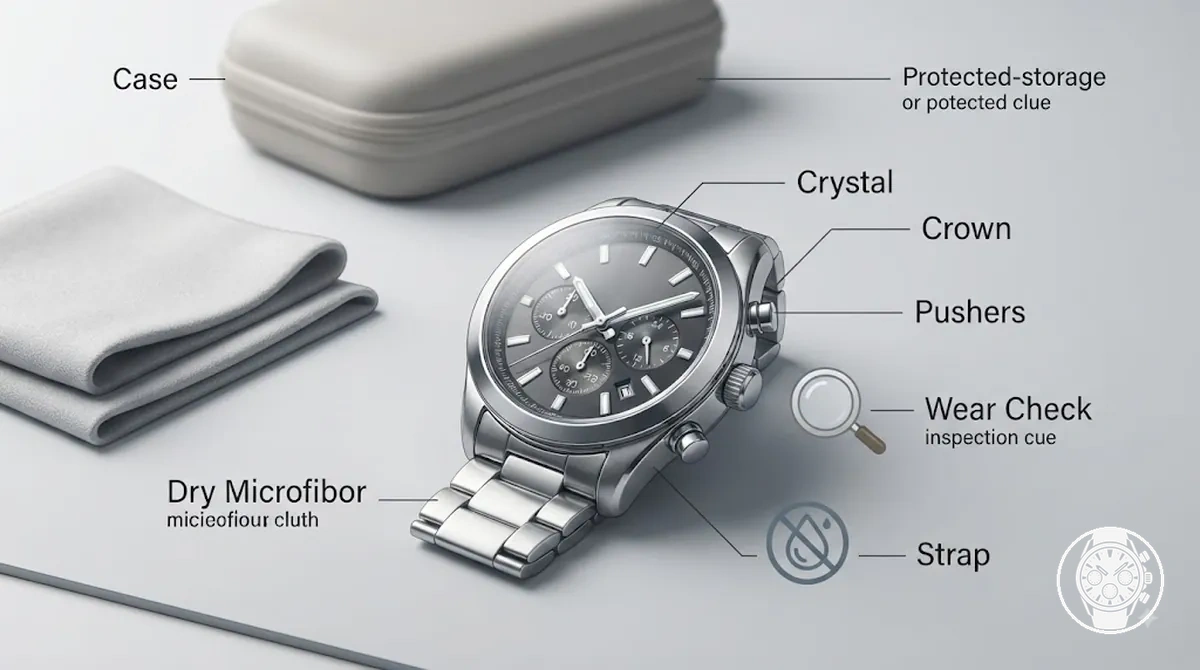
Quartz Chronograph Maintenance Basics organizes routine care by part and risk rather than as a repair sequence.
Quartz Chronograph Maintenance Basics organizes routine care by part and risk rather than as a repair sequence. The annotated example identifies the case, crystal, crown, pushers and strap or bracelet so these external maintenance areas can be recognised before more specific care tasks are considered.
- Case and crystal: keep the external condition clean and dry; visible dirt, sweat or moisture is the condition for external cleaning rather than case opening.
- Crown and pushers: keep these controls externally clean and use them according to the model instructions, especially where their position or operation affects the watch's stated water resistance.
- Strap or bracelet: inspect for dirt, retained moisture and visible wear, with care matched to the strap or bracelet material rather than one method applied to every material.
- Battery: use the model or calibre documentation for battery-life expectations; depleted-battery symptoms or replacement needs move the task from external care to specialist battery work.
- Gaskets and water resistance: treat seal condition and pressure verification as specialist-service items; Citizen recommends inspection every 2 to 3 years for its water-resistant watches because gasket and component deterioration can affect water resistance.
- Storage and usage habits: store the watch dry and protected when unworn, and avoid impacts, moisture exposure or operating conditions that exceed the specific model's documented limits.
Regular Cleaning for the Case, Crystal, Crown, and Pushers
Clean the case, crystal, crown, and pushers with controlled external contact: begin with a soft cloth, use a damp cloth or diluted mild soap only when the watch's documented water resistance and physical condition permit moisture, and finish by removing residue and drying every cleaned surface. Seiko advises wiping moisture, sweat, and dirt from a watch with a soft, dry cloth and warns that direct faucet pressure can allow moisture to enter a water-resistant watch; protecting the crown, pushers, and seals therefore takes priority during wet cleaning.
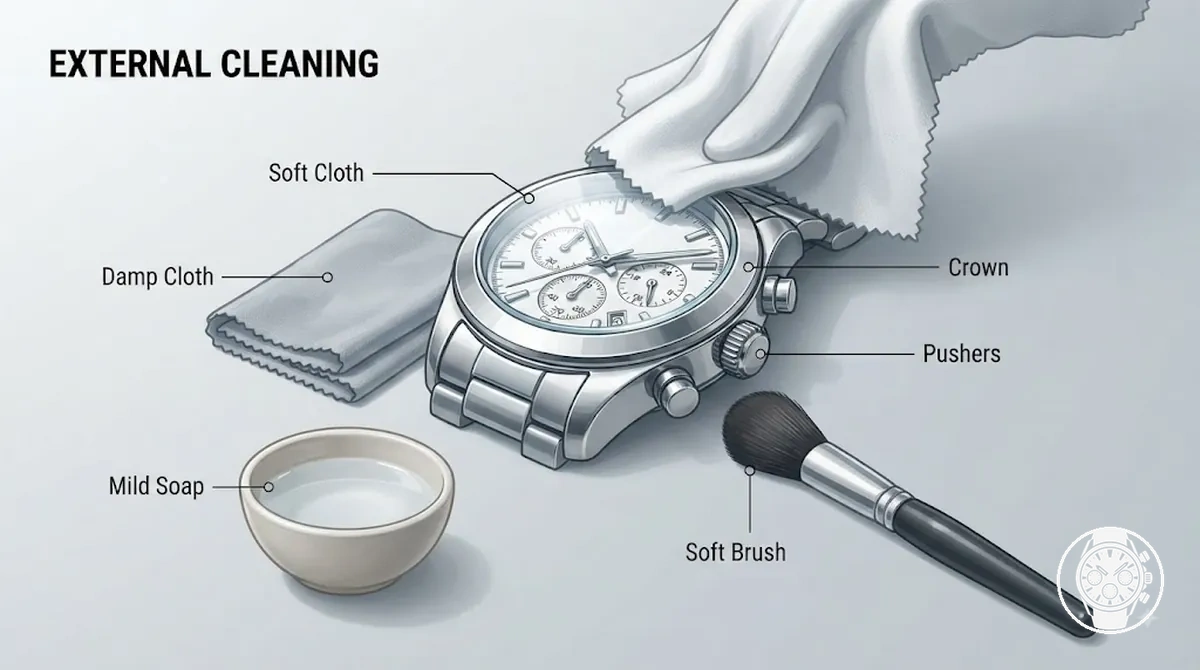
- Wipe the case and crystal. Use a clean soft cloth or microfiber cloth to remove fingerprints, loose dust, sweat, and surface moisture before introducing any liquid. Seiko recommends a soft, dry cloth for moisture, sweat, and dirt, which makes dry wiping the appropriate first action and reduces unnecessary moisture around the controls.
- Check the watch before using moisture. Use a damp cloth only when the model's instructions and present condition permit water contact; if water resistance is unknown, keep the cleaning method dry. Longines states that water resistance can be affected by gasket deterioration or an accidental impact on the crown, so the documented rating does not by itself confirm the current condition of the seals.
- Dilute mild soap for compatible surfaces. Longines specifies one drop of pH-neutral dish soap in a bowl of lukewarm water in its cleaning guidance for suitable water-resistant watches; use that manufacturer-specific dilution only where the watch's materials and instructions permit it. Apply controlled moisture with a damp cloth or soft brush rather than allowing liquid to collect around the crown and pushers.
- Brush accessible crevices lightly. Use a soft-bristle brush to loosen visible grime around case edges and accessible areas beside the pushers without forcing the bristles into gaps. Longines recommends a soft-bristle toothbrush for external cleaning and identifies gritty crown or pusher operation as a condition for professional attention rather than increased brushing force.
- Keep the crown and pushers secured. Do not operate these controls during wet cleaning unless the specific model documentation explicitly permits it, because moving controls while wet can expose sealing interfaces to moisture. Longines instructs users not to activate the time-setting crown or push-pieces underwater and to keep them pushed in or screwed down before water exposure, while Seiko advises against turning or pulling the crown when a watch is wet.
- Remove residue and complete drying. Where moisture-based cleaning is permitted, lift remaining mild-soap residue with a clean damp cloth and then dry the case, crystal, crown area, and pushers with a clean soft cloth. Do not direct high-pressure water at the watch; Seiko warns that faucet pressure can cause moisture ingress even when a watch is water resistant.
Do not use harsh chemicals, abrasive cleaning methods, force, or high-pressure water to clear stubborn residue around the crown or pushers. If water resistance is unknown, moisture becomes visible beneath the crystal, or a crown or pusher remains sticky or gritty after light external cleaning, stop cleaning and use appropriate specialist inspection rather than increasing water exposure or mechanical force.
Soft Cloth and Mild Soap Cleaning
Use a soft cloth or microfiber cloth with minimal controlled moisture to clean fingerprints and surface grime from the crystal and case; use mild soap only when the watch manufacturer's care instructions permit moisture-based cleaning. Keep the cloth lightly damp rather than wet, remove soap residue with a clean damp cloth, and complete drying before further use. If the watch has low or unknown water resistance, keep cleaning dry unless its model-specific instructions explicitly permit moisture.
Soft Cloth and Mild Soap Cleaning controls moisture, soap strength, wiping, residue removal, and drying.
Soft Cloth and Mild Soap Cleaning controls moisture, soap strength, wiping, residue removal, and drying.
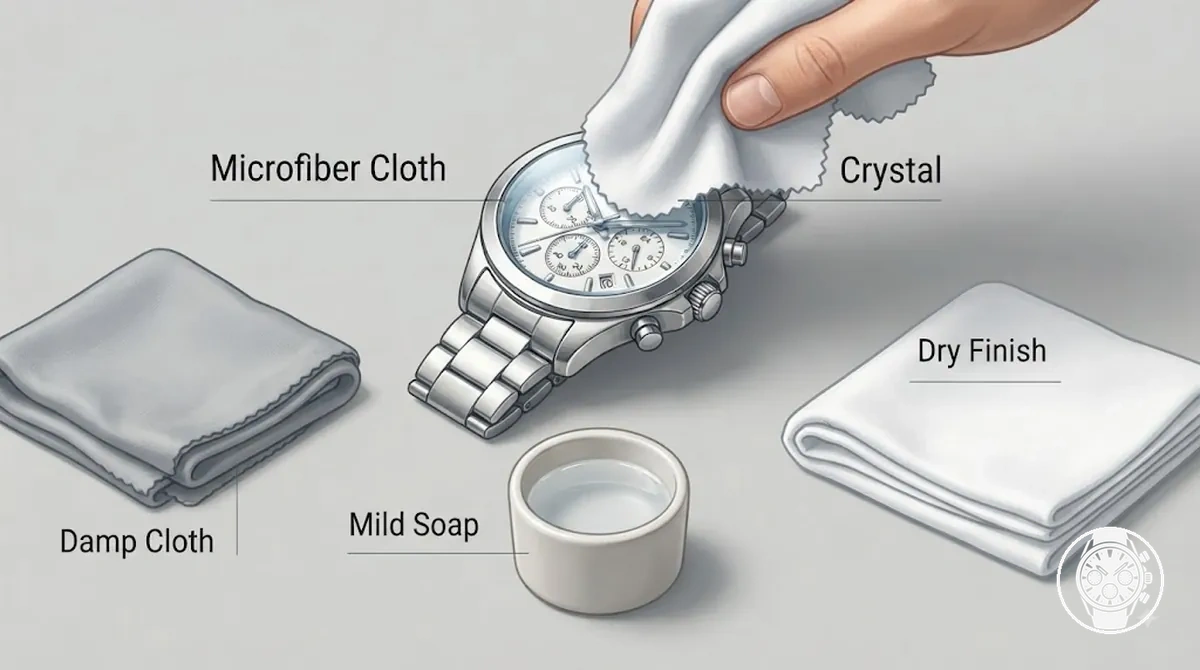
- Cloth: Use a clean soft cloth or microfiber cloth on the crystal and case.
- Moisture: Use only enough water to make the cloth lightly damp; do not soak the watch.
- Soap: If permitted, use diluted mild soap; avoid strong detergent, abrasive pads, and alcohol polish.
- Wiping: Wipe gently across the surface, then remove residue with a separate clean damp cloth.
- Drying: Finish with a dry soft cloth and wait until no surface moisture remains.
Crown, Pusher, and Bezel Crevice Care
Crown, Pusher, and Bezel Crevice Care removes external debris and buildup with a soft brush or cloth while keeping the crown and pushers secured whenever moisture is present. These moving controls need lighter handling than flat case surfaces because their crevices meet sealing interfaces; Citizen instructs users to keep the crown fully pushed in and not operate the crown or buttons when a watch is wet because water can enter the case. Limit cleaning to accessible external surfaces and gentle pressure.
Limit cleaning to accessible external surfaces and gentle pressure.
Crown, Pusher, and Bezel Crevice Care organizes cleaning around the narrow external gaps without driving debris toward moving controls. The annotated example identifies the crown, chronograph pushers, bezel edge, and external crevices that should receive gentle cleaning and drying.
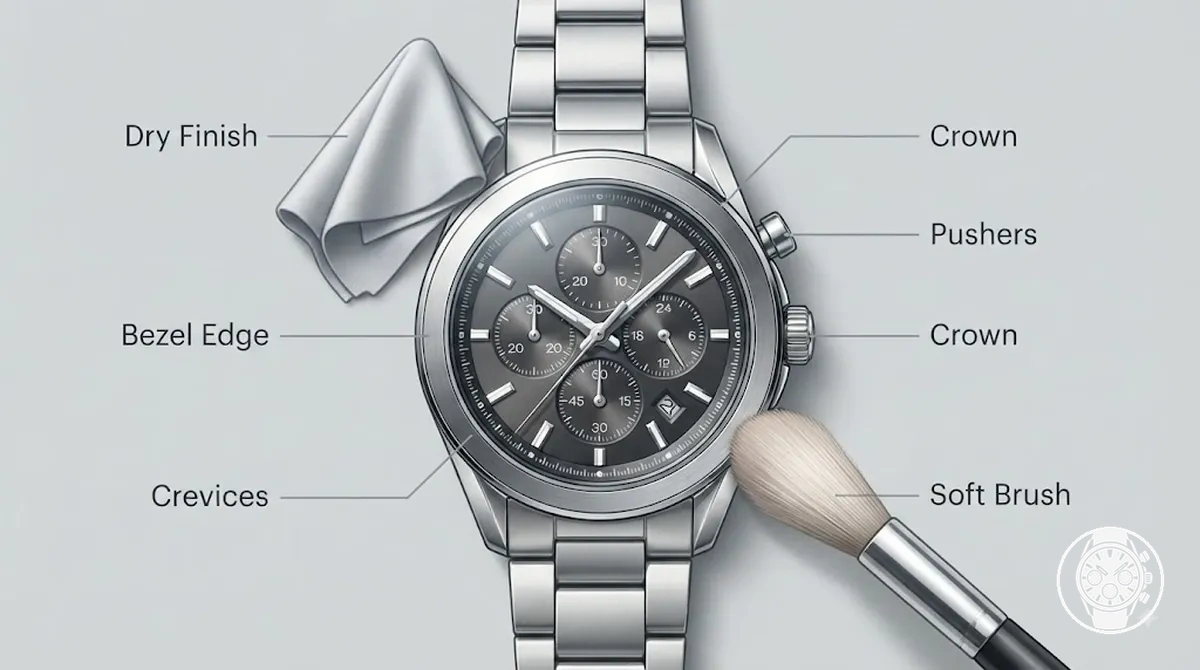
- Crown: Keep the crown in its normal fully pushed-in position during moisture-based cleaning; secure a screw-lock crown where the model uses one. Citizen specifies a fully pushed-in crown before water contact, while Seiko advises against turning or pulling out the crown when the watch is wet because moisture may enter the case.
- Pushers: Use a soft brush with gentle pressure to move visible debris away from the external pusher crevices, then complete drying with a soft cloth. Do not operate chronograph pushers during wet cleaning; Citizen warns that operating buttons while a watch is wet can allow water into the case.
- Bezel: Wipe accessible buildup and residue from the bezel edge with a soft brush or cloth, keeping the cleaning action on the exposed external edge. Leave material that cannot be reached without disturbing the bezel for specialist service.
- Crevices: Brush accessible gaps outward so debris moves away from the crown and pushers rather than deeper toward the controls. Keep the action strictly external and do not disturb controls or case parts to reach concealed material.
- Drying: Finish the crown, pushers, bezel edge, and surrounding crevices with a soft, dry cloth until no external moisture is visible. Seiko recommends wiping moisture, sweat, and dirt from the watch with a soft, dry cloth.
If a pusher remains sticky or the crown has a gritty feel after gentle external cleaning, stop operating the affected control and seek specialist service because the abnormal movement may indicate debris or another condition beyond accessible surface cleaning, and further pressure could aggravate it.
Watch Strap and Bracelet Cleaning by Material
Watch Strap and Bracelet Cleaning by Material starts with material identification because a leather strap, stainless steel bracelet, rubber or silicone strap, fabric strap, and coated or delicate band do not share the same safe exposure to moisture, soap, friction, or drying. Citizen specifies dry-cloth care for leather but soap and a soft toothbrush for metallic or synthetic-rubber bands, while Casio specifies a mild neutral detergent and soft toothbrush for metal bands and water washing for resin bands; where the exact fabric, coating, or composite construction is not documented, its manufacturer-specific care instructions remain the required boundary. The table organizes each material by safe cleaning approach, drying need, and the damage condition that can shift care from cleaning to strap replacement.
| Material | Safe cleaning approach | Drying need | Damage or replacement signal |
|---|---|---|---|
| Leather strap | Blot water, sweat, and surface moisture with a soft, dry cloth rather than rubbing. Citizen specifies this method for leather and warns that alcohol and other volatile substances can cause discoloration or deterioration. | Remove moisture promptly and let the leather ventilate before storage or wear; avoid prolonged damp contact. | Surface moisture and dirt remain cleaning conditions. Consider strap replacement when the leather is cracked, materially worn, deformed, or otherwise structurally deteriorated; Citizen states that natural leather wears, deforms, and discolours over time. |
| Stainless steel bracelet | Use a soft toothbrush with a weak solution of water and mild neutral detergent or soapy water for accessible bracelet links. Casio specifies this method for metal bands, followed by rinsing away detergent residue. | After permitted rinsing, wipe the bracelet with a soft absorbent cloth and allow remaining moisture between links to dry. | Removable dirt and residue are cleaning conditions. Stop using the bracelet and seek service when corrosion or structural wear affects a pin or link; Casio states that rust can cause band pins to move out of position or fall out. |
| Rubber or silicone strap | First identify the actual synthetic material: Citizen specifies soap and a soft toothbrush for synthetic rubber polyurethane bands, while Casio specifies water washing for resin bands. Do not automatically transfer either method to an undocumented silicone formulation. | Rinse permitted soap residue from polyurethane or resin as applicable and wipe the strap dry with a soft cloth; Citizen also specifies well-ventilated, out-of-sun drying for certain urethane bands. | Sweat and ordinary surface dirt are cleaning conditions. Citizen identifies loss of elasticity or cracking in urethane as replacement signals because these conditions represent material deterioration rather than removable contamination. |
| Fabric strap | The reviewed manufacturer evidence does not establish one cleaning method for every fabric or textile strap; use the instructions for the specific weave, backing, dye, stitching, and attachment construction rather than assuming rubber-band washing is suitable. | Remove moisture and allow a permitted wet-cleaned fabric strap to air-dry completely before storage or wear. No universal drying time is specified by the reviewed sources because textile construction and environmental conditions differ. | Odor or removable surface dirt can remain cleaning conditions while the fabric, stitching, and attachment points are intact. Consider replacement when wear, fraying, failed stitching, or attachment damage compromises the strap's structure rather than merely its cleanliness. |
| Coated or delicate materials | Use only the cleaning method specified for the particular coating, finish, backing, or composite construction. Casio notes that strong rubbing can discolor painted components, so care suitable for bare stainless steel should not automatically be applied to a coated surface. | Use gentle pat drying or moisture avoidance according to the documented finish. The reviewed sources do not specify one drying procedure that is valid for every coated or delicate material. | Removable residue is a cleaning condition while the finish and structure remain intact. Consider specialist assessment or replacement when coating deterioration, cracking, structural wear, or attachment damage remains after surface cleaning because further cleaning does not repair material failure. |
Cleanable condition: continue material-specific cleaning when the strap or bracelet remains structurally sound and the issue is removable sweat, moisture, odor, dirt, or residue. Replacement condition: consider strap replacement when deterioration affects dependable attachment or material integrity—for example, Citizen identifies cracking or lost elasticity in urethane as replacement signals, while Casio identifies rust-related pin displacement as a condition requiring the watch to be taken out of use and serviced.
Leather Strap Care
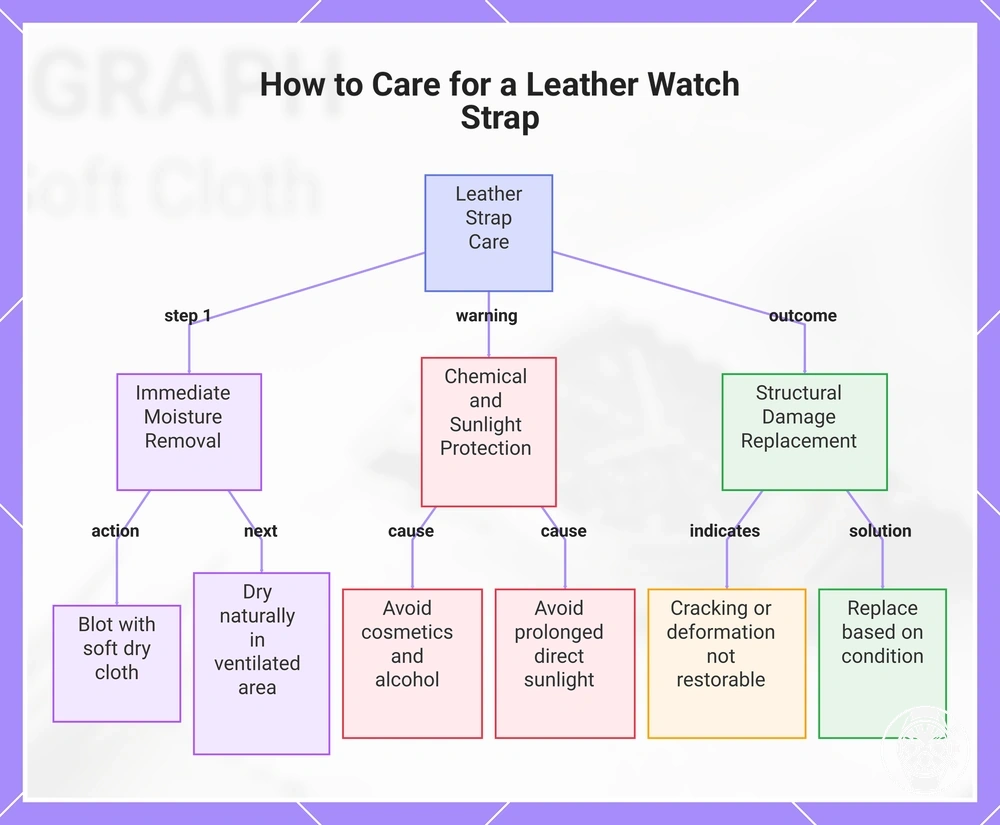
A leather strap needs low-moisture care: remove sweat and moisture promptly with a soft, dry cloth, limit chemical exposure, and allow natural drying before wearing or storing the watch. Citizen specifies blotting a wet or sweaty leather band with a dry, soft cloth rather than rubbing it and warns that cosmetics or substances containing alcohol or other volatile materials can cause discoloration or deterioration; Seiko identifies moisture, perspiration, and prolonged direct sunlight as causes of leather deterioration. If the leather develops structural cracking or deformation, further cleaning will not restore the damaged material, so replacement should be considered according to the strap's condition.
- Do remove sweat and moisture: blot the leather strap promptly with a soft, dry cloth and let it dry naturally in a ventilated location; persistent odor after complete drying is a condition for checking the maker's leather-specific cleaning guidance rather than increasing moisture exposure.
- Do limit lotions and chemicals: remove transferred lotion or cosmetic residue using the leather maker's permitted method. Citizen warns that cosmetics and substances containing alcohol or other volatile materials can contribute to leather discoloration or deterioration.
- Do condition only when appropriate: use a small amount of conditioner only when the strap maker permits it for that leather and finish. The reviewed manufacturer guidance does not establish a universal conditioner type, quantity, or application interval for every leather strap, so those values remain material-specific.
- Do not saturate or force drying: keep water exposure minimal and avoid concentrated heat. Seiko advises removing moisture and perspiration with a soft, dry cloth and notes that moisture and prolonged direct sunlight can accelerate leather deterioration, making gentle natural drying the evidence-supported approach.
- Do consider replacement for structural wear: for example, a worn strap with visible cracking plus deformation around a repeatedly flexed or attachment area has material damage rather than removable surface contamination. Citizen states that natural leather wears and deforms over time and recommends periodic replacement, but its guidance does not specify one universal replacement interval because leather type, use, and material condition differ.
This chart shows the key steps for leather strap care, including immediate moisture removal, protection from chemicals and sunlight, and when to consider replacement.
Metal Bracelet, Rubber, and Fabric Strap Care
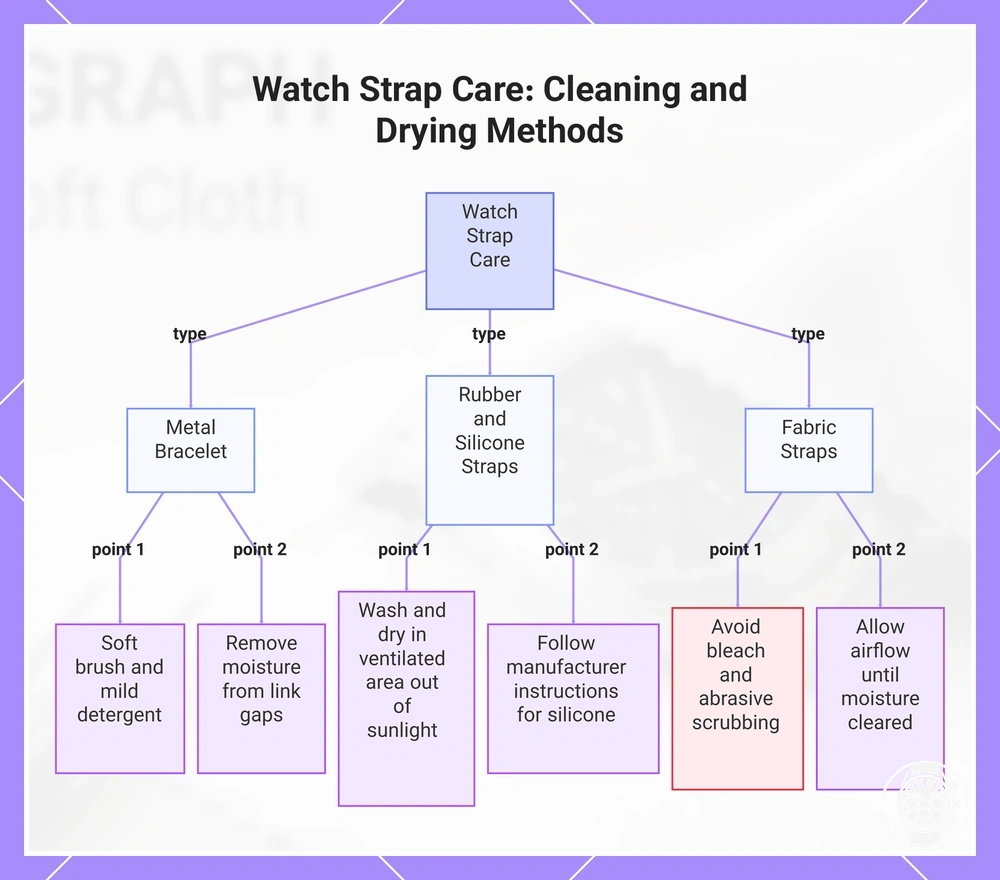
When a metal bracelet, rubber strap, silicone strap, or fabric strap is removable and its watch design permits straightforward removal, cleaning the band separately can keep cleaning moisture and residue away from the watch case; otherwise, clean it while attached using the water-exposure limits for the watch. Metal and specified synthetic-rubber or resin bands have manufacturer-supported wet-cleaning methods, while the reviewed evidence does not establish one universal wet-cleaning method or drying time for every silicone strap or fabric strap. In every group, drying is complete only after accessible surface water and moisture retained in link gaps or absorbent material have been removed before wear or storage.
- Metal bracelet: Clean residue from a metal bracelet and its link gaps with a soft brush and mild cleaning solution where the manufacturer permits water. Casio specifies a soft toothbrush with a weak solution of water and mild neutral detergent for metal bands, followed by rinsing detergent away and wiping with a soft absorbent cloth; Citizen similarly specifies neutral detergent or soapy water with a soft toothbrush for heavy metal-band soiling. Avoid abrasive scrubbing, and finish by removing moisture from the link gaps rather than leaving water between bracelet components.
- Rubber and silicone straps: For a rubber strap identified as synthetic rubber or polyurethane, Citizen specifies soap with a soft brush, thorough rinsing to remove residue, and drying; Casio specifies washing resin bands with water and wiping them dry with a soft cloth. Citizen also specifies a well-ventilated location out of direct sunlight for drying certain urethane bands. The reviewed manufacturer evidence does not establish the same soap, rinsing, or soaking method for every silicone strap, so an undocumented silicone formulation should follow its own maker's material-care instructions rather than a polyurethane or resin procedure being treated as universal.
- Fabric strap: A fabric strap can retain moisture within its weave, backing, or stitching, so odor control depends on removing permitted cleaning residue and allowing airflow until absorbed moisture has cleared. The reviewed manufacturer evidence does not specify one universal brush type, wet-cleaning method, or drying time in minutes or hours for all fabric straps because textile construction and permitted water exposure differ. Avoid bleach and abrasive scrubbing; where wet cleaning is permitted, allow airflow and consider drying complete only when the fabric no longer contains detectable retained moisture before wear or storage.
This chart shows the recommended cleaning and drying methods for metal bracelets, rubber/silicone straps, and fabric straps, including key warnings and manufacturer instructions.
Water Resistance Protection During Cleaning and Wear
Water resistance is conditional protection; a water-resistant watch does not have a permanently effective barrier against every form of water exposure. Seiko states that water resistance can deteriorate as gaskets age or when watch components are deformed by impact, while Citizen instructs users to keep the crown fully pushed in and to secure a screw-lock crown where fitted. For a quartz chronograph, the effective boundary therefore depends on the stated rating, crown closure, and the condition of its seals and gaskets.
For a quartz chronograph, the effective boundary therefore depends on the stated rating, crown closure, and the condition of its seals and gaskets.
Cleaning and wear can increase water-entry risk when pressure, soap, saltwater, chlorine, or heat exceeds the conditions allowed for the specific watch. Seiko advises against placing even a water-resistant watch directly under running faucet water because local water pressure can exceed the conditions represented by ordinary static exposure, and its guidance warns that soap and steam during bathing or sauna use can accelerate deterioration of water resistance; after permitted seawater exposure, Seiko specifies fresh-water cleaning followed by thorough drying. The reviewed manufacturer guidance does not establish one universal chlorine concentration, water temperature, or exposure duration that is acceptable for every quartz chronograph, so swimming, showering, rinsing, and cleaning under water remain conditional on the model's documented rating and current seal condition.
Cleaning and wear can increase water-entry risk when pressure, soap, saltwater, chlorine, or heat exceeds the conditions allowed for the specific watch.
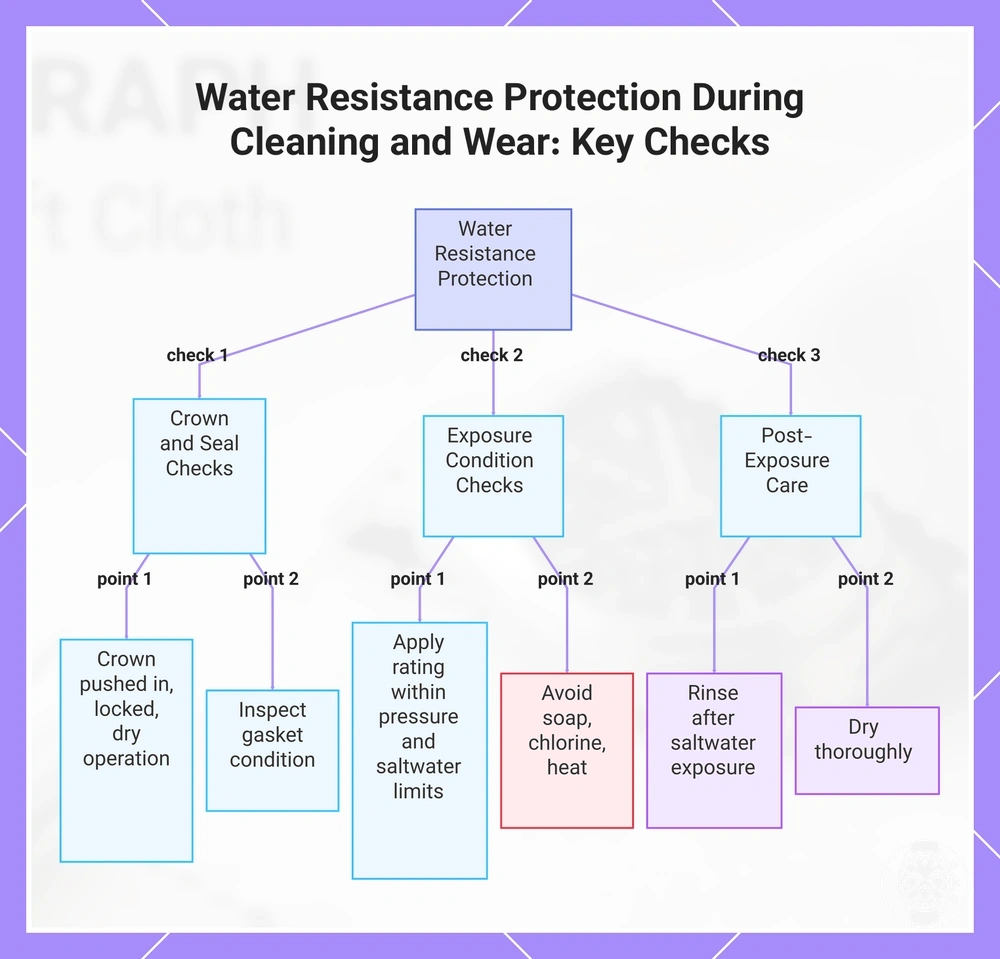
Water Resistance Protection During Cleaning and Wear uses the following checklist to verify the main exposure and seal-protection conditions; broader decisions about ratings and suitable activities belong to the dedicated water resistance and durability context.
- Crown closure: Keep the crown fully pushed in during permitted water exposure and securely lock it when the watch has a screw-lock crown. Citizen warns against operating the crown or buttons while a watch is wet because water can enter the case.
- Seals and gaskets: Treat gasket condition as a service-dependent variable rather than assuming the original water resistance remains unchanged with age. Seiko states that deteriorated gaskets or deformation caused by impact can reduce water resistance, so a suspected seal problem requires inspection rather than additional water exposure.
- Rating and pressure: Apply the rating only within the manufacturer's stated exposure conditions. As a numerical example, Seiko's general water-resistance guidance distinguishes 3 bar for accidental splashes and rain, 5 bar for swimming, yachting and showering, and 10, 15, or 20 bar for bathing and shallow diving; Seiko still advises against direct faucet flow, showing that a pressure rating does not authorise every form of water contact.
- Soap, chlorine, and heat: Treat chemical and thermal exposure separately from the pressure rating. Seiko states that soap and steam associated with bathing or sauna use can accelerate deterioration of water resistance, while the reviewed manufacturer evidence does not specify one universal safe chlorine concentration, exposure time, or temperature for every quartz chronograph; verify the model documentation before exposing the watch to those conditions.
- Saltwater: After seawater contact that the watch's rating and instructions permit, remove salt according to the manufacturer's care procedure. Seiko specifies washing an applicable water-resistant watch with fresh water after seawater exposure and then drying it thoroughly, while avoiding direct running water from a faucet.
- Drying: Remove external moisture after permitted exposure, including moisture around the crown, pushers, caseback, and bracelet or strap interfaces. Seiko recommends wiping moisture, sweat, and dirt away with a soft, dry cloth; persistent moisture inside the watch or suspected loss of water resistance is a service condition rather than a reason for further wet cleaning.
This chart summarizes the main checks for maintaining water resistance during cleaning and wear, covering crown and seal condition, exposure limits, and post-exposure care.
Crown Position, Gaskets, and Seal Checks
Crown position, gasket and seal condition, and the caseback should be checked externally before a quartz chronograph is exposed to moisture because these checks can identify water-entry risk but cannot verify water resistance. Keep a pushed-in crown fully closed or a screwed-down crown secured as specified for the model, and do not remove a gasket or open the caseback for inspection. If the crown feels loose, gasket condition is unknown, or prior water exposure creates concern about seal integrity, stop further moisture exposure and use professional pressure testing because an external check cannot confirm the seal under pressure.
- Crown position: Confirm that a conventional crown is fully pushed in or that a screwed-down crown is securely closed before permitted moisture exposure. Citizen specifies that the crown should be completely pushed in and a screw-lock crown securely locked before water contact; a crown that is open, pulled out, or cannot be secured is a stop cue rather than a condition for wet cleaning.
- Gasket age and seal condition: Treat unknown gasket age or condition as an unverified seal state. Citizen recommends inspection of its water-resistant watches every 2 to 3 years and states that gaskets and other components may require replacement to maintain water resistance; the 2-to-3-year interval is Citizen's manufacturer guidance, not a universal replacement interval for every quartz chronograph.
- Caseback condition: Check the exterior for visible damage, displacement, or signs that the caseback has been disturbed. A caseback that looks normal does not establish the condition of its gasket, while visible damage or uncertainty following prior case opening is a reason to keep the watch away from moisture until professionally checked.
- Pressure testing: Use professional pressure testing when seal integrity needs verification after service, impact, suspected deterioration, or an unknown gasket condition. Seiko states that gasket deterioration or deformation of watch components after accidental shock can reduce water resistance and recommends periodic water-resistance checks; no universal pressure-testing interval for every quartz chronograph is established by the reviewed manufacturer guidance.
- Stop cue: A loose-feeling crown, unknown gasket condition, visibly compromised caseback, or signs of moisture after prior water exposure require specialist assessment before further wet cleaning or water exposure. These conditions cannot be cleared by an external visual or feel-based seal check, so keep subsequent care dry until the watch's water resistance has been professionally assessed.
Soap, Heat, Chlorine, and Saltwater Risks
Soap, heat, chlorine, saltwater, sweat, and humidity can affect a quartz chronograph's seals, surface finishes, and strap materials, but the outcome is conditional on the material, exposure duration, watch condition, and manufacturer-permitted use. Seiko states that soap and steam associated with bathing or sauna use can accelerate deterioration of water resistance, while Citizen identifies perspiration, moisture, detergents, and other chemicals as deterioration or discoloration risks for particular band materials. Use exposure-specific prevention and the model's care instructions rather than assuming that permitted water contact also permits every chemical or heat exposure.
- Soap: Soap can leave film and expose seals or strap materials to substances outside their specified care method. Seiko advises against wearing a watch while bathing or using a sauna because soap and steam can accelerate deterioration of water resistance; where soap cleaning is explicitly permitted for a band, follow its specified rinse and drying method rather than treating shower exposure as equivalent to cleaning.
- Heat: Hot water and sauna heat combine elevated temperature with moisture or steam, creating a different exposure condition from ordinary cool-water contact. Seiko advises against wearing a watch in a bath or sauna and notes that operating-temperature limits vary by calibre; avoid hot-water and sauna exposure unless the specific watch documentation explicitly permits the condition.
- Chlorine: Pool water introduces chemical exposure in addition to water exposure, and the reviewed manufacturer evidence does not specify one universal safe chlorine concentration or exposure duration for all quartz chronographs, seals, finishes, and strap materials. For swimming, verify that both the watch and band are intended for the exposure and follow their post-swim care instructions rather than assuming a water-resistance rating establishes chlorine compatibility.
- Saltwater: Saltwater can leave salt residue on the watch and strap after permitted beach or swimming use. Seiko specifies that an applicable water-resistant watch used in seawater should be cleaned with fresh still water, not placed directly under running faucet water, and then dried thoroughly with a soft cloth; apply that rinse only when the specific watch and strap are documented for the preceding water exposure.
- Sweat: Sweat can leave moisture and residue on the case, bracelet, and strap materials during everyday or gym use. Seiko recommends wiping moisture, sweat, and dirt away with a soft, dry cloth, while Citizen specifies blotting a wet or sweaty leather band with a dry, soft cloth rather than rubbing it; after exercise, use the cleaning and drying method specified for the actual band material.
- Humidity: Persistent humidity can prolong moisture contact and contribute to odor or material deterioration in moisture-sensitive straps. Seiko states that urethane deterioration can accelerate when the band remains wet in highly humid conditions, while Citizen identifies moisture as a deterioration factor for urethane; remove retained moisture and complete drying using the material-specific method, noting that the reviewed manufacturer guidance does not specify one universal drying duration for every strap material.
Battery Timing and Quartz Movement Care
Battery timing for a quartz movement has no universal replacement interval: battery life is movement- and use-specific, so maintenance should monitor battery age, chronograph use, and operating condition rather than apply one fixed schedule. TAG Heuer states that a quartz-watch battery normally lasts several years and recommends prompt replacement when a battery-powered quartz watch stops, while a model-specific low-energy indication such as skipping seconds should be interpreted only through that calibre's documentation. The practical symptoms to watch are stopping, persistent timing irregularity, or a documented low-battery indication.
For broader calibre-specific expectations, see movement and battery life .
Observation becomes a professional service need when those symptoms persist, when the watch requires battery replacement, or when moisture protection is uncertain after case opening. Low-energy signals are calibre-specific: Daniel Wellington identifies two-second jumps as a possible low-battery or service signal on its quartz watches, whereas Citizen documents two-second interval movement as an insufficient-charge warning on specified rechargeable Eco-Drive calibres, so skipping seconds is not a universal weak-battery signal. Case opening can also affect the sealing boundary; TAG Heuer's Partial Service for quartz watches includes battery renewal, replacement of all gaskets, and a final inspection, making seal replacement and water-resistance verification reasons for professional service rather than routine owner cleaning. For broader calibre-specific expectations, see movement and battery life.
| Signal | Likely meaning | Owner-safe action | When to use a specialist |
|---|---|---|---|
| Stopped watch | Battery depletion is one possible cause; TAG Heuer advises replacing the battery promptly when its battery-powered quartz watches stop. | Record when stopping occurred and check the model or calibre documentation for its battery requirements. | Use professional service when battery replacement requires case opening, diagnosis, gasket attention, or water-resistance verification. |
| Timing irregularity | Skipping seconds can be a documented low-energy signal on particular movements, but its meaning is calibre-specific; Daniel Wellington identifies two-second jumps as a possible low-battery or service signal, while Citizen specifies two-second interval movement as an insufficient-charge warning on certain rechargeable Eco-Drive calibres. | Compare the observed seconds-hand pattern with the exact model or calibre instructions before treating it as a weak-battery symptom. | Use professional service when abnormal timing persists or the documented warning calls for battery or movement attention. |
| Frequent chronograph use | Function use can change energy consumption. Citizen's E210 documentation states that remaining charge varies with the frequency of chronograph and alarm use, so this model-specific example shows why function usage belongs in battery timing assessment rather than supporting a universal interval. | Monitor operation and use the specific calibre documentation to interpret battery life or remaining-charge expectations under actual function use. | Use a specialist when increased function use is accompanied by stopping, abnormal operation, or a documented energy warning that requires service. |
| Unknown battery age | Remaining battery life cannot be reliably assigned a universal number when the battery history, movement, and usage are unknown; the reviewed manufacturer evidence provides no single replacement interval applicable to every quartz chronograph. | Identify the model or calibre, check its documented battery-life expectation, and monitor for stopping or its specified low-energy signal. | Arrange professional assessment when battery history is unknown and operating symptoms indicate battery attention. |
| Post-case-opening water-risk concern | Seal condition becomes relevant after case opening; TAG Heuer's quartz Partial Service combines battery renewal with replacement of all gaskets and a final inspection. | Limit avoidable moisture exposure when gasket condition or post-service water resistance is uncertain. | Use professional service when gasket inspection, seal replacement, or pressure testing is needed to assess water resistance after case access. |
When the Battery Usually Needs Attention
A quartz chronograph battery commonly needs attention on a model-specific multi-year schedule rather than at one universal interval: for example, Citizen specifies approximately 2 years for calibre 052 when the chronograph is used for 1 hour per day, while Seiko specifies approximately 3 years for calibre A824 under conditions including 1 hour of stopwatch use per day. Battery age, usage, and condition therefore set replacement timing, and visible symptoms matter more than a universal schedule.
- Stopped movement: A stopped battery-powered quartz watch can indicate depleted battery capacity. TAG Heuer states that its quartz-watch batteries have a lifespan of several years and advises prompt battery replacement when a quartz watch stops; if battery attention does not restore operation, the symptom requires service diagnosis rather than assuming the battery was the only cause.
- Weak timekeeping symptoms: Treat unusual timekeeping or a low-energy hand pattern according to the exact calibre instructions rather than as a universal weak-battery signal. Where a model documents a battery-life warning, that defined indication is the actionable value; otherwise, persistent abnormal timekeeping warrants assessment rather than diagnosis from hand behaviour alone.
- Chronograph function: Frequent chronograph use can shorten battery life on movements where the chronograph draws additional energy. Citizen specifies approximately 2 years for calibre 052 with 1 hour of chronograph use per day, while Seiko states that its A824 battery can expire before its approximately 3-year specification when watch functions are used more than the stated conditions, which include 1 hour of stopwatch use per day.
- Battery age and service history: Compare battery age with the specific movement documentation and any recorded replacement date; without the calibre and service history, the reviewed manufacturer evidence does not support one numerical replacement interval for every quartz chronograph. A known replacement date provides a useful timing reference, while an unknown history makes stopped movement or a documented warning more informative than calendar age alone.
- Stored watch: A newly purchased or long-stored watch can have less remaining battery life than its published new-battery specification. Seiko states that the factory-installed monitor battery in calibre A824 may provide less than the specified approximately 3-year life once the watch is in the owner's possession, so an early battery symptom after purchase does not by itself establish abnormal battery drain.
When Battery Work Should Stay With a Specialist
Quartz chronograph battery work should stay with a specialist when battery replacement requires opening a secured caseback, preserving or restoring water resistance, replacing a gasket, performing pressure testing, assessing corrosion, or verifying chronograph function after service. Citizen states that removing a caseback for battery replacement can introduce dust and leave the water seal incomplete, while Seiko states that opening and reclosing a caseback can reduce the watch's original water-resistant quality. The service boundary is therefore the need to control sealing, contamination, case closure, or post-service function rather than battery access alone.
- Use a specialist when the caseback increases access or resealing risk: A screw-down or otherwise secured caseback requires controlled removal and refitting without compromising the case or seal. Citizen recommends professional battery replacement because caseback removal can introduce dust and result in incomplete water sealing and malfunction.
- Use a specialist when water resistance must be verified: Opening the case changes the sealing condition, so visual closure alone does not verify restored water resistance. Seiko specifies a water-resistance test after battery replacement for applicable water-resistant watches and explicitly requires that test after every battery replacement on watches rated at 10 bar or higher.
- Use a specialist when the gasket requires replacement: Citizen identifies water-resistant gaskets around components including the caseback, crown, and watch glass and states that, for its watches with replaceable batteries, water-resistant gaskets are replaced during battery replacement. This makes gasket condition part of the battery service when the watch relies on those seals for water resistance.
- Use a specialist when pressure testing is part of the service requirement: Pressure testing is the verification step for water resistance when the model or manufacturer requires it after case opening. Seiko's 10-bar-or-higher threshold requires a water-resistance test at every battery replacement, while Citizen states that divers' watches and watches with high water resistance require an appropriate inspection environment after battery replacement.
- Use a specialist when corrosion or moisture is visible or suspected: Corrosion, internal moisture, or evidence of water entry changes the task from routine battery work to inspection for damage. Citizen states that water entering a watch can damage the mechanism, precision electronic components, or dial and directs the watch to repair rather than continued use when water has entered.
- Use a specialist when the watch is high-value or chronograph function needs verification: For a high-value watch, professional inspection limits avoidable risk to the case, sealing system, finish, and movement, although the reviewed manufacturer evidence provides no universal monetary value at which specialist service becomes mandatory. Chronograph requirements are calibre-specific; for example, Seiko's 7T94 instructions require the main time and stopwatch-hand position to be reset after battery replacement, so post-service function can involve more than installing a new battery.
Detailed case-opening and replacement steps are outside this maintenance section because the procedure depends on the calibre, caseback construction, gasket system, and post-service requirements; readers who need the separate process can use the battery replacement guidance without treating it as a reason to open a sealed case unnecessarily.
Chronograph Function Checks and Daily Use Habits
Chronograph function checks should confirm that start, stop, reset, hand return, and pushers continue to behave as specified during daily use; a repeatable change from the documented behaviour is the decision signal for moving from routine observation to troubleshooting or service. Citizen's H50 calibre instructions provide a model-specific example: after reset, its chronograph second and minute hands should indicate 0 seconds and 0 minutes, and Citizen specifies adjustment when those hands do not return to those positions. Keep routine checks gentle and observational rather than applying extra force or attempting calibration during maintenance.
and 3:00 a.m., a 6-hour restricted period, because the date may not change correctly the following day.
Routine maintenance means observing normal control response and limiting avoidable shock, magnetism, and moisture exposure; it does not include correcting a displaced hand or repairing a resistant control. Date-setting restrictions are also calibre-specific: Seiko's VK68 instructions specify that the date should not be set between 9:00 p.m. and 3:00 a.m., a 6-hour restricted period, because the date may not change correctly the following day. If a chronograph function repeatedly fails its documented start, stop, reset, or hand-return behaviour, or abnormal operation persists after shock, magnetism, or moisture exposure, treat the condition as a troubleshooting or service issue rather than continuing the routine check.
- Start and stop: Operate the chronograph normally and observe whether each command produces the documented response. Citizen's H50 instructions specify that its upper-right pusher starts the chronograph, stops it during measurement, and restarts it when pressed again; repeated failure to respond is an abnormal symptom, while extra pressure is not an appropriate maintenance response.
- Reset and hand return: Observe the reset position after timing has stopped. Citizen specifies 0 seconds and 0 minutes for the H50 chronograph second and minute hands after reset; persistent hand return to another position moves the condition beyond routine observation and into the calibre-specific adjustment or service process.
- Pushers and moisture: Use pushers only within the watch's documented water-use conditions and note any new resistance or inconsistent response. Citizen warns against operating the crown or buttons while a watch is wet because water can enter the case; abnormal pusher feel or chronograph behaviour following moisture exposure is therefore a reason to stop wet use and have the condition assessed rather than applying more force.
- Date-setting caution: Follow the calibre's documented date-setting window instead of assuming one restriction applies to every quartz chronograph. Seiko specifies a 9:00 p.m. to 3:00 a.m. restriction for the VK68, so its 6-hour window is a model-specific prevention condition rather than a universal rule.
- Shock: Avoid strong impacts and observe hand return after an accidental shock. Citizen's H50 instructions identify a chronograph minute hand displaced from its 0-minute reset position as a possible consequence of strong shock; persistent displacement is a troubleshooting signal rather than a routine maintenance task.
- Magnetism: Keep the watch away from strongly magnetic objects and observe movement or timekeeping after suspected exposure. Citizen's general watch precautions warn that strong magnetism can affect watch operation; persistent abnormal behaviour after exposure should be checked against the specific calibre instructions or assessed through service.
- Daily-use decision signal: Continue routine checks while start, stop, reset, hand return, and pusher response remain consistent with the model instructions. Move to troubleshooting or professional service when a documented function repeatedly fails, a reset hand remains displaced, a pusher develops persistent abnormal resistance, or shock, magnetism, or moisture exposure is followed by continuing abnormal operation.
This chart shows the main chronograph function checks and the decision signal for moving from routine observation to troubleshooting or service.
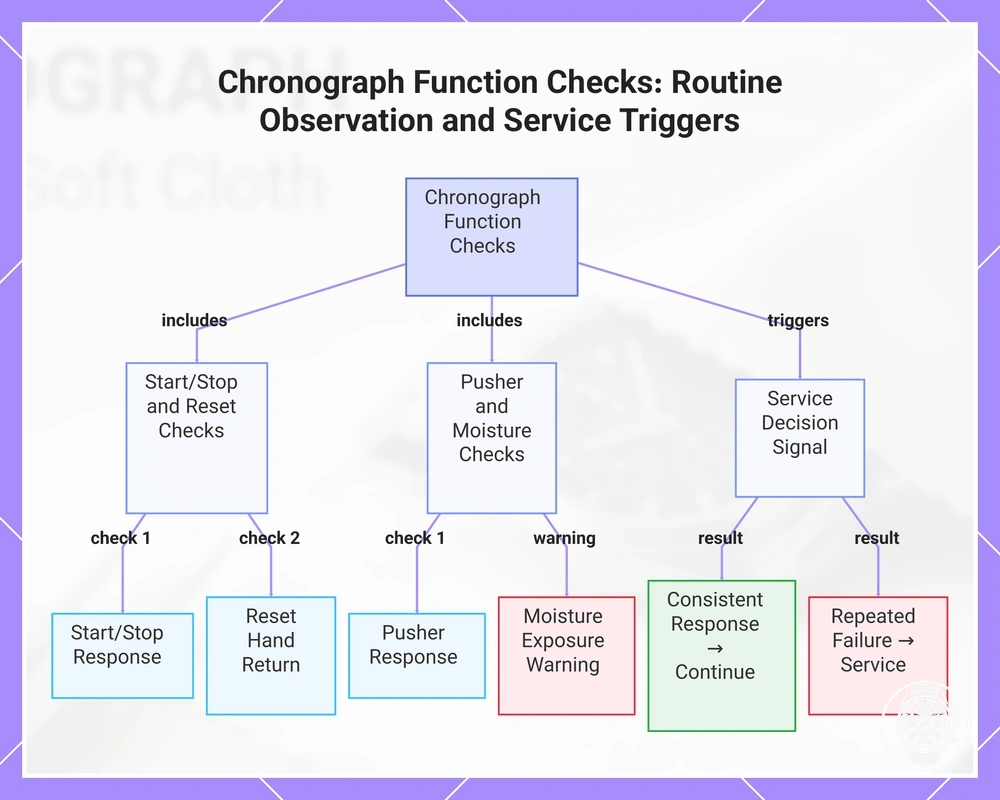
Stopwatch Start, Stop, and Reset Checks
A stopwatch check verifies that the quartz chronograph responds normally to start and stop commands, shows elapsed-time hand movement and subdial response during measurement, and returns its stopwatch hands to the model's expected reset position. Citizen specifies for calibre H50 that the chronograph second and minute hands should indicate 0 seconds and 0 minutes after reset; keep pusher feel gentle throughout the check and do not apply extra pressure when a control does not respond normally.
- Start: Press the model's start pusher once and observe pusher feel, elapsed-time hand movement, and the relevant subdial response. Citizen specifies that pressing and releasing the upper-right pusher starts measurement on calibre H50; the expected observed state is active chronograph measurement, so do not apply extra pressure if the expected response does not occur.
- Stop: Press the model's stop control once and observe whether the elapsed-time hands stop at the measured position. Citizen specifies that the H50 upper-right pusher stops measurement when pressed during chronograph operation; use one deliberate press for the observation rather than repeatedly operating an unresponsive control.
- Reset: After stopping the stopwatch, press the model's reset control once and observe the reset position and subdial response. Citizen specifies that the H50 lower-right pusher resets the chronograph and that its chronograph second and minute hands should return to 0 seconds and 0 minutes; if they return elsewhere, record the symptom rather than attempting an adjustment.
- Check the result: The observed value is normal when the pushers respond consistently, the elapsed-time hands and relevant subdials respond during measurement, and the stopwatch hands return to the model's documented reset position. If repeated failure, misaligned hands, or inconsistent reset behavior persists during this local check, treat it as a troubleshooting symptom under common problems or seek appropriate service rather than continuing to operate the controls.
Impact, Magnetism, and Setting Habits
Preventive setting habits for a quartz chronograph reduce avoidable stress on the quartz movement and chronograph controls by limiting strong impact, strong magnetism, extreme temperatures, improper crown handling, and pusher use around moisture. Citizen's watch precautions identify strong shock, strong magnetic fields, temperatures outside a calibre's specified operating range, and operation of controls while wet as conditions that can affect operation or increase water-entry risk; these are conditional risks rather than evidence that every minor bump or brief nearby magnetic exposure causes damage.
- Impact: Avoid dropping the watch or exposing it to strong shock. Citizen warns that strong impact can cause malfunction, performance deterioration, or case damage, so after a hard knock the preventive habit is to check for a change in normal operation rather than repeatedly pressing or forcing the controls.
- Magnetism: Keep the quartz chronograph away from strong magnetic fields and avoid prolonged close placement beside strongly magnetic objects. Citizen explains that strong external magnetism can interfere with the step motor in an analogue quartz watch and affect timekeeping; because the reviewed guidance does not specify one universal safe distance for every magnetic source and quartz movement, use the watch manufacturer's distance or exposure guidance where provided rather than assuming every nearby magnet has the same effect.
- Extreme temperatures: Keep the watch within the operating-temperature range specified for its calibre rather than applying one temperature limit to all quartz chronographs. Citizen states that temperatures outside a watch's specified operating range can stop the watch or impair its functions; the reviewed evidence does not establish one universal minimum or maximum temperature for every quartz chronograph, so the model or calibre documentation supplies the applicable heat and cold limits.
- Crown handling: Keep the crown fully pushed in during normal wear, secure a screw-lock crown where fitted, and do not force a crown that resists normal setting. Citizen instructs users to keep the crown in its normal position and warns against operating it while the watch is wet because moisture can enter the case; waiting until the exterior is dry reduces avoidable seal and water-entry risk during setting.
- Setting habits: Change the date only within the permitted setting conditions for the specific calibre. For example, Seiko's VK68 chronograph instructions specify that the date should not be set between 9:00 p.m. and 3:00 a.m. because doing so can interfere with the following date change; this 6-hour restricted period is a VK68-specific example, not a universal rule for every quartz chronograph.
- Pushers and moisture: Do not operate chronograph pushers while the watch is wet unless the specific model documentation expressly permits that operation. Citizen warns that operating buttons while a watch is wet can allow water to enter the case, so the safer daily-use habit is to dry the exterior and follow the model's documented control conditions before using the pushers.
Safe Storage Between Wears
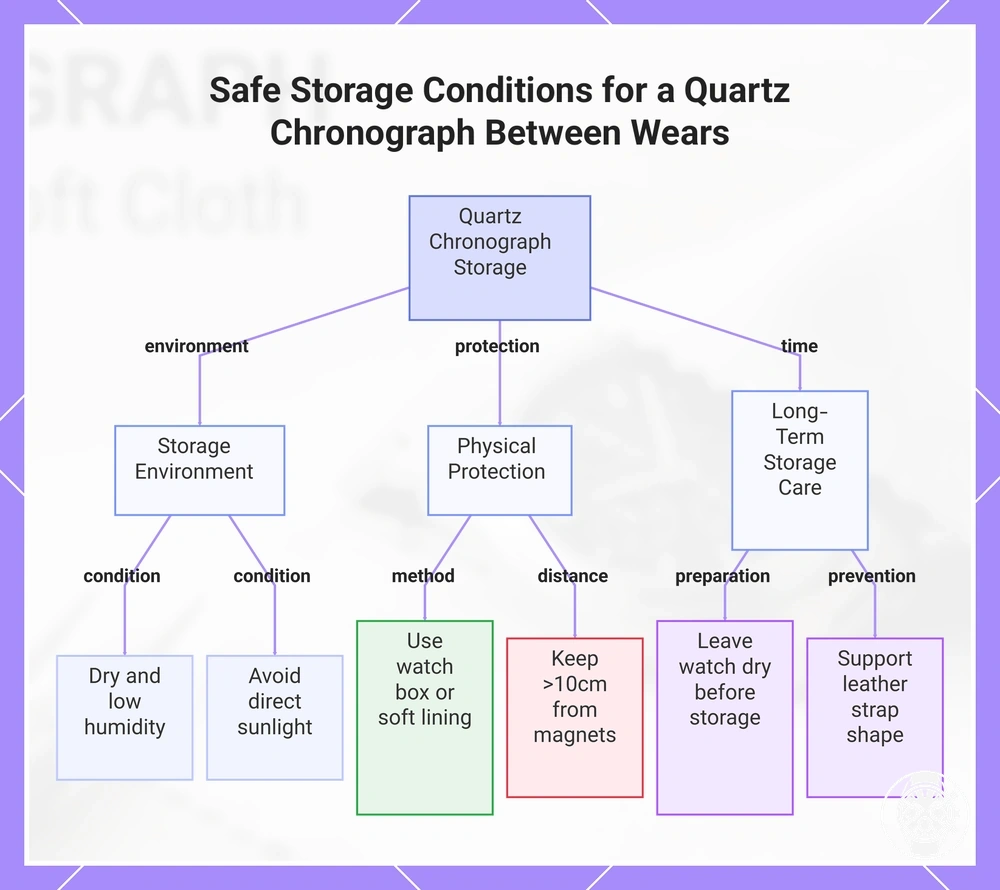
Safe storage between wears keeps a quartz chronograph in a dry place, separated from hard objects and unnecessary environmental stress, with stable conditions that limit dust, moisture, impact, magnet exposure, sunlight, and strap deformation. Seiko's watch-care guidance recommends storage in a location with little dust or humidity and specifies keeping a watch more than 10 cm away from magnetic products; a watch box or simple case with soft lining can provide separation from loose objects without requiring a specialist storage product.
In practical terms, use the same dry, separated storage habit after daily wear and check the storage environment more deliberately when the watch will remain unworn for a long period.
A daily-wear quartz chronograph that will be worn again the next day can rest dry and separately on soft lining, while a watch worn only occasionally needs greater attention to its environment during long idle periods. Casio advises removing dirt, sweat, and moisture before long-term storage and keeping the watch in a cool, dry place, while Seiko recommends a well-ventilated location and avoidance of prolonged direct sunlight. For a leather strap, prolonged moisture or sunlight can contribute to deterioration, so keep the strap shape naturally supported rather than tightly folded or crushed; the reviewed manufacturer guidance does not specify a universal storage angle or bend radius. In practical terms, use the same dry, separated storage habit after daily wear and check the storage environment more deliberately when the watch will remain unworn for a long period.
Safe Storage Between Wears checklist: Use these conditions to organise dry, separated, and stable storage.
Safe Storage Between Wears checklist: Use these conditions to organise dry, separated, and stable storage.
- Watch box: Use a watch box, case, or similarly protected location with soft lining and enough separation to prevent the watch from contacting loose hard objects; this controls dust exposure and avoidable impact or rubbing without requiring luxury storage.
- Dry place and humidity: Do not store the watch while damp. For long idle periods, Casio specifies a cool, dry place, while Seiko recommends a location with little humidity; where humidity is present, reducing prolonged moisture exposure limits conditions associated with deterioration of susceptible watch and strap materials.
- Magnets: Keep the quartz chronograph more than 10 cm from magnetic products where Seiko's guidance applies. Seiko identifies magnetic accessories, speakers, and other magnetic products as sources that can affect watch operation, so physical distance provides a measurable storage boundary rather than relying on visual separation alone.
- Strap shape: Store a leather strap in a natural, supported shape rather than sharply folding or crushing it during long idle periods. The reviewed manufacturer guidance supports avoiding conditions that contribute to leather deterioration but does not specify a universal bend angle, radius, or storage form for every strap.
- Sunlight: Keep the stored watch out of prolonged direct sunlight. Seiko identifies sunlight as a deterioration factor for leather straps, so a shaded storage position is preferable when the watch will remain unworn.
- Long idle periods: Before extended storage, leave the watch dry and choose a stable, ventilated location rather than a damp or impact-prone space. Casio specifies a cool, dry place for long-term storage, and Seiko recommends a well-ventilated location, giving occasional-wear watches a clearer storage condition than simply leaving them loose between uses.
This chart shows the key storage conditions and actions required to keep a quartz chronograph safe between wears, including environmental, physical, and long-term care requirements.
Maintenance Tools and Specialist Service Boundaries
Maintenance tools for a quartz chronograph divide into owner-safe external-care tools and specialist repair tools according to what the task affects and the user's skill: a microfiber cloth and soft brush suit accessible external cleaning, while a case opener, internal screwdrivers, gasket tools, and pressure testing belong to specialist service when the work affects the caseback, seals, or internal components. Seiko's watch-care guidance supports removing moisture, sweat, and dirt with a soft, dry cloth, while its servicing guidance treats case opening, gasket replacement, and subsequent water-resistance testing as service operations. The table applies this tool → appropriate use → risk boundary to routine maintenance.
| Owner-safe external care | Specialist or high-risk work |
|---|---|
| Microfiber cloth: Appropriate use → external cleaning of accessible case, crystal, and bracelet surfaces when the cloth is clean, soft, and dry. Risk → abrasive debris trapped in a cleaning cloth can work against gentle surface care, so visible contamination is a reason to use a clean cloth rather than increase pressure. | Case opener: Appropriate use → caseback removal when internal access is required. Risk → opening the case crosses the external-care boundary because the caseback fit and sealing system are disturbed; inexperienced owners should leave this operation to a watchmaker. |
| Soft brush: Appropriate use → gentle removal of accessible debris from suitable external bracelet or case areas. Risk → a soft strap brush is sufficient only for surface debris on a material that permits brushing; embedded contamination, corrosion, or a need for disassembly moves the task beyond routine brushing. | Screwdrivers: Appropriate use → removal or adjustment of components secured by screws when the watch design requires it. Risk → correct driver fit and component knowledge are required because slipping or using the wrong size can damage screw heads, nearby components, or finishes; internal screw work therefore belongs to suitably skilled service. |
| Cleaning kit: Appropriate use → external care only when the included cloth, soft brush, or mild cleaner is compatible with the particular case, bracelet, or strap material. Risk → no single cleaner is established by the reviewed evidence as suitable for every quartz chronograph material, so uncertain cleaner-to-material compatibility is a decision signal to use dry external care or obtain model-specific guidance. | Gasket tools: Appropriate use → controlled removal, inspection, positioning, or replacement of seals during case service. Risk → gasket condition and installation are part of the watch's water-resistance system; Citizen's service guidance states that applicable water-resistant watches can require gasket and other component replacement to maintain water resistance, making seal work a specialist-service task. |
| Strap tool: Appropriate use → strap replacement when the attachment design is known and the user can control the tool without contacting vulnerable case surfaces. Risk → suitability is conditional on attachment type and skill; uncertainty about spring bars, fitted end pieces, screws, or tool control is a reason to use a watchmaker rather than force the attachment. | Pressure testing: Appropriate use → instrument-based verification of water resistance after relevant case or seal work. Risk → visual closure does not verify water resistance; Seiko specifies water-resistance testing after battery replacement for applicable water-resistant watches and specifies testing each time the battery is replaced for watches rated at 10 bar or higher, so pressure testing belongs to specialist service with appropriate equipment. |
The service boundary is determined by the affected component and the verification required: use a microfiber cloth, soft brush, or material-compatible cleaning kit when maintenance remains on accessible external surfaces, and use a strap tool only when the attachment method and safe technique are understood. Choose specialist service when the task requires a case opener, internal screwdrivers, gasket tools, pressure testing, or assessment of corrosion, caseback fit, or sealing, because these conditions require repair skill or verification that routine external-care tools cannot provide.