Men’s Quartz Chronograph Watch Size and Wrist Fit Guide
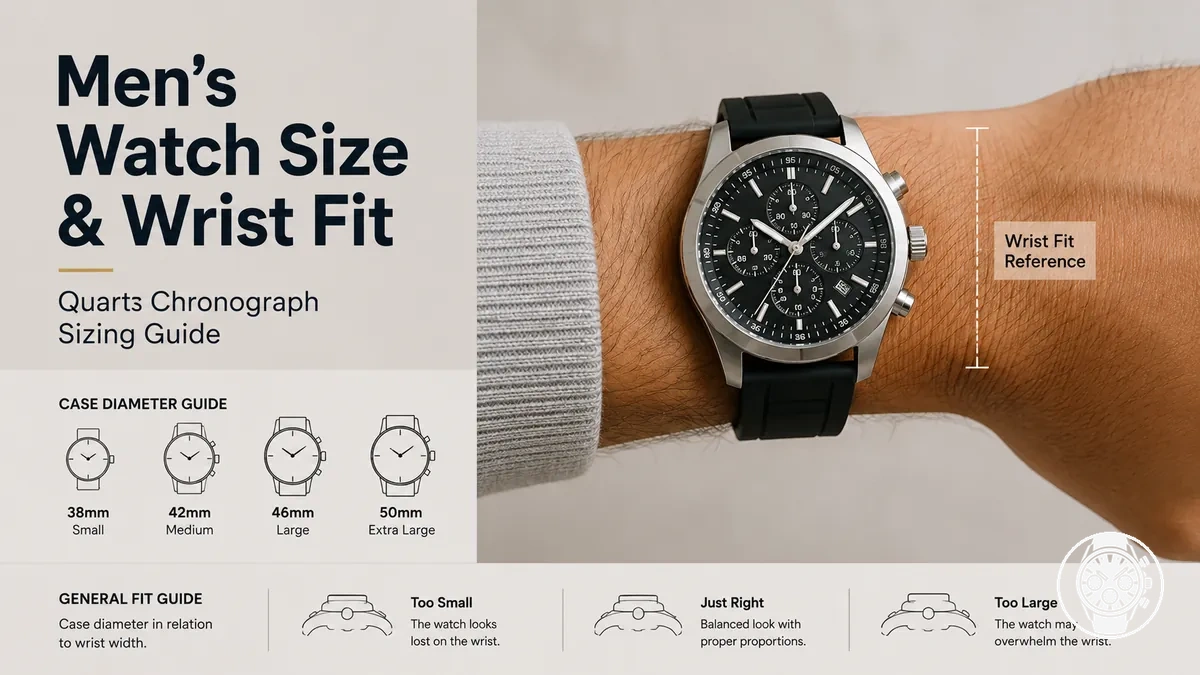
A men’s quartz chronograph watch should be sized for wrist fit, comfort, and visual proportion by assessing wrist size against case diameter, thickness, lug-to-lug length, dial presence, case design, and strap fit. Citizen’s Size & Fit Guide supports this multi-factor approach by directing wearers to consider wrist size and personal preference together with case shape, bezel, crown, pushers, and other case features. Diameter is therefore one sizing measurement, not a complete measure of how the watch will fit or appear on the wrist.
Diameter is therefore one sizing measurement, not a complete measure of how the watch will fit or appear on the wrist.
Measured watch size and worn appearance describe different parts of the fit decision: case diameter indicates case width, thickness affects how high the case sits on the wrist, and lug-to-lug length indicates the case’s longitudinal wrist coverage. Citizen specifically states that case thickness affects how high a watch sits, while its sizing guidance treats wrist measurement as part of selecting a comfortable fit. Dial presence, including the visual effect of chronograph subdials and pushers, can further change perceived size, so these measurements and design features should be considered together when judging comfort.
Citizen specifically states that case thickness affects how high a watch sits, while its sizing guidance treats wrist measurement as part of selecting a comfortable fit.
No single case diameter provides a universal wrist-size match because wrist shape, case construction, strap style, sleeve context, and personal preference can change the result. As a model-specific illustration of why multiple dimensions matter, Seiko Australia specifies the men’s quartz chronograph SSB451 at 40.0 mm in diameter, 11.5 mm thick, and 45.8 mm lug-to-lug; those three measurements describe width, height, and longitudinal coverage rather than reducing its wrist presence to the 40.0 mm diameter alone. Wrist-size matching should therefore compare the watch’s combined dimensions and strap fit with the wearer’s wrist rather than treating diameter as an isolated fit rule.
Table of Contents
How Chronograph Watch Size Changes Wrist Fit
Chronograph watch size changes wrist fit by changing wrist coverage, case presence, comfort, readability, and visual balance, while the final result remains conditional on case geometry and the wearer’s wrist. The 1916 Company’s watch-fit guidance illustrates case diameters from 34 mm to 44 mm on the wrist and explains that case shape, lug dimensions, thickness, and pushers can change how a given diameter wears. Chronograph fit is therefore a combined physical and visual judgment rather than a case-diameter judgment alone.
Chronograph fit is therefore a combined physical and visual judgment rather than a case-diameter judgment alone.
Wrist coverage is the physical span occupied by the case and lugs, while perceived size is the visual presence created by case size, dial layout, pushers, bezel presence, and case proportions. The 1916 Company gives a concrete comparison in which a 34 mm Datejust has a slim case and restrained profile, while a 36 mm Patek Philippe chronograph appears substantially larger because its pronounced lugs and chronograph pushers add case presence; the same source notes that the 36 mm watch can appear close in size to a 38 mm Vacheron Constantin. This difference between measured diameter and perceived size is relevant across men’s quartz chronograph watches because external case elements can change wrist presence without changing the nominal diameter by the same amount.
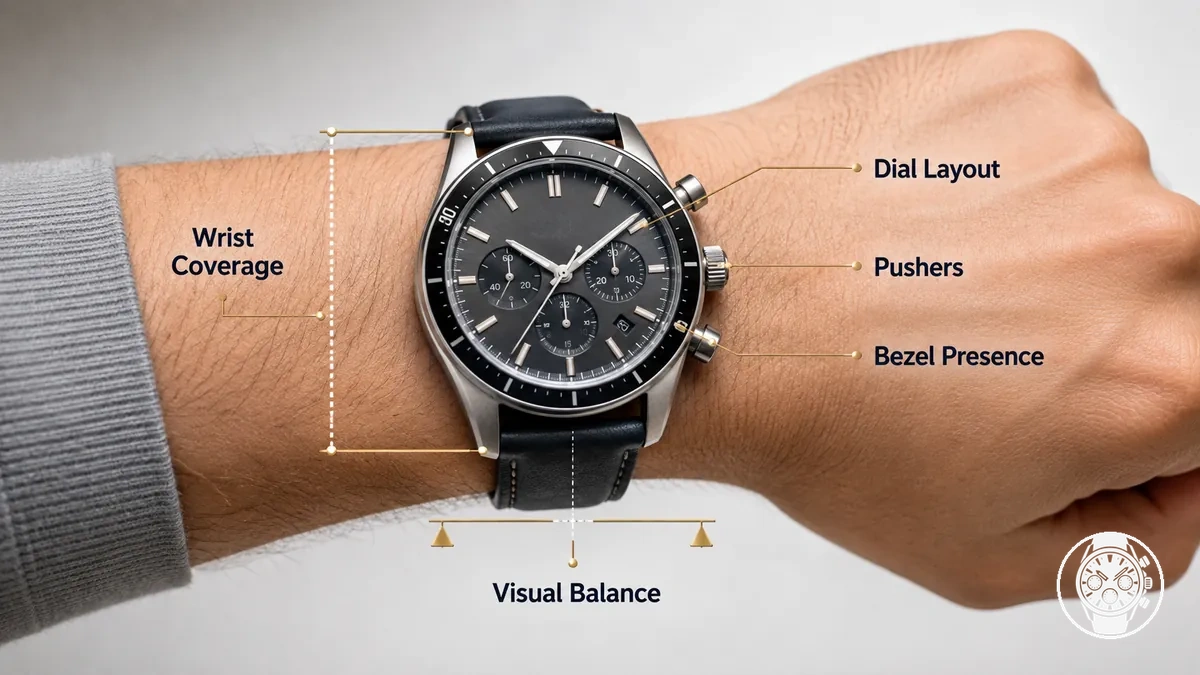
Chronographs can therefore wear visually larger than simpler watches when subdials, pushers, bezel design, or projecting lugs add visual weight around the dial and case. The 1916 Company also compares two 40 mm watches measuring 8.3 mm and 15.5 mm thick and reports that the 15.5 mm watch appears larger on the wrist because thickness and lug design increase its presence, showing why identical diameter does not guarantee identical comfort or visual balance. Wrist-size and diameter matching should consequently treat case diameter as one input and verify how the complete case occupies the wrist before making a sizing decision.
Wrist Size Ranges and Case Diameter Matching
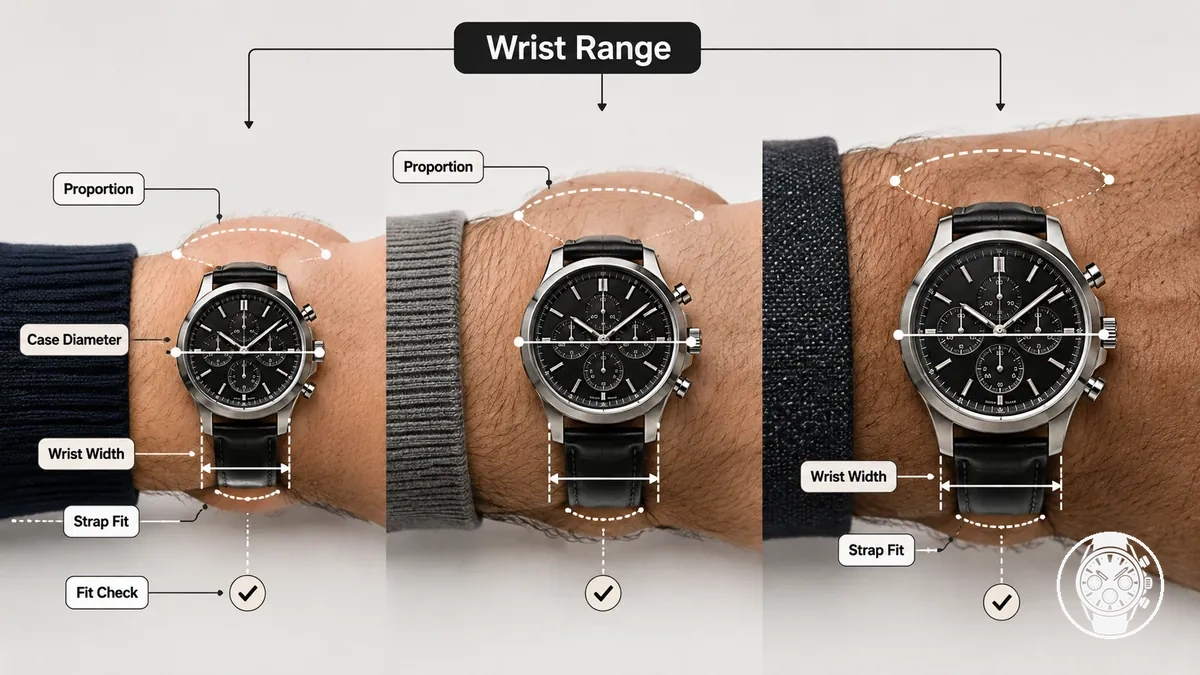
Wrist size ranges provide a conditional starting point for matching case diameter to proportion: Longines Australia places wrist circumference below 16 cm with 32–36 mm cases, 16–17.8 cm with 36–42 mm cases, and above 17.8 cm with 42–46 mm cases. These ranges are guides rather than fixed rules because wrist width and strap fit still affect how a chronograph sits on an individual wrist.
Wrist size ranges and case diameter matching organise the initial fit decision by proportion before the physical fit is checked.
Wrist size ranges and case diameter matching organise the initial fit decision by proportion before the physical fit is checked. The table uses Longines Australia’s wrist-circumference and case-diameter guidance as starting ranges, with wrist circumference, wrist width, and case diameter as the organising criteria.
| Wrist range | Case diameter starting point | Fit effect | Check before choosing |
|---|---|---|---|
| Small wrists: below 16 cm | 32–36 mm | A lower diameter reduces case width and can reduce overhang when the complete case remains within the wrist width. | Check wrist width against the complete case and lugs, then verify strap fit. |
| Average wrists: 16–17.8 cm | 36–42 mm | The diameter range provides a broader choice of case proportions within Longines Australia’s medium-wrist guidance. | Compare the complete case with wrist width and confirm a comfortable strap fit. |
| Larger wrists: above 17.8 cm | 42–46 mm | A higher diameter increases lateral wrist coverage and case presence relative to a lower diameter. | Check the complete case proportions and strap fit rather than treating the diameter as a requirement. |
Case diameter alone does not close the fit decision: for example, suppose two chronographs are both 40 mm in diameter, but one has lugs that remain within the wearer’s wrist width while the other has lugs that extend beyond it; under that condition, the second watch has greater longitudinal overhang despite the identical 40 mm diameter. Strap fit is a separate verification step: Hamilton’s wrist-sizing instructions recommend leaving enough space for a little finger between the strap and wrist and accounting for extra looseness when measuring if that is the preferred fit. These checks narrow the proportion decision before applying the more specific guidance for small wrists and larger wrists.
Small Wrists and Lower-Diameter Chronographs
Small wrists can benefit from lower-diameter chronographs because a lower case diameter reduces lateral case coverage, while a shorter lug span reduces the distance the case extends across the wrist and therefore the risk of overhang. As a model-specific example, Seiko Australia specifies the quartz SSB479 at 38.7 mm in case diameter, 45.1 mm lug-to-lug, and 12.6 mm thick; these dimensions provide a compact reference point, not a universal size requirement for small wrists.
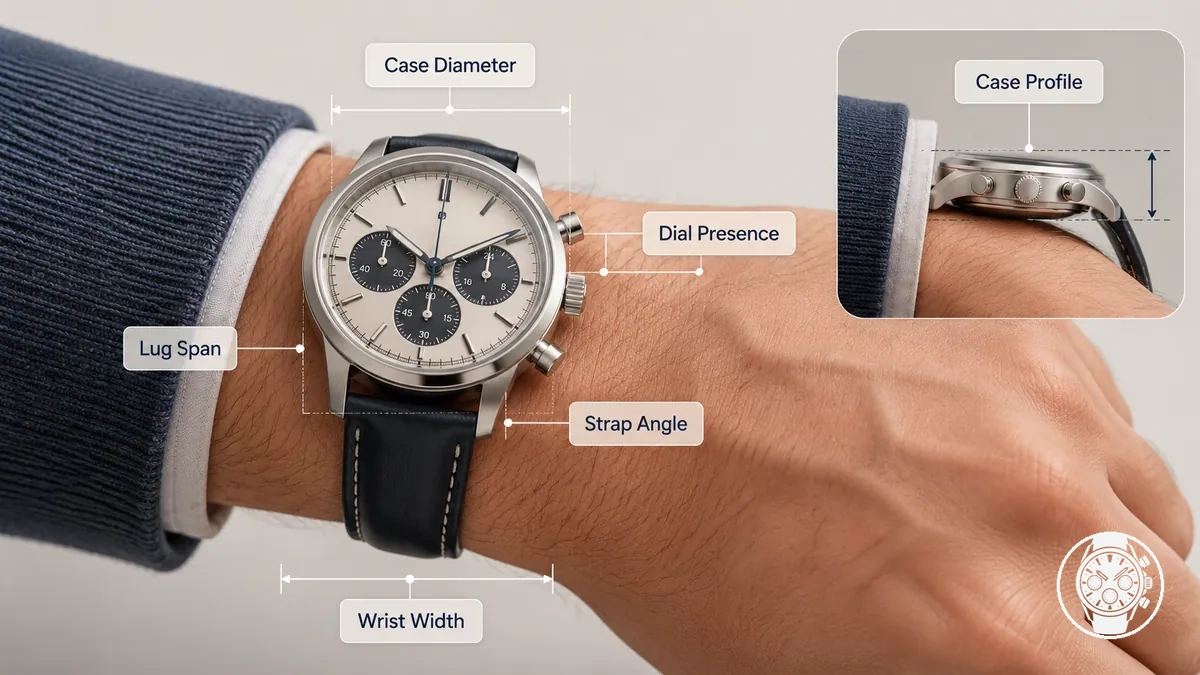
For physical fit, compare the complete lug span with the usable wrist width and check whether the strap angle lets the strap turn down around the wrist rather than projecting outward; for visual fit, assess whether the slimmer profile and dial presence remain proportionate instead of dominating the wrist. Seiko Australia’s SSB479 illustrates these checks with a 45.1 mm lug-to-lug span and 12.6 mm case thickness around a 38.7 mm case, while the manufacturer does not specify a minimum wrist circumference for that model. Comfort should therefore be verified on the individual wrist by checking lug overhang, strap articulation, case height, dial presence, and sleeve clearance rather than treating a particular case diameter as mandatory or assuming a larger chronograph is unsuitable.
Average and Larger Wrists with 40mm to 44mm Cases
Average wrists and larger wrists can evaluate 40mm, 42mm, and 44mm case values by comparing each case diameter with wrist width, visual balance, wrist coverage, and comfort outcome rather than treating one diameter as automatically suitable. Citizen Watches Australia specifies quartz chronograph examples across this range: the AN8175-55E has a 40mm case, the AN8190-51L has a 42mm case, and the AN8184-89E has a 44mm case. These manufacturer-stated case values provide numerical reference points, while wrist width and case shape still determine how much of the wrist the complete watch occupies.
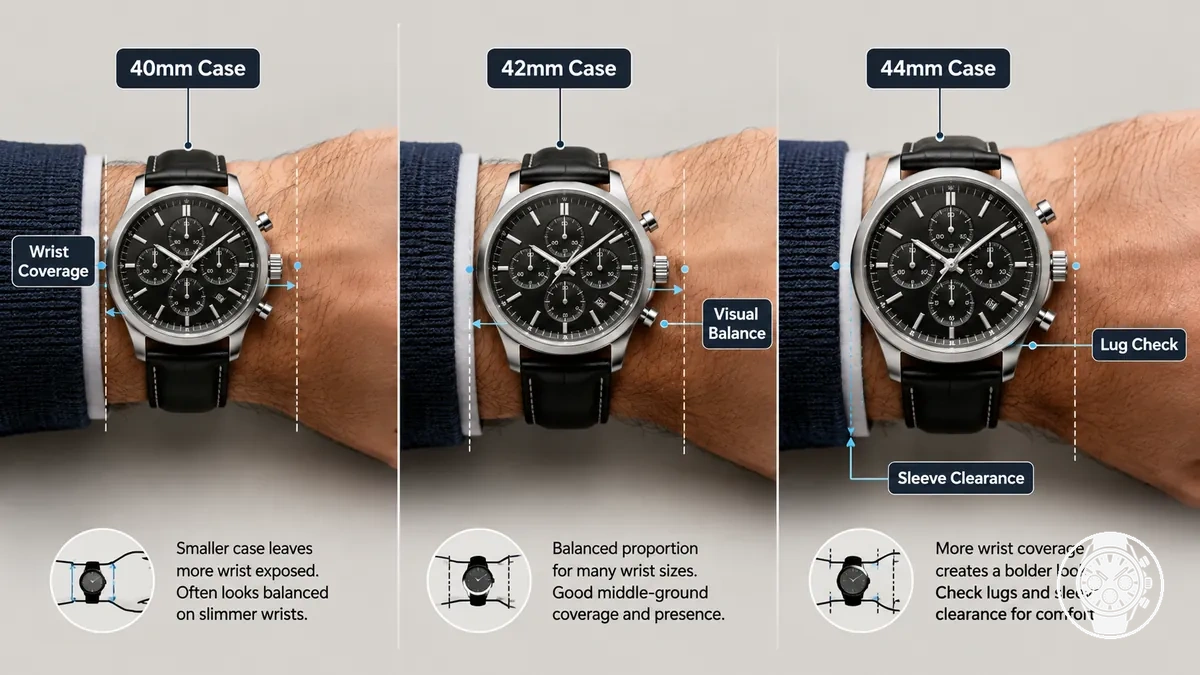
Across these three reference values, nominal case diameter increases by 2mm from 40mm to 42mm, another 2mm from 42mm to 44mm, and 4mm from 40mm to 44mm; these are calculated diameter differences from the Citizen Watches Australia specifications, not universal differences in on-wrist fit. Use the comparison below to judge proportion, then verify lug overhang, strap pull, dial crowding, and sleeve clearance on the wrist when possible.
- 40mm: Citizen Watches Australia specifies the AN8175-55E quartz chronograph with a 40mm case. For an average wrist, this case value provides the lowest nominal diameter of the three examples; its comfort outcome still requires the complete case and lugs to remain proportionate to the wearer's wrist width.
- 42mm: Citizen Watches Australia specifies the AN8190-51L quartz chronograph with a 42mm case. Its nominal case diameter is 2mm greater than the 40mm example, so the fit check should determine whether that additional lateral wrist coverage preserves the wearer's preferred visual balance without unwanted lug overhang or strap pull.
- 44mm: Citizen Watches Australia specifies the AN8184-89E quartz chronograph with a 44mm case. Its nominal diameter is 2mm greater than the 42mm example and 4mm greater than the 40mm example, providing larger wrists with a higher-coverage case value to assess without establishing 44mm as a mandatory size.
- Shared fit checks: For 40mm, 42mm, and 44mm cases, compare the complete lug span with wrist width, check whether the strap follows the wrist without unwanted outward pull, assess whether the chronograph dial appears crowded or proportionate, and confirm acceptable sleeve clearance. These local checks determine whether the measured case value translates into suitable wrist coverage, visual balance, and comfort for the individual wearer.
Case Diameter, Thickness, and Lug-to-Lug Balance
For a men’s quartz chronograph, case diameter measures lateral case width and primarily affects wrist coverage, thickness measures case height and affects projection and potential sleeve clearance, while lug-to-lug length measures the longitudinal case span and is the key measurement for assessing potential wrist overhang. Longines Australia’s sizing guidance illustrates the distinction numerically by pairing 36–42 mm case diameters and 9–12 mm thicknesses with its 16–17.8 cm medium-wrist category, while also advising that diameter and thickness be considered together. These are measurement attributes used to assess proportion and conditional comfort; preferred visual presence remains a style preference.
These are measurement attributes used to assess proportion and conditional comfort; preferred visual presence remains a style preference.
Case diameter, thickness, and lug-to-lug balance connect different measurements to different fit effects, with strap integration adding the condition of how the watch follows the wrist. The table separates wrist coverage, case height, wrist overhang, and stability so that each measurement supports a distinct buying decision.
| Measurement | What it changes | Risk when mismatched | Fit decision |
|---|---|---|---|
| Case diameter | Controls lateral wrist coverage and contributes to proportion. | A case occupying too much of the available wrist width can appear dominant and leave less lateral clearance. | Compare the stated diameter with wrist width and the amount of coverage preferred; Longines Australia uses 36–42 mm as its case-diameter guidance for 16–17.8 cm wrists. |
| Thickness | Sets case height above the wrist and influences potential sleeve clearance and comfort. | Greater case height projects farther above the wrist and can require more clearance beneath a close cuff. | Consider case depth with wearing conditions; Longines Australia lists 9–12 mm thickness for its 16–17.8 cm medium-wrist category. |
| Lug-to-lug length | Sets the longitudinal span that must sit across the usable top surface of the wrist. | Wrist overhang becomes a risk when the effective lug span extends beyond that usable wrist width. | Compare the model’s stated lug-to-lug length directly with the usable top width of the individual wrist; no universal lug-to-lug threshold for men’s quartz chronographs is specified by the reviewed manufacturer guidance. |
| Strap integration | Determines how the strap connection leaves the lugs and follows the wrist, affecting stability. | A connection that remains relatively straight beyond the lugs can increase the effective wearing span before the strap turns around the wrist. | Check whether the strap can follow the individual wrist while maintaining comfortable tension; Longines’ wrist-sizing instructions use enough strap space for an index finger as the measurement condition. |
Apply the measurements together: use case diameter for lateral wrist coverage, thickness for case height and sleeve clearance, and lug-to-lug length plus strap integration for potential wrist overhang and stability. For example, Longines Australia’s medium-wrist guidance combines a 16–17.8 cm wrist circumference with a 36–42 mm case diameter and 9–12 mm case thickness, demonstrating that even its numerical guidance treats width and height as separate sizing variables rather than reducing fit to one number. The case and dial features guide can clarify the related components without changing this measurement-to-fit assessment. For the buying decision, verify the specific chronograph’s diameter, thickness, lug-to-lug length, and strap integration against the individual wrist rather than assuming that one headline case-size value establishes fit.
Why Chronographs Can Wear Larger Than Their Diameter
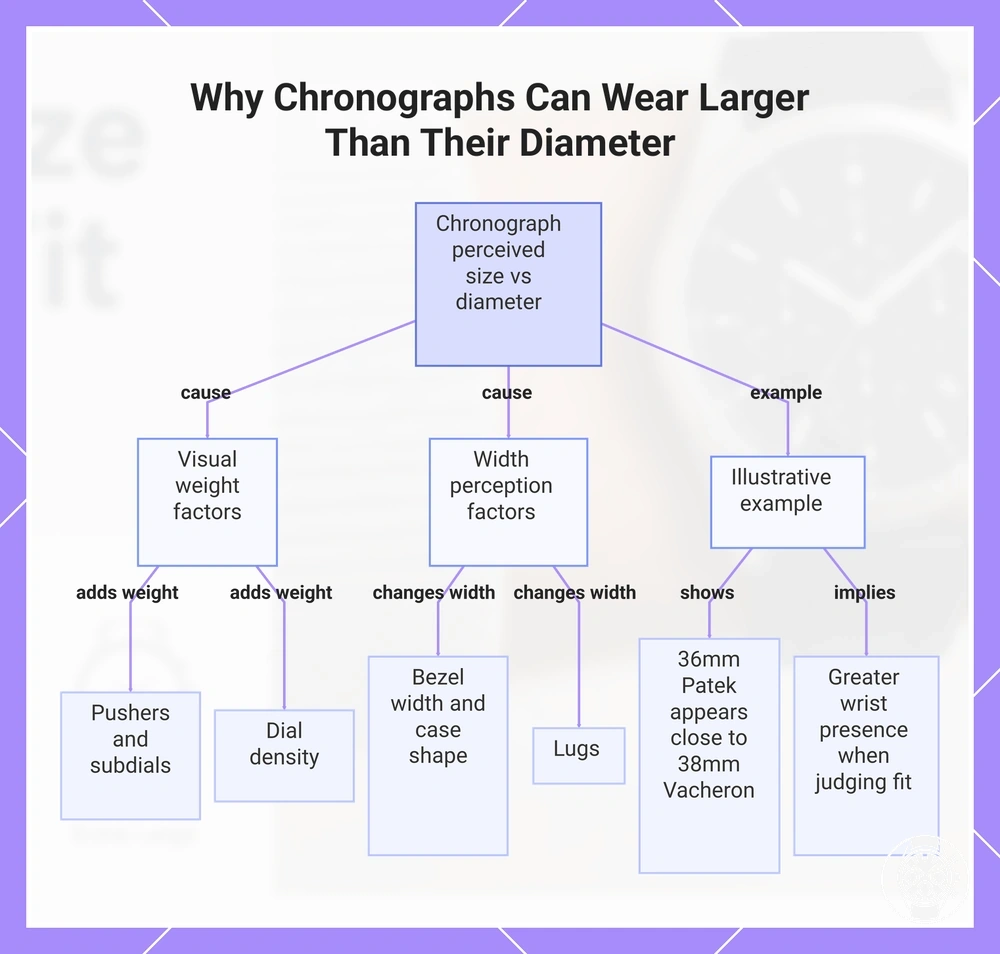
Chronographs can wear larger than their measured diameter when pushers, subdials, bezel width, dial density, and case shape add visual weight beyond the case-width measurement itself. The 1916 Company’s watch-sizing guidance identifies pushers, bezel design, dial proportions, lugs, and case shape as features that can change perceived size; the reviewed evidence does not establish a universal numerical increase in perceived size for these features, so diameter is only one visible cue.
The 36 mm example therefore illustrates why a chronograph can look larger without its measured diameter changing.
The contrast is measured size versus worn appearance: The 1916 Company describes a 36 mm Patek Philippe chronograph with pronounced lugs and pushers as appearing close in size to a 38 mm Vacheron Constantin, a 2 mm difference in stated diameter that does not produce an equivalent difference in visual impression. In a chronograph, prominent pushers and subdials with greater dial density can add visual weight, while bezel width and case shape can change how broadly the watch is perceived across the wrist; the magnitude depends on the specific design and is not quantified by the reviewed source. The 36 mm example therefore illustrates why a chronograph can look larger without its measured diameter changing. That difference between specification and perceived size can translate into greater wrist presence when judging fit.
That difference between specification and perceived size can translate into greater wrist presence when judging fit.
This chart explains why chronographs often appear larger than their measured diameter, showing the contributing factors and a real-world example.
When Thickness Changes Comfort and Sleeve Fit
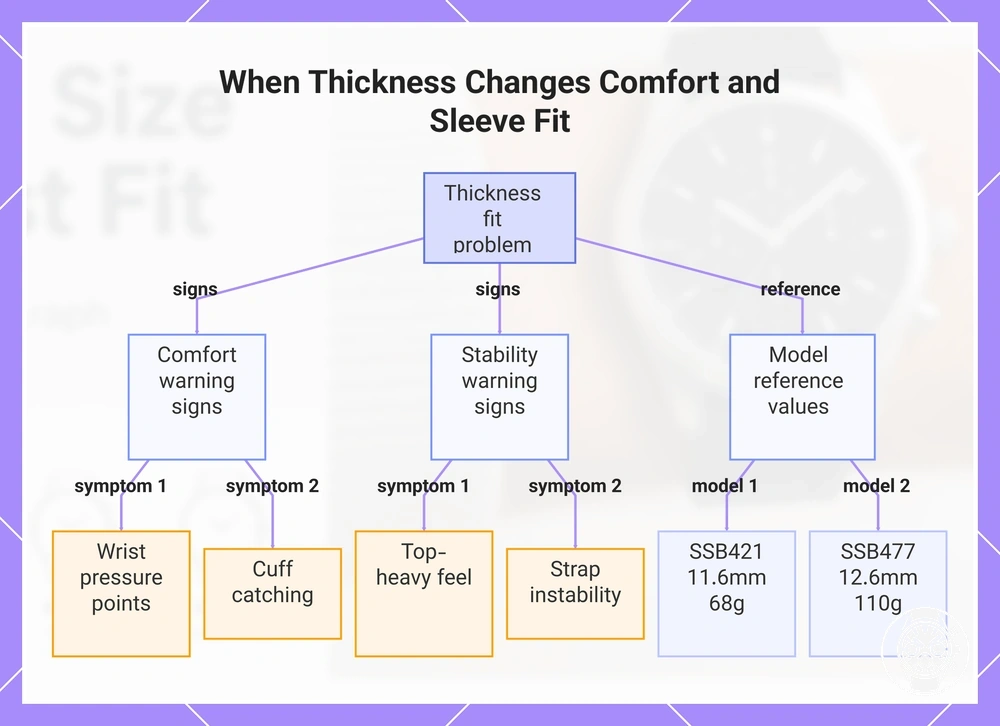
Chronograph thickness changes comfort and sleeve fit when case height causes persistent pressure points, interferes with normal wrist movement, or repeatedly catches on the wearer’s cuff. No universal thickness threshold in millimetres for these outcomes is specified by the reviewed evidence; Seiko Australia instead provides model-specific reference values, including 11.6 mm for the SSB421 and 12.6 mm for the SSB477. Thickness is therefore a fit problem when its case height produces observable discomfort or insufficient sleeve clearance in the wearer’s actual use context, rather than simply because one case is thicker than another.
Chronograph thickness changes comfort and sleeve fit when case height causes persistent pressure points, interferes with normal wrist movement, or repeatedly catches on the wearer’s cuff.
Case height increases the watch’s projection above the wrist, so cuff interaction is relevant when that projection repeatedly prevents a work or formal sleeve from passing over the case during normal wrist movement. Top-heaviness is a separate diagnostic condition: it is present when the case repeatedly tilts or shifts because the strap does not stabilise it, while pressure points are indicated by persistent local discomfort at a case, caseback, lug, or strap contact area. For a numerical reference, Seiko Australia specifies the SSB421 at 11.6 mm thick and 68.0 g and the SSB477 at 12.6 mm thick and 110.0 g; the calculated thickness difference is 1.0 mm, while the manufacturer-stated weights differ by 42.0 g, demonstrating that thickness alone does not represent the complete stability or comfort condition. Check the case under the sleeves actually used for work and formal settings; the related daily and formal wear fit guidance covers that use context without making thinness a universal requirement.
Check the case under the sleeves actually used for work and formal settings; the related daily and formal wear fit guidance covers that use context without making thinness a universal requirement.
Signs that thickness is affecting daily wear:
- Wrist pressure: Treat persistent local pressure during normal daily wear as a comfort warning; the reviewed manufacturer evidence does not specify a universal millimetre threshold at which pressure begins.
- Cuff catching: Treat repeated contact that stops the wearer’s actual cuff from passing over the case during normal wrist movement as insufficient sleeve clearance for that sleeve-and-watch combination.
- Top-heavy feel: Check case height together with watch weight and strap stability when the case repeatedly tilts or shifts on the wrist; thickness alone does not establish a universal top-heaviness threshold.
- Strap instability: Treat repeated case movement despite a comfortably adjusted strap as a stability problem for that wrist, strap, and case combination rather than as proof that every case of the same thickness will behave identically.
- Restricted movement: Treat repeated case or cuff interference with the wearer’s normal wrist movement as a functional fit problem; the relevant boundary is observed interference because the reviewed evidence provides no universal case-height limit for unrestricted movement.
This chart shows the signs that indicate thickness is causing a fit problem and provides model-specific reference values.
40mm, 42mm, and 44mm Quartz Chronograph Fit Differences
The main 40mm, 42mm, and 44mm quartz chronograph fit differences are the 2mm steps in case diameter and the resulting change in wrist coverage: 42mm is 2mm wider than 40mm, while 44mm is 2mm wider than 42mm and 4mm wider than 40mm. Citizen Watches Australia specifies these three case-size reference points on quartz chronographs: 40mm for the AN8175-55E, 42mm for the AN8190-51L, and 44mm for the AN8184-89E. These diameter options should be judged against wrist proportions rather than treated as fixed wrist-size assignments.
These diameter options should be judged against wrist proportions rather than treated as fixed wrist-size assignments.
The table compares 40mm, 42mm, and 44mm quartz chronograph fit differences by size value and conditional fit tendency. Its comparison criteria are likely fit, visual effect, and comfort trade-off, with the decision condition based on how the complete case relates to the individual wrist.
| Size | Likely fit tendency | Visual effect | Check before choosing |
|---|---|---|---|
| 40mm | Uses 2mm less nominal case width than 42mm and 4mm less than 44mm, so it leaves more lateral wrist space when the other case dimensions are comparable. | More restrained wrist presence than the two wider options under comparable case geometry. | For smaller wrists, compare the complete lug span with usable wrist width and confirm comfortable strap contact. |
| 42mm | Sits numerically between the other options: 2mm wider than 40mm and 2mm narrower than 44mm. | Intermediate wrist presence between 40mm and 44mm when case shape, lug span, and thickness are comparable. | For average wrists, check whether the complete case preserves the preferred wrist coverage and whether the strap stabilises it comfortably. |
| 44mm | Uses 4mm more nominal case width than 40mm and 2mm more than 42mm, producing the greatest lateral coverage of these three options under comparable geometry. | Stronger wrist presence than the two narrower options when the remaining case proportions are comparable. | For larger wrists, check lug position, strap stability, wrist movement, and sleeve clearance rather than using diameter alone. |
The same 2mm increase can matter more to wrist proportion when less wrist width is available: calculated from the manufacturer-stated diameters above, moving from 40mm to 42mm increases nominal diameter by 5%, while moving from 42mm to 44mm increases it by approximately 4.8%. These calculated percentages describe case-diameter differences, not manufacturer fit recommendations, and Citizen Watches Australia does not specify universal wrist-circumference thresholds for the three cited models. Case shape, lug span, thickness, and strap integration can therefore change the comfort trade-off and visual effect produced by the stated diameter. The decision condition is to use 40mm, 42mm, or 44mm as a size reference, then verify wrist presence, complete-case coverage, strap stability, and sleeve clearance on the individual wrist.
Dial Size, Bezel Shape, and Subdial Spacing in Perceived Size
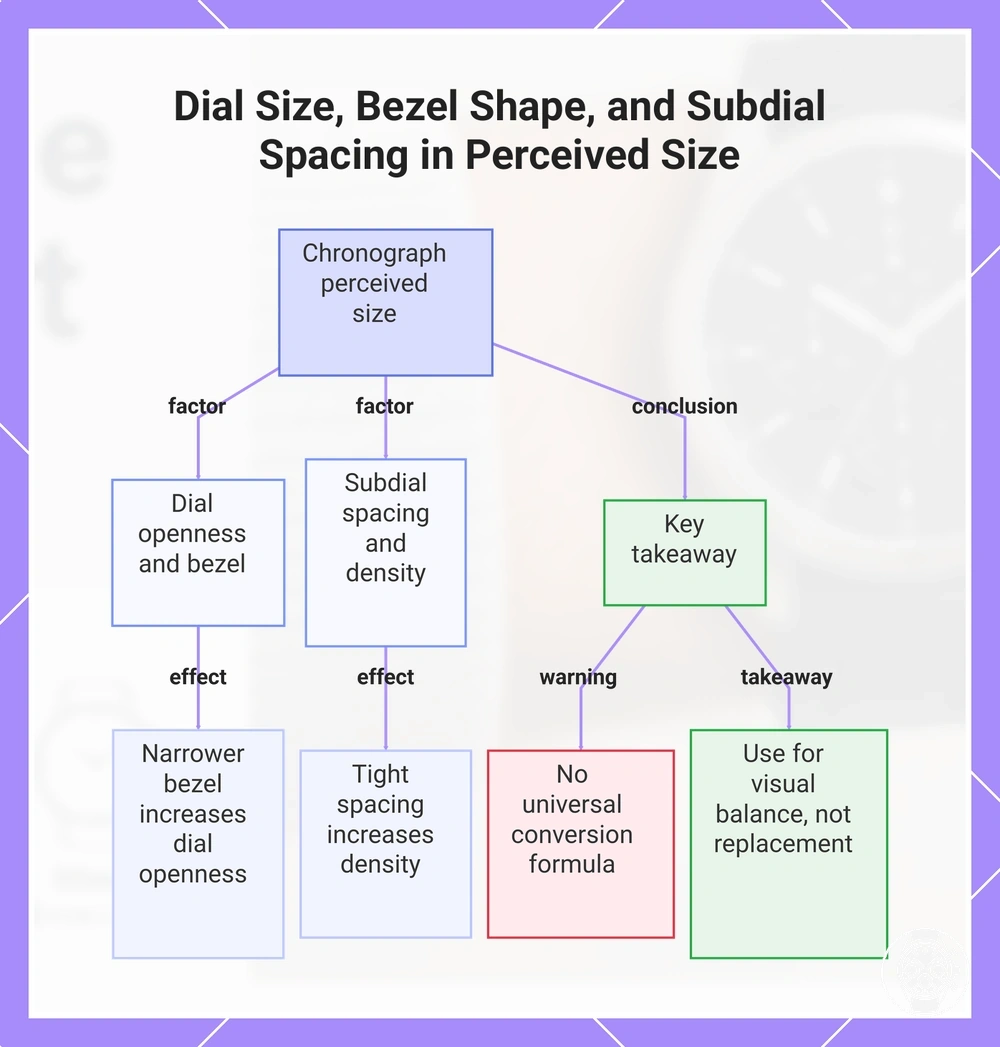
Dial size, bezel shape, and subdial spacing modify a chronograph's perceived size by changing dial openness, the visual boundary around the dial, and dial density. A greater visible dial area with a narrower bezel can make a watch look larger, while a broader bezel can make the dial look more contained; there is no verified universal millimetre conversion between these visual effects and measured case size. Perceived size is therefore a visual property, while measured size remains a physical dimension.
Perceived size is therefore a visual property, while measured size remains a physical dimension.
Dial area affects dial openness because more visible face area gives the dial greater visual presence, while bezel shape and bezel width determine how strongly the surrounding boundary separates the dial from the case. For example, Bulova Australia explains that two watches with the same 41 mm case diameter can appear different in size when one uses a thinner bezel and consequently exposes more dial area, providing a numerical example in which physical case diameter remains 41 mm while visual size changes. Subdial spacing modifies dial density: a tightly grouped subdial layout concentrates visual elements, whereas wider spacing can preserve more open dial area when the rest of the design permits it. Contrast between the dial, subdials, indices, bezel, and case can strengthen or soften these boundaries, so the combined density and contrast can change wrist appearance without changing the stated physical dimensions.
- Open dial: More visible dial area and a comparatively narrow bezel can increase dial openness and perceived presence.
- Thick bezel: More bezel area creates a broader visual boundary around the dial and can make the visible dial appear more contained.
- Crowded subdials: Tighter subdial spacing increases dial density; wider spacing can leave more open visual area when other design elements remain comparable.
- High contrast: Greater contrast can make dial, subdial, and bezel boundaries more visually distinct, but the reviewed evidence does not establish an exact visual-size rule or numerical effect.
- Case shape: The outline surrounding the dial can reinforce or reduce case presence, so equal case diameters do not necessarily create equal perceived presence.
Fit judgment should therefore use these design attributes to assess visual balance, not to replace physical measurements. The reviewed evidence provides no universal numerical threshold or formula that converts dial openness, bezel shape, subdial spacing, dial density, or contrast into an equivalent change in case diameter. Use perceived size to judge how the chronograph looks on the wrist, while using the watch's stated physical dimensions to assess its physical fit.
Fit judgment should therefore use these design attributes to assess visual balance, not to replace physical measurements.
This chart shows the key factors that influence a chronograph's perceived size and explains that there is no universal conversion formula between visual effects and measured case size.
How to Tell When a Chronograph Watch Is Too Big
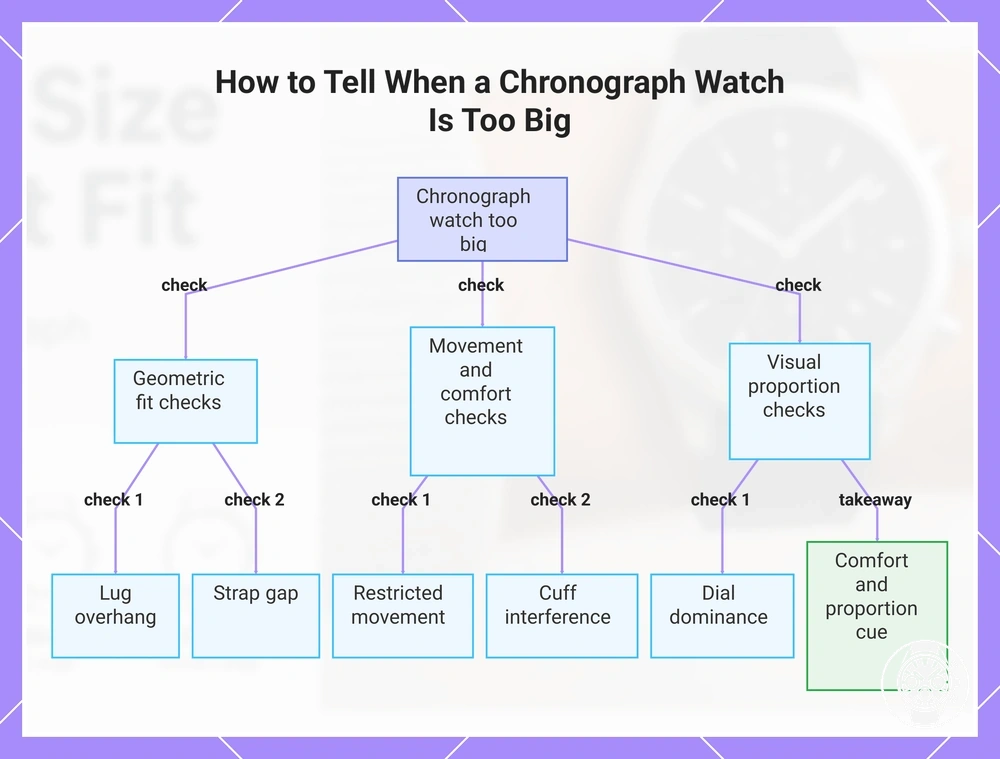
A chronograph watch is too big for a particular wrist when the lugs overhang the usable wrist width, the case interferes with normal wrist movement, or the dial visually dominates beyond the wearer's intended visual proportion. No universal case-diameter, case-height, lug-to-lug, or wrist-circumference cutoff establishes poor fit for every wearer, so the main too-big signals are overhang, restricted movement, unstable strap geometry, persistent discomfort, and unwanted visual dominance.
Use this diagnostic checklist with the chronograph positioned normally and the strap adjusted to a comfortable tension.
Use this diagnostic checklist with the chronograph positioned normally and the strap adjusted to a comfortable tension. The checklist tests lug position, case height, strap angle, wrist movement, and visual proportion directly on the wrist so that an oversized appearance can be separated from an unacceptable physical fit.
- Lug overhang: View the wrist from above and check whether the lugs overhang the usable top width of the wrist; overhang is a too-big signal because the case extends beyond the surface supporting it.
- Strap gap: Inspect the strap angle where the strap leaves the lugs; a strap that projects outward before turning down can increase the effective wearing span, while a strap that turns down near the lug can follow a narrower wrist more closely.
- Case height: Check whether the case remains stable or instead creates persistent pressure, tilting, or excessive projection above the wrist; the reviewed evidence does not establish a universal millimetre threshold at which case height becomes unacceptable.
- Restricted movement: Flex and extend the wrist through ordinary movement; repeated contact that restricts wrist movement is a physical poor-fit signal for that wrist, case design, and wearing position.
- Dial dominance: View the chronograph from above and decide whether the dial visually dominates beyond the intended visual proportion; dominance alone can remain a style preference when physical fit is acceptable.
- Cuff interference: Test the chronograph beneath the sleeve it will actually be worn with; repeated catching or failure of the cuff to pass over the case indicates insufficient clearance for that watch-and-sleeve combination.
- Comfort over time: Treat persistent pressure, repeated case shifting, or continual repositioning during normal wear as evidence that the watch is not maintaining an acceptable fit, even if its visual proportions initially appear suitable.
Lug position provides a direct geometric check, while case height and strap angle show whether the complete watch can sit securely enough for comfortable wrist movement. For example, suppose an illustrative wrist has 50 mm of usable top width: an illustrative 54 mm effective lug span would exceed that flat width by 4 mm in total, or approximately 2 mm at each side if perfectly centred, whereas an illustrative 48 mm span would remain 2 mm inside the width in total; these hypothetical measurements demonstrate the geometry and are not fit thresholds. Wrist curvature, case design, and strap articulation can change the real contact geometry, so the same nominal dimensions do not establish identical fit on every wrist. Personal style can favour substantial wrist presence, but persistent overhang, restriction, pressure, or instability separates poor physical fit from style preference.
Personal style can favour substantial wrist presence, but persistent overhang, restriction, pressure, or instability separates poor physical fit from style preference.
A large-dial chronograph is an edge case: its dial can intentionally dominate the wrist without making the watch physically too big when the lugs remain supported, the strap follows the wrist, and the case permits comfortable movement. Because the reviewed evidence establishes no universal numerical boundary between intentional visual dominance and excessive visual proportion, use comfort and proportion together as the decision cue: a dominant dial can be intentional, while persistent physical interference indicates that acceptable fit has not been achieved.
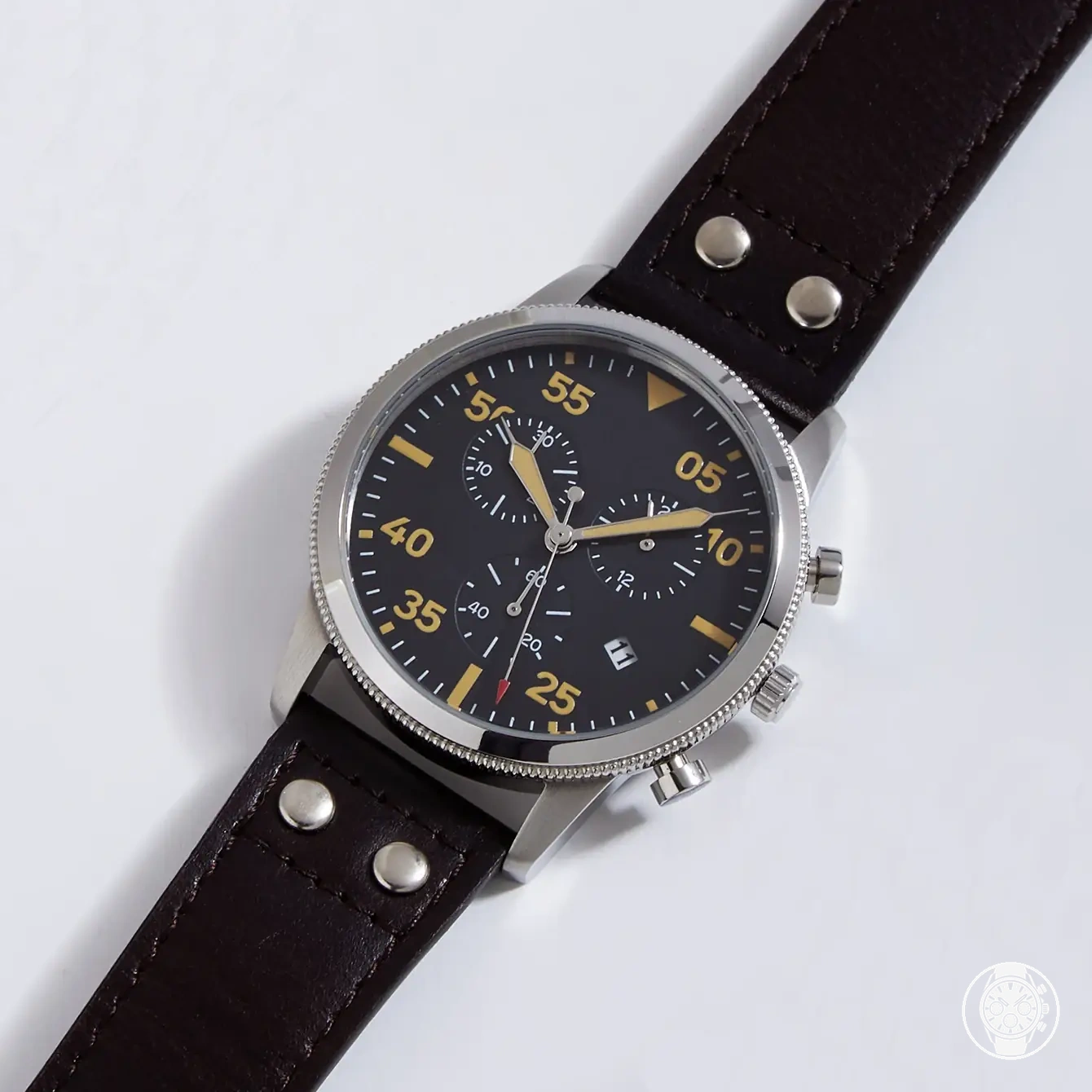
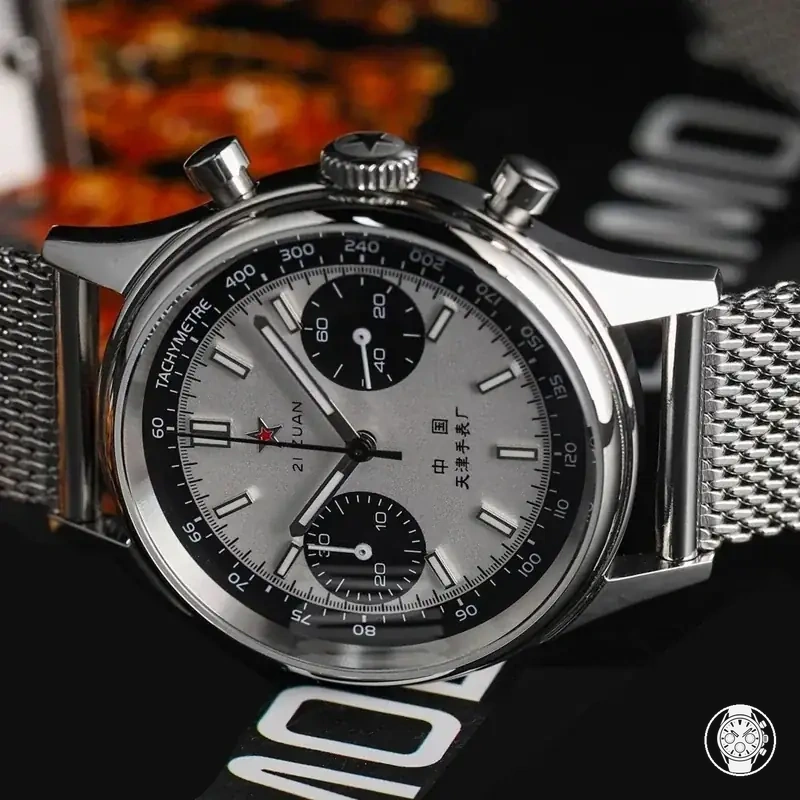
The products below are useful examples for comparing available options.
The products below are useful examples for comparing available options. Before buying, check that the compatibility criteria, key features, and product details match your needs.
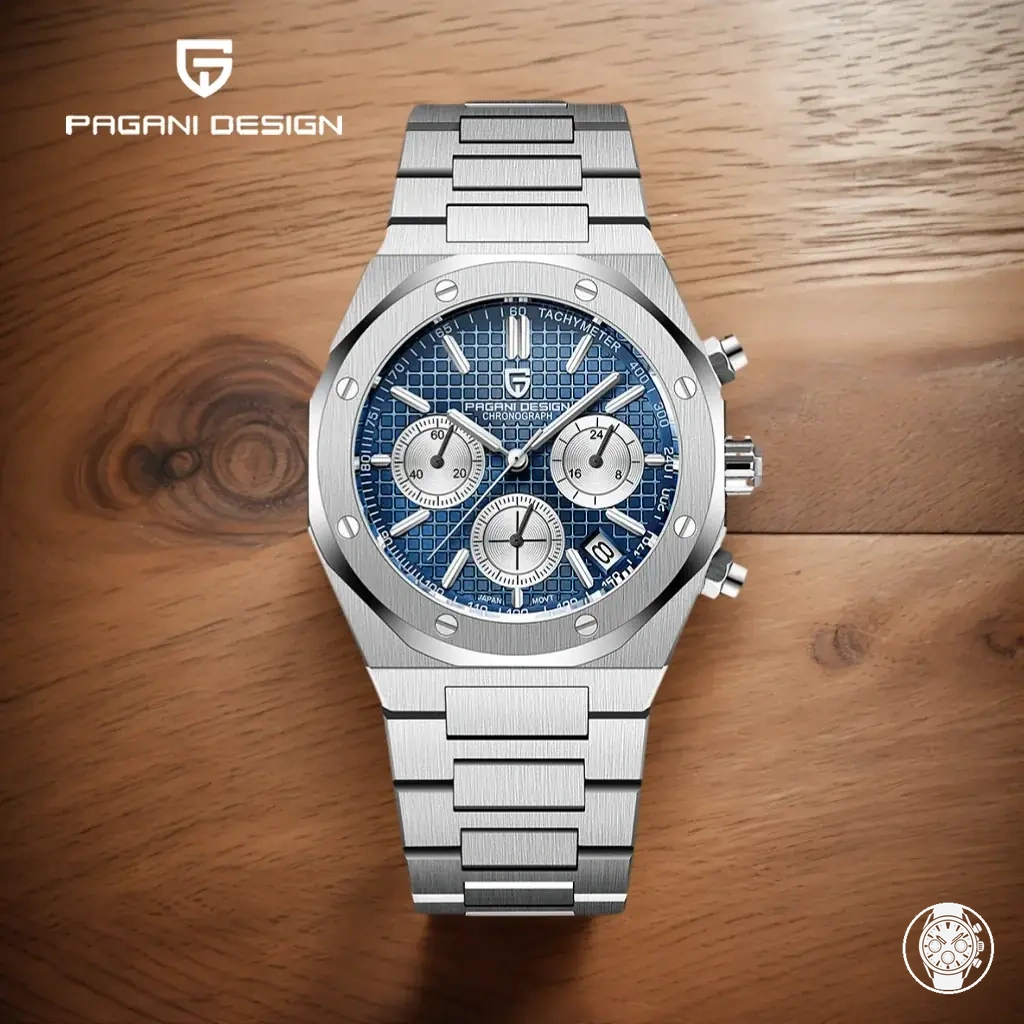
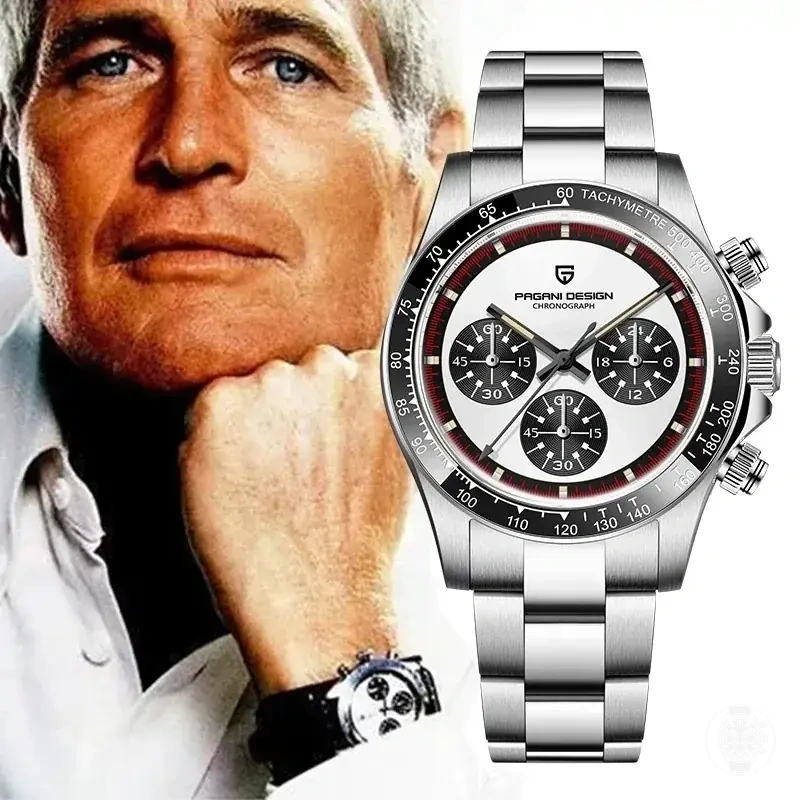
This chart shows the main diagnostic checks to determine if a chronograph watch is too big for your wrist, separating physical fit from visual proportion.
Slim and Large-Dial Quartz Chronographs as Sizing Trade-Offs
Slim quartz chronographs and large-dial quartz chronographs involve different sizing trade-offs: a slim case reduces case height and can improve comfort and sleeve fit, while a large dial increases dial presence and can support readability and stronger visual presence. Neither option has a universal wrist-size advantage, and no single thickness, dial-diameter, or wrist-circumference threshold defines suitability for every wearer. Slim and large-dial designs therefore solve different fit problems.
Slim and large-dial designs therefore solve different fit problems.
Slim and large-dial quartz chronographs as sizing trade-offs can be compared by the fit advantage each design provides and the compromise it introduces. Comfort, readability, wrist size, and use context are the comparison criteria that determine the decision outcome.
| Option | Fit advantage | Trade-off | Better when |
|---|---|---|---|
| Slim quartz chronographs | Reduced case height can provide more sleeve clearance and a more understated fit when the case remains stable on the wrist. | A slim case does not determine wrist coverage or readability; lug geometry, dial area, strap angle, and wrist size remain separate fit variables. | Better when comfort, sleeve fit, and reduced wrist projection are the limiting conditions and the complete case still suits the wearer’s wrist proportions. |
| Large-dial quartz chronographs | A larger visible dial can provide greater dial presence and more visual space for chronograph markings, supporting readability when the layout remains clear. | Greater dial presence produces stronger wrist presence, so lug position, case height, sleeve clearance, and visual proportion still need to remain acceptable. | Better when readability and visual presence are priorities and the complete case fits the wearer’s wrist size without overhang, restricted movement, or unstable strap contact. |
Choose between these trade-offs by identifying whether case height and sleeve clearance or dial presence and readability create the stronger constraint in the intended use context. For example, suppose two otherwise illustrative chronographs are 10 mm and 13 mm thick: the 10 mm case projects 3 mm less in case height, but that calculated difference does not establish the better overall fit because lug span, dial size, strap geometry, and wrist shape remain independent variables. Likewise, a large dial can remain suitable on a smaller wrist when the complete case stays proportionate, while a wider wrist can still favour an understated fit when reduced case height better matches the use context. The fit-led decision signal is to favour the slim case when comfort and sleeve fit are limiting factors, or the large dial when readability and stronger wrist presence are priorities and physical fit remains acceptable.
Final Size Checks Before Choosing a Men’s Quartz Chronograph
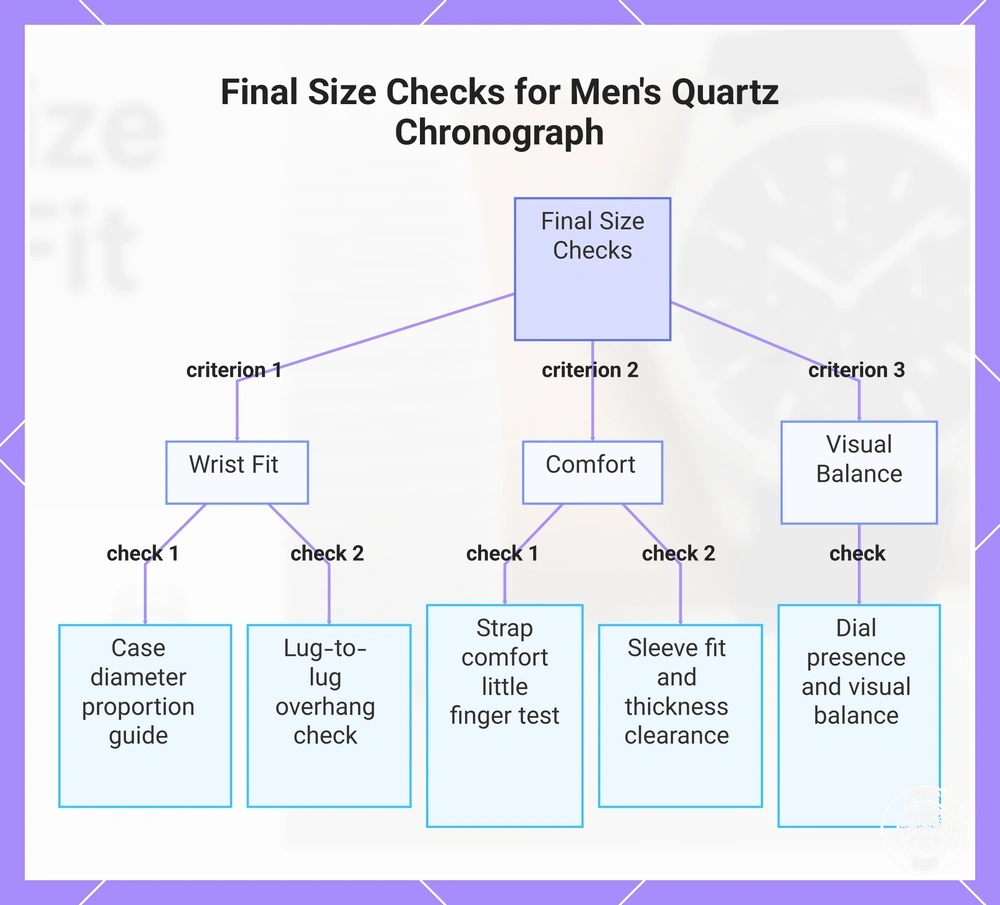
The final size checks before choosing a men’s quartz chronograph are to compare wrist size with case diameter and lug-to-lug length, then verify that thickness, dial presence, strap comfort, sleeve fit, and use context produce acceptable wrist fit, comfort, and visual balance. Longines Australia’s sizing guidance compares wrist circumference with case diameter and thickness, while Hamilton’s wrist-sizing instructions add a separate strap-comfort check. These final checks establish fit confidence rather than a universal fit guarantee.
Wrist fit, comfort, and visual balance are the organising criteria.
Use the following fit checklist as a final review after the individual measurements have been considered. Wrist fit, comfort, and visual balance are the organising criteria.
- Wrist size: Record wrist circumference and consider usable wrist width so the complete case can be assessed against the individual wrist rather than a size label alone.
- Case diameter: Longines Australia gives general guidance of 32–36 mm for wrists below 16 cm, 36–42 mm for wrists from 16–17.8 cm, and 42–46 mm for wrists above 17.8 cm; treat these as proportion guides, not quartz-chronograph fit limits.
- Lug-to-lug length: Confirm that the complete longitudinal span is acceptably supported by the usable top width of the wrist; if the lugs extend beyond that supporting surface, overhang is a fit warning.
- Thickness: Check whether case height permits comfortable wrist movement and adequate sleeve clearance; no universal thickness threshold establishes comfort for every wrist and case design.
- Dial presence: Confirm that the chronograph dial creates the intended visual presence without exceeding the wearer’s preferred visual balance.
- Strap comfort: Hamilton’s wrist-sizing instructions recommend leaving enough room to place a little finger between the strap and wrist when using its measuring method; also confirm that the strap stabilises the case without persistent pressure.
- Sleeve fit: Test the watch beneath the sleeve it will actually be worn with and treat repeated catching or insufficient clearance as a fit issue for that watch-and-sleeve combination.
- Use context: Verify that the same case remains practical for the intended conditions, especially where sustained comfort, wrist movement, or sleeve clearance matters.
- Final confidence: Treat the size as provisionally suitable when case coverage, lug support, strap stability, wrist movement, sleeve clearance, and visual proportion are all acceptable for the wearer.
The checklist should be interpreted as one combined fit decision rather than nine independent rules. Longines Australia’s guidance shows that wrist circumference, case diameter, and case thickness are separate sizing variables, while Hamilton’s method treats strap looseness as another comfort condition. Lug-to-lug length, dial presence, and sleeve interaction therefore still need model-specific or on-wrist verification. The final result should remain qualified by wrist shape and case design.
The final result should remain qualified by wrist shape and case design.
Once these final size checks provide sufficient fit confidence, broader selection criteria can be considered separately when deciding how to choose the right chronograph. That next step expands the decision beyond sizing without changing the fit conclusions established here.
That next step expands the decision beyond sizing without changing the fit conclusions established here.
Fit confidence means the men’s quartz chronograph has satisfied the relevant size, comfort, and visual-balance checks for the individual wearer; it does not settle every broader buying criterion. Use the separate buying checklist for those remaining decision variables after the final fit review, then compare suitable options without treating this sizing assessment as a fit guarantee.
Before buying, check that the compatibility criteria, key features, and product details match your needs.
The products below are useful examples for comparing available options. Before buying, check that the compatibility criteria, key features, and product details match your needs.
This chart shows the three main criteria—wrist fit, comfort, and visual balance—and their key checks to confirm fit confidence for a men's quartz chronograph.