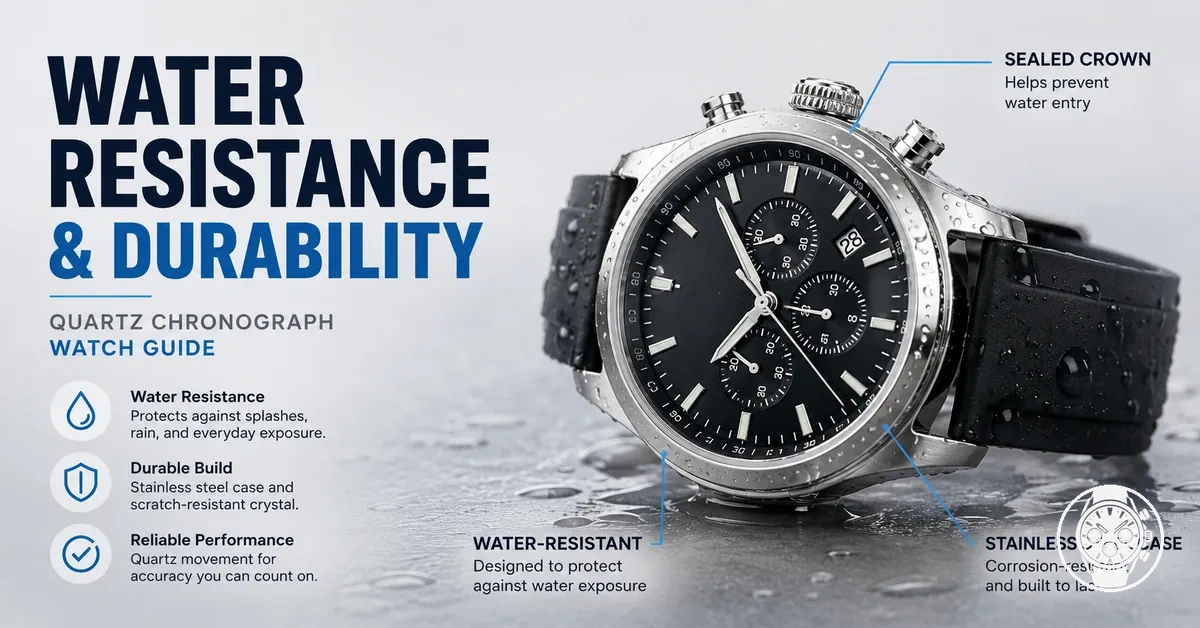
Men’s Quartz Chronograph Watch Water Resistance and Durability
A men’s quartz chronograph watch has conditional water resistance and durability: wet-use protection is bounded by its water-resistant rating and the condition of its seals, crown and pushers, while wear resistance is bounded by the condition and construction of the case, crystal and strap. ISO 22810:2010 establishes requirements and test methods for watches designated as water-resistant, so a rating describes tested water resistance rather than universal protection from water. Seiko states that water resistance can deteriorate as gaskets age or watch parts deform after accidental shock. Ratings and real conditions must therefore be interpreted together.
Ratings and real conditions must therefore be interpreted together.
For daily wear around splash, sweat or rain, the watch’s stated rating and the manufacturer’s use conditions set the wet-use boundary; Citizen, for example, classifies 3-atmosphere water resistance for minor exposure such as rain, 5-atmosphere resistance for swimming and general washing work, and 10- or 20-atmosphere resistance for skin diving and marine sports, while excluding operation of the crown or buttons when the watch is wet across those categories. Citizen also instructs users to keep the crown in its normal closed position and warns that operating the crown or buttons on a wet watch can allow water to enter and damage internal components. Maintenance connects water resistance with durability because Seiko advises removing moisture, sweat and dirt with a soft, dry cloth to support the durability of the case back, gaskets and band. These conditional protection principles define the safe-use frame for men’s quartz chronograph watches.
These conditional protection principles define the safe-use frame for men’s quartz chronograph watches .
The practical risk depends on exposure and watch condition as well as the marked rating: ageing seals can reduce resistance to water, accidental shock can deform parts, and moisture or dirt left on the watch can contribute to deterioration. Seiko specifically warns that strong shocks should be avoided and recommends regular water-resistance checks because gasket ageing and accidental deformation can impair protection; this also means case, crystal and strap durability should be judged under the actual wear and maintenance conditions rather than treated as permanent properties. The first distinction to establish is therefore what water resistance means for a men’s quartz chronograph watch before applying its rating to a particular exposure.
Table of Contents
What Water Resistance Means on a Men’s Quartz Chronograph Watch
Water resistance on a men’s quartz chronograph watch is rated protection against water entry under specified pressure and exposure conditions. ISO 22810:2010 specifies requirements and test methods for watches designated as water-resistant, while Citizen Watch explains that the marked water-resistant level determines the types of exposure for which a watch is intended. Rated protection therefore describes resistance under defined conditions, not permanent waterproof certainty.
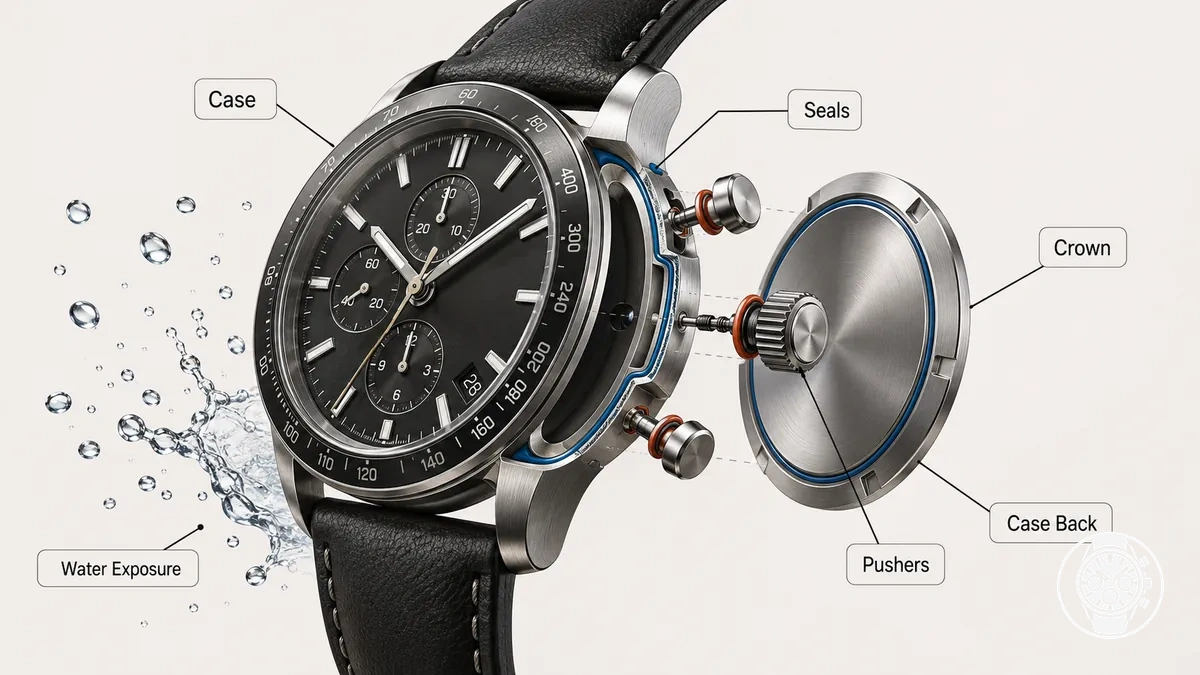
The case, case back, crown, pushers and seals form the water-entry boundary of a men’s quartz chronograph watch, so the condition of these parts changes the practical risk during exposure. Citizen Watch identifies water-resistant gaskets as sealing components and states that deterioration of a gasket, damaged glass or deformation of watch components can impair water resistance; it also warns that operating the crown or buttons while the watch is wet can allow water to enter. Pressure rating and real exposure are related but not interchangeable: Citizen states that 1 bar corresponds to 1 atmosphere of pressure and a nominal water depth of 10 m, while its usage guidance separately limits watches according to the type of water contact. For example, Citizen classifies a 3 bar water-resistant watch for exposure such as perspiration, face-washing splashes and rain, but not for conditions involving significant changes in water pressure, demonstrating how rating, exposure and component condition jointly affect water-entry risk.
The case, case back, crown, pushers and seals form the water-entry boundary of a men’s quartz chronograph watch, so the condition of these parts changes the practical risk during exposure.
Normal splash protection therefore has a narrower exposure condition than prolonged contact or forceful water pressure; Citizen specifically advises against placing a water-resistant watch directly under running tap water because tap pressure can exceed the pressure encountered at the corresponding nominal depth. The pressure marking should therefore be interpreted with its stated exposure conditions rather than as proof of protection for every wet-use scenario, which is why the individual water-resistant rating labels require separate interpretation.
Waterproof Claims, Water-Resistant Labels, and Rating Limits
Waterproof claims, water-resistant labels, and rating limits are separate evidence layers for a men’s quartz chronograph watch: wording is not a substitute for a stated rating, a marking such as ATM, BAR or metres expresses a pressure or depth-related rating, and safe use remains conditional on the watch and exposure. ISO states that ISO 22810:2010 establishes requirements, test methods and authorised marking for water-resistant watches, while manufacturer guidance adds use conditions that a marking alone does not describe. Labels therefore need rating and condition context.
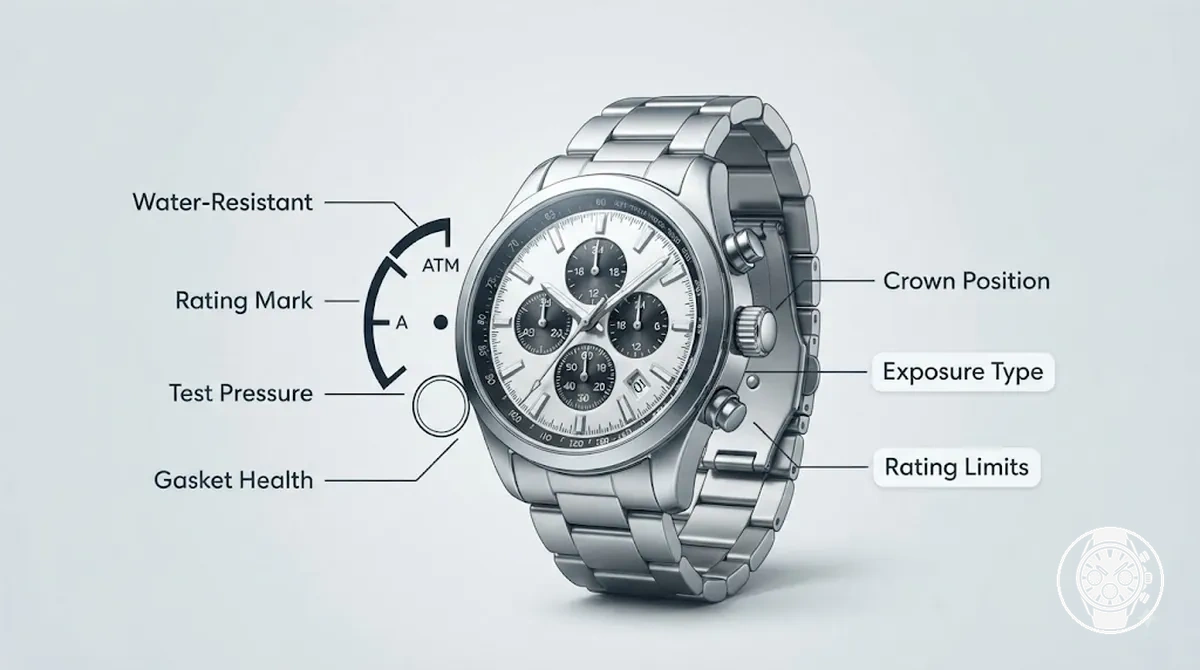
A practical reading order is label wording, then rating value, then real-use condition; this keeps a marketing expression separate from test pressure and from the conditions affecting a men’s quartz chronograph watch in use. The table organises common label or marking categories by likely meaning, condition that changes user risk, and safer interpretation.
| Label or marking | What it can indicate | Condition that changes risk | Safer interpretation |
|---|---|---|---|
| Waterproof claim | Wording alone supplies no pressure rating or exposure category unless supporting technical information is provided. | Test pressure, water rating and manufacturer-specific limitations remain unspecified. | Do not infer a water-use condition until a supported resistance label or rating is identified. |
| Water-resistant label | ISO states that ISO 22810:2010 defines requirements and tests for watches designated as water-resistant; manufacturer markings can then identify a particular resistance level. | Manufacturer guidance, watch condition and exposure type determine how the label should be applied in use. | Read the label together with its stated rating and permitted-use conditions. |
| ATM or BAR | A pressure rating; Citizen Watch states that 1 BAR is equivalent to 1 atmosphere and a nominal water depth of 10 metres. | Static pressure equivalence does not remove restrictions involving crown position, buttons, running water or other exposure conditions. | Use the numerical pressure rating with the manufacturer's activity and handling guidance. |
| Metres | A depth marking associated with a water-resistance level; Citizen Watch equates 1 BAR with a nominal depth of 10 metres. | The metre figure does not by itself describe every real-use pressure, duration or operating condition. | Treat metres as rating information rather than a stand-alone permission for a particular activity. |
Rating limits also depend on service condition: Seiko states that ageing gaskets and deformation caused by accidental shock can reduce water resistance, so gasket health is a relevant condition rather than a permanent property. Crown position and controls matter as well; Citizen Watch advises against using the crown or buttons while wet and against using a screw-lock crown while it is unlocked. For a numerical example, Citizen classifies 3 BAR as resistance for everyday moisture such as perspiration, face-washing splashes and rainfall, while Seiko's use table extends 5 BAR to swimming, yachting and showering; these manufacturer-specific categories show that a higher rating can expand stated exposure conditions without eliminating other rating limits. Safe use therefore remains conditional on the stated rating, gasket health, crown position, manufacturer guidance and exposure type.
Safe use therefore remains conditional on the stated rating, gasket health, crown position, manufacturer guidance and exposure type.
For a men’s quartz chronograph watch, waterproof claims should be treated as wording, water-resistant labels as bounded classifications, and ATM, BAR or metres as rating information that still requires a condition check. Test pressure provides one evidence layer, while seal age, crown position and real-use exposure provide another; the exact meaning of the individual rating units and levels belongs in the following rating-unit detail.
ATM, BAR, Metres, and Static Pressure Ratings
A water resistance rating expressed in ATM, BAR, or metres is a rating unit for a pressure-related test condition, not an exact real-use depth for a men’s quartz chronograph watch. The Bureau International des Poids et Mesures defines 1 standard atmosphere as 101,325 Pa and lists 1 bar as 100,000 Pa, while Citizen Watch states that 1 bar is roughly equal to 1 atmosphere in its watch guidance. ATM, BAR, and metre markings therefore describe controlled pressure conditions that require qualification when compared with real-use pressure.
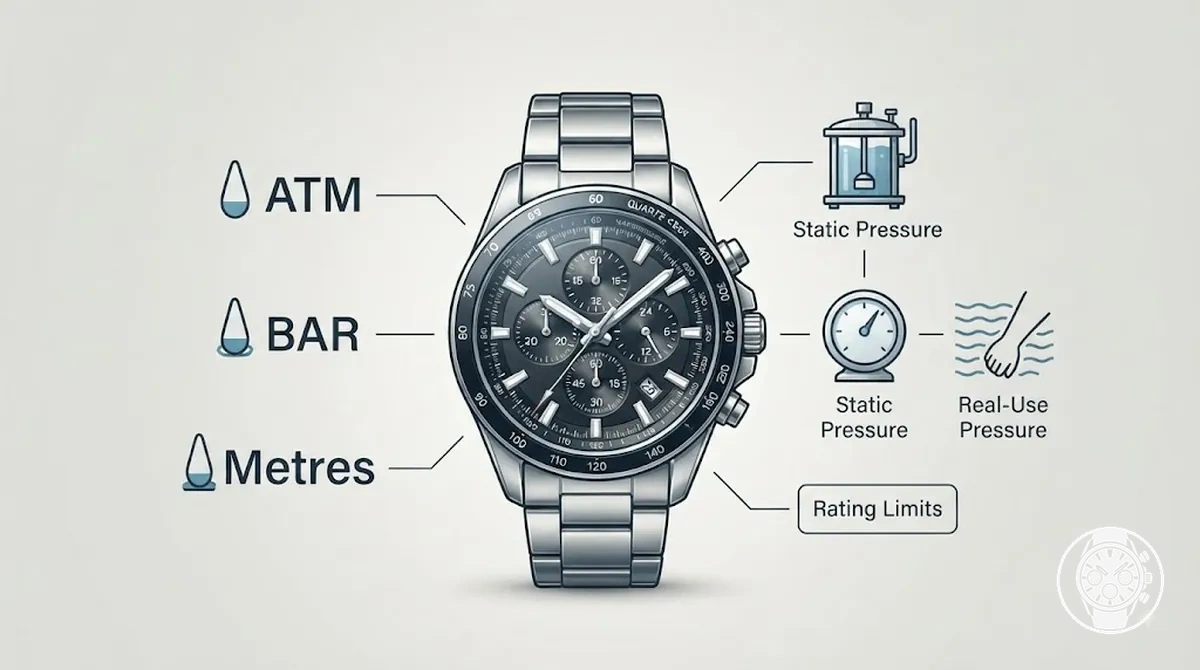
The rating-unit comparison below separates the stated value from the real-use limitation: Citizen Watch, for example, uses WR 50 with a 5-bar specification and WR 100/200 with 10/20-bar specifications in its water-resistance guidance. These markings organise the relationship between rating unit, test condition, and cautious interpretation rather than establishing a real-use depth from the number alone.
| Rating unit | What it describes | Real-use limitation | Writing caution |
|---|---|---|---|
| ATM | Atmospheric pressure; the Bureau International des Poids et Mesures defines 1 standard atmosphere as 101,325 Pa. | The pressure value alone does not specify the movement or other conditions of a particular water exposure. | Present ATM as a pressure rating and qualify practical use with the manufacturer’s stated conditions. |
| BAR | Pressure; the Bureau International des Poids et Mesures lists 1 bar as 100,000 Pa, while Citizen Watch states that 1 bar is roughly equal to 1 atmosphere for its watch guidance. | Citizen Watch separately assigns use conditions to its 5-, 10-, and 20-bar water resistance ratings, so the BAR value alone does not define every real-use condition. | State the BAR value and its applicable manufacturer test or use condition rather than converting pressure alone into a real-use depth. |
| Metres | A depth marking used with a water resistance rating; Citizen Watch pairs WR 50 with 5 bar and WR 100/200 with 10/20 bar in its guidance. | The metre marking remains tied to the manufacturer’s water-resistance classification and does not independently specify real-use movement or pressure conditions. | Treat metres as rating information and qualify any practical-use interpretation with the stated conditions. |
For a numerical example, Citizen Watch specifies a 5-bar water resistance rating for moderate water exposure including swimming but excludes skin diving, while its 10- and 20-bar categories include skin diving but exclude scuba and saturation diving. The practical consequence is that real-use pressure and movement must be interpreted through the manufacturer’s conditions rather than inferred from static pressure or a metre marking alone.
Why No Chronograph Watch Should Be Treated as Fully Waterproof
A chronograph watch should not be treated as fully waterproof; it should be treated as water-resistant only when its rating and current condition support the exact use case. Citizen Watch instructs users to keep the crown in its normal position and not operate the crown or pushers while the watch is wet because water can enter the case, so complete water protection should not be inferred from a water-resistant marking alone.
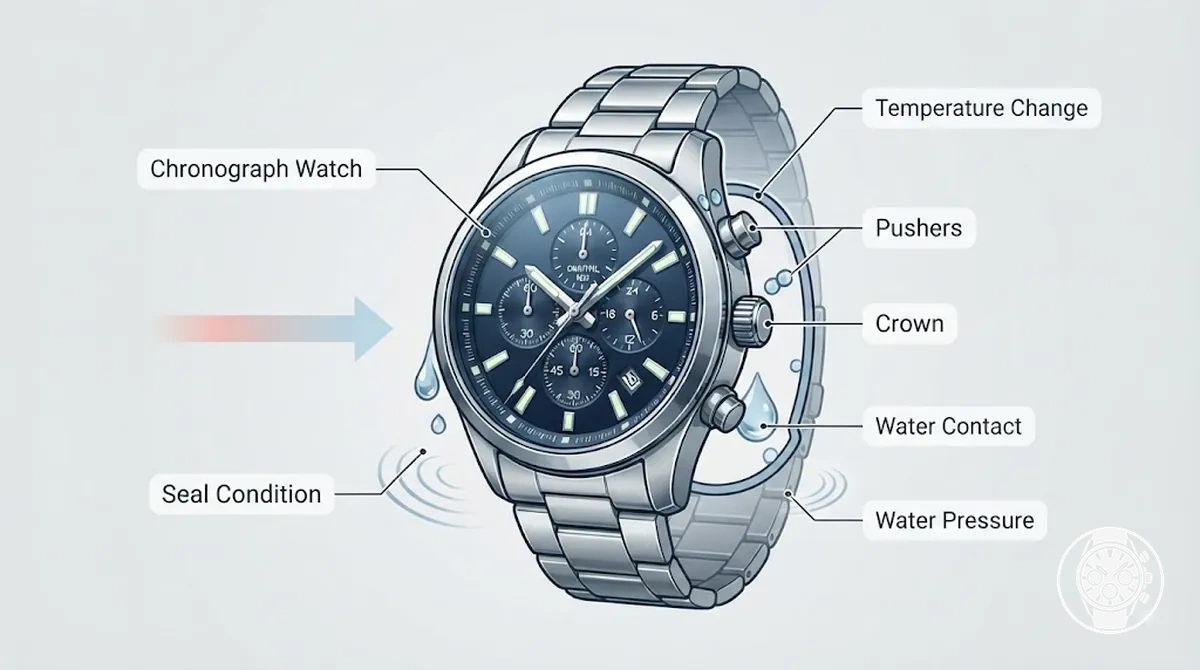
Local conditions further limit certainty: Seiko states that gasket wear from ageing and deformation caused by accidental shock can reduce water resistance, making the watch's present seal condition and servicing history relevant to the assessment. Citizen Watch advises against hot-water and sauna exposure because high temperature can deteriorate water-resistant gaskets, while its guidance assigns different permitted uses to different water-pressure ratings rather than treating water resistance as one universal state. The pushers and crown therefore need to remain in the manufacturer-specified sealed condition during applicable water contact, while gasket condition, temperature changes, servicing history, and water pressure must remain within the conditions supported for that watch. These limits support a cautious interpretation of a chronograph watch as conditionally water-resistant rather than fully waterproof.
Safe Water Exposure for Daily Wear, Rain, Showering, and Swimming
Safe water exposure for a men’s quartz chronograph watch is conditional: Citizen Watch classifies 3-atmosphere water resistance for minor exposure such as rain and 5-atmosphere water resistance for swimming, while its standard guidance excludes crown or button operation when the watch is wet. Showering and ocean use require separate checks because heat, soap, salt, water pressure, pusher use, crown position, and strap material introduce conditions that the rating alone does not resolve. Safe exposure therefore depends on rating, condition, and environment.
Safe exposure therefore depends on rating, condition, and environment.
A practical decision should match the wet-use situation to the manufacturer’s rating threshold and exposure guidance rather than treating all water contact alike. The table separates daily wear, rain, showering, swimming, and ocean use.
| Situation | Main risk | Safer condition | What to avoid |
|---|---|---|---|
| Daily wear | Splash, sweat, and moisture remaining on the case or strap material. | Citizen Watch classifies 3 atmospheres for occasional accidental splashing; keep the crown in its normal closed position and dry the watch after water contact. | Water exposure when the watch has no water-resistant indication, or leaving a water-sensitive strap wet. |
| Rain | Extended wetting and pusher use while droplets remain on the watch. | Citizen Watch includes rain within the minor-exposure category for 3-atmosphere water resistance. | Operating the crown or chronograph pushers while the watch is wet. |
| Showering | Heat, soap or shampoo, and directed water add conditions beyond a simple splash. | Follow the instructions for the specific watch and keep its crown and controls in the manufacturer-specified sealed state. | Assuming a swimming-capable rating also establishes suitability for hot water, soap, or shower exposure. |
| Swimming | Repeated immersion, changing water pressure, chlorine, and pusher use. | Citizen Watch specifies 5 atmospheres as its minimum category that includes ordinary swimming. | Swimming with a 3-atmosphere-only rating or operating pushers while wet unless the specific watch instructions permit it. |
| Ocean use | Salt, waves, repeated immersion, and residue remaining after exposure. | Use the watch only within its manufacturer-stated marine-use category; Citizen Watch instructs users of applicable water-resistant watches to rinse off seawater with fresh water afterward and wipe the watch dry. | Leaving salt residue on the watch, using wet controls, or exceeding the stated water-use category. |
For daily wear and rain, Citizen Watch specifies 3 atmospheres for occasional accidental splashing and separately classifies swimming as unsuitable at that rating; keeping the crown closed, avoiding wet pusher use, and drying the watch after exposure address different water-entry and moisture conditions. Strap material requires its own check because the case rating does not specify how a particular leather, textile, or other strap should be exposed to water. That distinction matters when assessing daily wear suitability where ordinary wear, splash, rain, and drying can occur together.
That distinction matters when assessing daily wear suitability where ordinary wear, splash, rain, and drying can occur together.
You can swim with a men’s quartz chronograph watch when its specific rating, present condition, and manufacturer guidance support that exposure; Citizen Watch places ordinary swimming at 5 atmospheres while limiting 3 atmospheres to minor exposure. Showering needs a separate manufacturer check because heat and soap introduce conditions not established by a swimming rating, while Citizen advises against hot-water exposure and wet crown or button operation. For ocean use, salt and waves add another exposure condition, and Citizen instructs users to rinse an applicable water-resistant watch with fresh water after seawater contact and wipe it dry. Treat the rating threshold as the starting point, then qualify use by seal condition, crown position, heat, soap, salt, pressure, pusher use, strap material, and the instructions for the specific watch.
Splash, Sweat, and Rain Exposure
During ordinary wear, splash, sweat, and rain exposure can fall within light wet use when the watch rating supports it: Citizen Watch classifies 3 atmospheres as suitable for minor exposure such as perspiration, face-washing splashes, and rain, while a non-water-resistant watch should not be exposed to moisture. Brief water contact still requires crown closure, pusher avoidance, and prompt drying, and the practical limit remains conditional on the watch's stated rating and present condition.
Brief water contact still requires crown closure, pusher avoidance, and prompt drying, and the practical limit remains conditional on the watch's stated rating and present condition.
For daily exposure, drying time has no universal minute threshold in the reviewed Citizen Watch and Seiko guidance; both manufacturers instead instruct users to remove moisture or perspiration with a dry cloth, while Seiko advises drying a leather strap as soon as possible and then leaving it in a well-ventilated area.
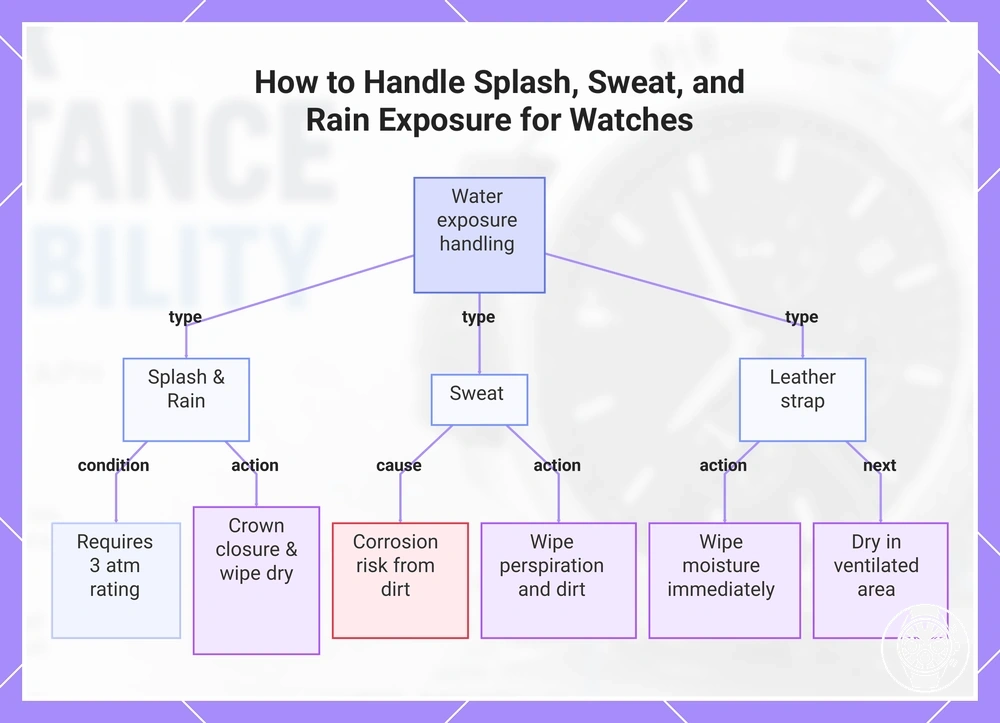
- Splash: For a watch rated to at least 3 atmospheres under Citizen Watch guidance, an occasional splash is within the stated minor-exposure category; wipe water from the case after brief contact rather than leaving moisture on the watch.
- Sweat: Sweat combined with accumulated dirt increases corrosion risk around metal components; Citizen Watch states that corrosion or accumulated foreign matter can produce black residue when exposed to moisture or perspiration, so wipe perspiration and dirt from the case and band after ordinary wear.
- Rain: A 3-atmosphere Citizen Watch is rated for minor exposure including rain, but crown closure and pusher avoidance still apply; Citizen instructs users to keep the crown in its normal position, securely lock a screw-lock crown, and not operate the crown or buttons while the watch is wet.
- Leather strap: Moisture and sweat can cause leather wear, discoloration, or deterioration; Seiko advises wiping moisture and sweat from a leather strap as soon as possible with a soft, dry cloth and placing it in a well-ventilated area after removing the watch from the wrist. Because Seiko does not specify a fixed drying time in minutes, use complete surface dryness rather than an invented time threshold before storage.
This chart shows the main exposure types and their handling requirements for watches, including splash, rain, sweat, and leather strap care.
Showering, Swimming, and Ocean Use
Showering, swimming, and ocean use require a supported rating level and more wet-use caution than splash exposure because heat, soap, chlorine, salt, waves, changing pressure, and control operation add separate conditions. Citizen Watch specifies 5 atmospheres as its category for ordinary swimming, while its 3-atmosphere category covers occasional accidental splashing and excludes swimming; Citizen also advises removing a watch before bathing and not operating its crown or buttons while wet. These exposures therefore require stronger rating evidence than splash contact.
These exposures therefore require stronger rating evidence than splash contact.
The exposure type determines the added stress: showering combines heat and soap, pool use combines chlorine with repeated immersion and changing pressure, and ocean use combines salt with waves and repeated saltwater contact. Manufacturer instructions can differ—for example, Seiko specifies that its watches marked WATER RESISTANT 5 BAR are suitable for swimming and showering, whereas Citizen's general precautions advise removing a watch before bathing—so shower, pool, and ocean variables must be checked against the instructions for the specific watch.
| Exposure | Added stress | Safer handling |
|---|---|---|
| Showering | Heat and soap add temperature and chemical conditions beyond water pressure alone; Citizen advises removing the watch before bathing, while Seiko permits showering for specified 5-bar watches. | Do not infer shower suitability from rating level alone. Follow the specific manufacturer's instructions and keep the crown and pushers in their specified sealed state. |
| Swimming | Pool use adds repeated immersion, changing pressure, and chlorine. Citizen specifies 5 atmospheres for ordinary swimming but excludes skin diving at that rating. | Use the watch for swimming only when its stated rating and instructions support it. Avoid pusher use underwater or while wet because Citizen states that operating the crown or buttons while wet can allow water to enter and damage internal components. |
| Ocean use | Salt, waves, and repeated saltwater exposure add conditions affecting the case and strap as well as the watch's sealing boundary. | Keep ocean use within the model's stated conditions and perform post-exposure rinsing with fresh water; Citizen and Seiko both instruct users to rinse an applicable water-resistant watch after seawater exposure and dry it afterward. |
After permitted pool or ocean use, cleaning should follow the manufacturer's instructions and the limits of the strap material; Citizen specifically requires fresh-water rinsing and drying after seawater immersion, and Seiko likewise specifies fresh-water rinsing followed by complete drying after sea use. Pusher use underwater remains excluded by Citizen's standard water-resistance guidance even at 5, 10, and 20 atmospheres, unless the documentation for a particular watch expressly establishes a different operating condition. Showering, swimming, and ocean use are therefore conditional on rating level, crown and seal condition, strap material, water chemistry, temperature, exposure pressure, and the instructions for the specific watch.
Chronograph Pushers, Crown, Seals, and Case-Back Leak Points
A men’s quartz chronograph watch has multiple condition-dependent leak points because the chronograph pushers and crown pass through the case while the case-back and crystal depend on sealed case joints. Citizen Watch states that operating the crown or buttons while a watch is wet can allow water entry and damage internal components, while Seiko states that gasket ageing or deformation caused by accidental shock can impair water resistance. The practical solution is to judge water resistance by the condition and permitted use of the chronograph pushers, crown, gasket and stem tube, case-back, and crystal seal rather than by the case rating alone.
The part-risk map below connects each physical entry point or service condition to a supported handling value, warning sign, or explicit evidence limitation.
The part-risk map below connects each physical entry point or service condition to a supported handling value, warning sign, or explicit evidence limitation. Citizen Watch provides specific wet-use conditions for pushers and the crown, while the reviewed manufacturer guidance does not establish one universal numerical wear threshold for the gasket, stem tube, case-back joint, or crystal seal across all chronograph watches; the parts being organised are pushers, crown, gasket, case back, crystal seal, and service condition.
| Entity/part | Attribute/condition | Value or warning sign | Effect/risk/decision |
|---|---|---|---|
| Pushers | Operation in wet conditions | Citizen Watch specifies no button operation while wet in its standard guidance, including its listed 3-, 5-, 10-, and 20-atmosphere water-resistance categories. | Keep chronograph pushers inactive while wet unless the documentation for the specific watch expressly permits wet operation; Citizen identifies water entry as the relevant risk. |
| Crown | Position during water exposure | Citizen Watch specifies the crown in its normal position and requires a screw-lock crown to be securely locked. | A pulled-out or unsecured crown falls outside the manufacturer-specified wet-use condition, so close or lock it before applicable water exposure. |
| Gasket | Age and physical condition | Seiko states that gasket ageing can reduce water resistance; the reviewed general manufacturer guidance provides no universal replacement age or wear threshold for every watch. | An aged or unverified gasket creates uncertain sealing performance and should not be assumed to retain its original water-resistance condition. |
| Case back | Case joint and sealing condition | No universal numerical leak threshold for the case-back joint is specified in the reviewed manufacturer guidance; Seiko states that watch deformation from accidental shock can impair water resistance. | Impact, prior case opening, or uncertain sealing condition makes the case-back joint a service-condition checkpoint before relying on water resistance. |
| Crystal seal | Crystal-to-case joint condition | No universal numerical wear or leak threshold for the crystal seal is specified in the reviewed manufacturer guidance; Seiko identifies accidental deformation as a condition that can impair water resistance. | Visible damage or significant impact creates uncertainty at the crystal case joint, so its sealing condition should be verified rather than assumed. |
| Service condition | Seal status after ageing, impact, or case opening | Seiko states that water resistance is not permanently guaranteed and recommends periodic water-resistance checking; the reviewed general guidance does not specify one universal inspection interval for all watches. | When seal age, impact history, or previous case opening is uncertain, use the specific manufacturer or service documentation to determine the applicable inspection requirement. |
Chronograph pushers and the crown require distinct handling because both controls cross the watch case and therefore interact directly with seals around their openings. Citizen Watch specifies that the crown remain in its normal position, that a screw-lock crown be securely locked, and that the crown or buttons not be operated while wet; its standard table applies the no-wet-operation condition across the listed 3-, 5-, 10-, and 20-atmosphere categories. The stem tube forms the crown-side case opening, but the reviewed manufacturer guidance provides no universal numerical wear limit for the stem tube across chronograph watches, so its acceptable service condition must be established for the specific watch. For leak prevention, avoid pusher use and crown operation in wet conditions unless the specific watch documentation expressly permits those actions.
For leak prevention, avoid pusher use and crown operation in wet conditions unless the specific watch documentation expressly permits those actions.
Seals and service condition determine whether the gasket, case-back joint, stem tube area, and crystal seal continue to support the watch’s intended resistance after ageing, impact, or case opening. Seiko states that gasket ageing and accidental deformation can impair water resistance and that water resistance is not permanently guaranteed, but the reviewed general manufacturer guidance does not provide one replacement interval or wear threshold applicable to every gasket or case joint. Prevention therefore means keeping sealed openings and case joints in sound condition and obtaining the model-specific water-resistance check required when gasket age, impact history, previous opening, or seal condition is uncertain.
Durability Factors for Cases, Crystals, Bezels, and Straps
Durability factors in a men’s quartz chronograph watch are the connected construction attributes that determine how the case, crystal, bezel, strap, and clasp respond to scratches, corrosion, moisture, and impact exposure during daily wear. No universal numerical scratch-resistance, corrosion-resistance, or impact threshold applies across all of these components and materials; manufacturer evidence instead provides material- and component-specific values or limitations. Durability therefore depends on connected construction attributes.
Durability therefore depends on connected construction attributes.
The table treats each visible component as a decision signal by pairing its durability attribute with a documented trade-off or evidence boundary and an inspection point. The parts compared are the case, crystal, bezel, strap, and clasp.
| Component | Durability attribute | Common trade-off | What to check |
|---|---|---|---|
| Case | Case metal and coating affect surface durability and corrosion resistance; Seiko reports that its Ever-Brilliant Steel has a Pitting Resistance Equivalent Number (PREN) value 1.7 times that of the steel grade used in most high-end watches in Seiko’s comparison. | That 1.7-times PREN comparison is specific to Seiko’s stated steel grades and measures corrosion resistance rather than scratch resistance or impact behaviour; a coating introduces a separate surface whose wear characteristics require coating-specific evidence. | Identify the case metal and any coating separately, then check the manufacturer’s corrosion, scratch, impact, and care information for that construction. |
| Crystal | Crystal type influences scratch resistance and impact behaviour, but the reviewed manufacturer evidence does not establish one numerical threshold that ranks all watch crystal types on both attributes. | A documented scratch-resistance property does not establish an equivalent impact-resistance value. | Check the stated crystal type and manufacturer-specific scratch, impact, and replacement guidance. |
| Bezel | Bezel material and finish affect surface marks and corrosion resistance; Rolex specifies the Cerachrom ceramic bezel used on its Cosmograph Daytona as corrosion-resistant, virtually scratchproof, and unaffected in colour by ultraviolet light. | Those properties are specific to Rolex’s Cerachrom component and do not establish the impact behaviour of every ceramic, metal, coated, or painted bezel. | Identify the bezel material or insert and check its stated scratch, corrosion, finish, and impact limitations. |
| Strap | Strap material determines its response to moisture and wear; Seiko states that leather bands are susceptible to deterioration and discoloration from moisture, sweat, and direct sunlight. | Case water resistance does not establish equal moisture tolerance for the strap; Seiko instructs users not to wear applicable non-Aqua Free leather bands while bathing, swimming, or working with water even when the watch itself is rated to 10 BAR or 20 BAR. | Match the strap to expected moisture and sport exposure, and inspect it for cracking, loss of flexibility, discoloration, or other deterioration. |
| Clasp | Clasp security depends on the closure and connecting pins remaining functional; Seiko states that stainless-steel pins used in some titanium bands can corrode. | Seiko states that advanced pin corrosion can cause a pin to protrude or fall out, the watch case to separate from the band, or the clasp to stop opening normally. | Check clasp operation, connecting pins, joints, and visible corrosion; Seiko advises discontinuing use and requesting repair if a pin protrudes. |
The case and crystal protect different surfaces of a men’s quartz chronograph watch, so case metal, coating, corrosion resistance, crystal type, scratch resistance, and impact exposure should be assessed as separate attributes. For a quantified case example, Seiko reports that Ever-Brilliant Steel has a PREN value 1.7 times that of the steel grade used in most high-end watches in its comparison, indicating a material-specific difference in corrosion resistance rather than a universal advantage in scratching or impact. For the crystal, the reviewed manufacturer evidence provides no comparable universal numerical threshold that combines scratch resistance and impact behaviour across all crystal types, so the stated crystal type and its manufacturer-specific limits remain the relevant evidence boundary. These construction differences become selection criteria when daily wear or sport use exposes the watch to different combinations of abrasion, moisture, corrosion, and occasional impact.
These construction differences become selection criteria when daily wear or sport use exposes the watch to different combinations of abrasion, moisture, corrosion, and occasional impact.
Straps, clasps, and bezels add exposure-specific durability factors: Seiko excludes applicable non-Aqua Free leather bands from bathing, swimming, and water work even when the watch head carries a 10-BAR or 20-BAR rating, while Rolex’s Cerachrom scratch and corrosion claims apply specifically to its ceramic bezel construction. Seiko also identifies an observable clasp-related limit: corrosion in stainless-steel pins used in some titanium bands can progress until a pin protrudes or falls out, at which point Seiko advises stopping use and requesting repair. For daily wear, sport use, and care expectations, the qualified choice is therefore the construction whose documented scratch resistance, corrosion resistance, moisture tolerance, impact limitations, and clasp condition correspond to the expected exposure rather than a material assumed to be preferable in every environment.
Stainless Steel, Titanium, and Case Coatings
Stainless steel, titanium, and case coatings affect a watch case through weight, corrosion resistance, hardness, surface marks, and finish wear. Citizen Watch reports that, for identically designed comparison watches, its surface-hardened Super Titanium weighs about 60% as much as stainless steel, while Citizen also identifies untreated titanium as comparatively soft and susceptible to scratching; case coatings and plating instead modify the surface of the underlying metal, so their hardness and wear pattern must be judged separately from the base case material. The practical trade-offs are therefore stainless steel corrosion resistance and weight, titanium lightness and surface-mark behaviour, and coating or plating hardness and finish wear.
| Material or finish | Durability strength | Limitation | Best-fit condition |
|---|---|---|---|
| Stainless steel | Stainless steel combines corrosion resistance with a harder reference surface than untreated titanium in Citizen Watch's material comparison; Citizen lists approximately 200 HV as its reference hardness for stainless steel. | The approximately 200 HV figure is Citizen's reference value rather than a universal hardness for every stainless-steel grade or case finish, and visible scratches still depend on the specific alloy, finish, and contact. | Fits conditions where corrosion resistance and a conventional metal-case surface are priorities and its greater weight relative to the cited titanium comparison is acceptable. |
| Titanium | Titanium reduces case weight; Citizen Watch reports that its treated Super Titanium is about 60% of the weight of stainless steel for identically designed comparison watches. | Citizen identifies untreated titanium as naturally soft and susceptible to scratches, so the scratch behaviour of surface-hardened Super Titanium must not be generalised to untreated titanium. | Fits conditions where lower weight is important, provided the specific titanium case finish or surface treatment supplies the required resistance to visible surface marks. |
| Case coatings | Case coatings or plating can increase surface hardness without changing the underlying case metal; Citizen Watch specifies approximately 1,000–1,400 HV for its Duratect DLC treatment and approximately 1,000–1,100 HV for its Duratect Titanium Carbide treatment. | Citizen states that these hardness measurements use a low-load test condition and that hardness alone does not represent scratch resistance in daily use, so neither range establishes a scratch-proof finish or a universal wear threshold. | Fits conditions where documented surface hardness is a priority, provided the specific coating or plating and its expected wear pattern are acceptable for the intended abrasion and impact exposure. |
For a numerical comparison, Citizen Watch's cited reference stainless steel is approximately 200 HV, while its Duratect DLC surface treatment is approximately 1,000–1,400 HV; this shows that a coating can have a substantially different measured surface hardness from the underlying metal without establishing guaranteed resistance to scratches. Material guidance should therefore remain conditional: use stainless steel where the documented grade and weight suit the exposure, titanium where reduced weight is valuable and its surface treatment addresses expected marks, or a coated finish where documented hardness and the coating's wear behaviour match the intended use.
Mineral, Sapphire, and Scratch-Resistant Crystal Choices
A crystal option is a trade-off between scratch resistance, impact behavior, clarity, and replacement practicality rather than a universal durability ranking: mineral crystal and hardened mineral are glass-based choices, while Citizen Watch describes its sapphire crystal as artificial glass with the hardness and high transparency associated with natural sapphire. A scratch-resistant crystal can therefore prioritise resistance to surface marks without establishing an equivalent shatter or impact-resistance value; the reviewed manufacturer evidence does not specify one comparable impact-energy threshold for mineral crystal, hardened mineral, and sapphire crystal.
| Crystal option | Scratch behavior | Impact trade-off | Practical note |
|---|---|---|---|
| Mineral crystal | The reviewed manufacturer evidence does not specify one numerical hardness or scratch threshold applicable to all watch-grade mineral crystal. | Scratch behavior does not establish shatter risk; no comparable manufacturer-defined impact-energy threshold was found for mineral crystal versus sapphire crystal. | Mineral crystal can be considered where affordability and replacement practicality matter, but the reviewed evidence does not establish a universal replacement cost; verify the specific watch's replacement part and service price after damage. |
| Sapphire crystal | Citizen Watch identifies sapphire glass as having the hardness of natural sapphire and a high level of transparency, supporting its use where resistance to routine surface marks and clarity are priorities. | Surface hardness is not an impact rating, and the reviewed manufacturer evidence does not provide one universal shatter-energy threshold for sapphire watch glass. | Use sapphire crystal conditionally when scratch resistance has priority, while treating impact exposure and model-specific replacement practicality as separate criteria. |
| Hardened mineral | Seiko specifies Hardlex as the crystal material on individual watches; for example, the HDB007 uses curved Hardlex, but Seiko's reviewed specification does not assign Hardlex a universal numerical scratch-resistance value. | The reviewed Seiko material provides no universal impact-energy or shatter threshold for Hardlex, so the hardened-mineral label alone does not quantify impact behavior. | Hardlex is a model-specific hardened mineral option; replacement practicality remains tied to the required crystal part, dimensions, and repair context. |
| Coatings | Coatings can change surface or optical behavior without redefining the underlying crystal material; Citizen Watch specifies dual-spherical sapphire glass with an anti-reflective coating on the Caliber 0100 AQ6010-06A. | An anti-reflective coating addresses optical surface performance rather than supplying a manufacturer-stated impact or shatter threshold. | The AQ6010-06A provides a numerical configuration example: Citizen specifies a 37.5 mm case with coated sapphire crystal, showing that coating and crystal material are separate attributes; surface marks on a coating and structural damage to the watch glass can therefore require different repair assessment. |
For practical crystal choice, prioritise sapphire crystal when documented scratch resistance and clarity matter most, while mineral crystal or hardened mineral can remain relevant when the specific watch's impact exposure, affordability, and replacement practicality are more important; coatings should be evaluated separately for surface wear and optical function. Because the reviewed manufacturer sources do not publish one directly comparable numerical scratch-versus-impact test across all three crystal options, a claim that one crystal material has the greatest total durability would exceed the available evidence.
How Water, Impact, and Constant Chronograph Use Affect Reliability
Reliability in a men’s quartz chronograph watch is exposure-dependent rather than inevitably reduced by normal chronograph use: water ingress and persistent condensation can threaten movement sensitivity, impact shock can affect the hands, case, movement, or sealing condition, and repeated pusher use or sustained chronograph operation can affect service condition or battery load under movement-specific conditions. Citizen Watch warns that operating the crown or buttons while a watch is wet can allow water to enter and damage internal components, while Seiko states that accidental shock and gasket deterioration can impair water resistance. Prevention therefore means recognising the exposure condition and its possible effect rather than assuming that ordinary chronograph operation itself causes reliability loss.
The exposures compared are water ingress, condensation, impact, pusher use, and heavy chronograph use.
The cause-and-effect relationships below distinguish identifiable prevention signals from guaranteed failure predictions; the reviewed manufacturer guidance provides model-specific chronograph operating limits but no universal pusher-cycle count or impact-energy threshold that predicts failure across all men’s quartz chronographs. The exposures compared are water ingress, condensation, impact, pusher use, and heavy chronograph use.
| Exposure | Affected part or function | Possible effect | Prevention signal |
|---|---|---|---|
| Water ingress | Movement and internal components | Citizen Watch states that operating the crown or buttons while wet can admit water and damage internal components, so movement sensitivity becomes a concern when the case sealing condition is compromised. | Internal water is an inspection signal; avoid assuming continued reliability from the original water-resistance rating alone. |
| Condensation | Crystal interior and movement environment | Citizen Watch treats fogging that persists for a long time as a condition requiring inspection, while Seiko identifies persistent condensation or internal droplets as a sign associated with deteriorated water-resistant performance. | Persistent internal fogging or droplets indicate servicing needs rather than normal exterior moisture. |
| Impact | Hands, case, movement, and sealing condition | Seiko warns against strong impact such as dropping a watch onto a hard surface and states that accidental deformation can impair water resistance; the reviewed manufacturer guidance specifies no universal impact-energy threshold for failure across quartz chronographs. | Impact shock followed by changed operation, visible deformation, or uncertain sealing condition is a risk-recognition signal for inspection. |
| Pusher use | Chronograph pushers and service condition | Repeated dry pusher use is part of normal chronograph operation, but Citizen and Seiko precautions exclude operating controls while wet because of water-ingress risk; the reviewed manufacturer guidance specifies no universal number of pusher cycles at which pusher wear causes failure. | Abnormal looseness, operation, or uncertain sealing condition indicates servicing needs; cycle count alone does not provide a supported failure threshold. |
| Heavy chronograph use | Chronograph movement and battery load | Citizen Watch specifies that calibre 0510 can continue chronograph measurement beyond 12 hours and warns that leaving the chronograph running rapidly runs down the battery; Citizen calibre B620 instead stops chronograph measurement automatically after 60 minutes. | Use the calibre-specific operating limit because continuous chronograph behaviour and battery load differ by movement. |
Movement sensitivity and battery load require movement-specific interpretation because chronograph operating duration is not universal: Citizen Watch specifies that calibre 0510 displays elapsed time through 11 hours 59 minutes 59 seconds and continues measuring after 12 hours unless stopped, with prolonged operation identified as a cause of rapid battery depletion. Citizen’s calibre B620 provides a contrasting numerical example because its chronograph measures up to 60 minutes and then stops automatically, so the two movements have different operating conditions and battery-load implications. This difference clarifies why reliability should be considered together with movement and battery life rather than treating constant chronograph use as one universal exposure. The reviewed manufacturer guidance provides no universal chronograph-duration, pusher-cycle, or impact threshold that predicts reliability loss across all men’s quartz chronograph movements.
These conditions support inspection and model-specific service guidance as risk recognition, not a prediction of guaranteed failure or permanent damage.
Prevention is distinct from repair: persistent condensation, confirmed water ingress, impact shock followed by changed operation, abnormal pusher condition, or operation outside a movement’s stated limits are risk-recognition signals that can establish servicing needs without identifying a specific repair. Seiko states that water resistance is not permanently guaranteed because gasket ageing and accidental deformation can affect it, while Citizen directs users toward inspection when water enters the watch or fogging persists. These conditions support inspection and model-specific service guidance as risk recognition, not a prediction of guaranteed failure or permanent damage.
Protective Habits That Preserve Water Resistance and Durability
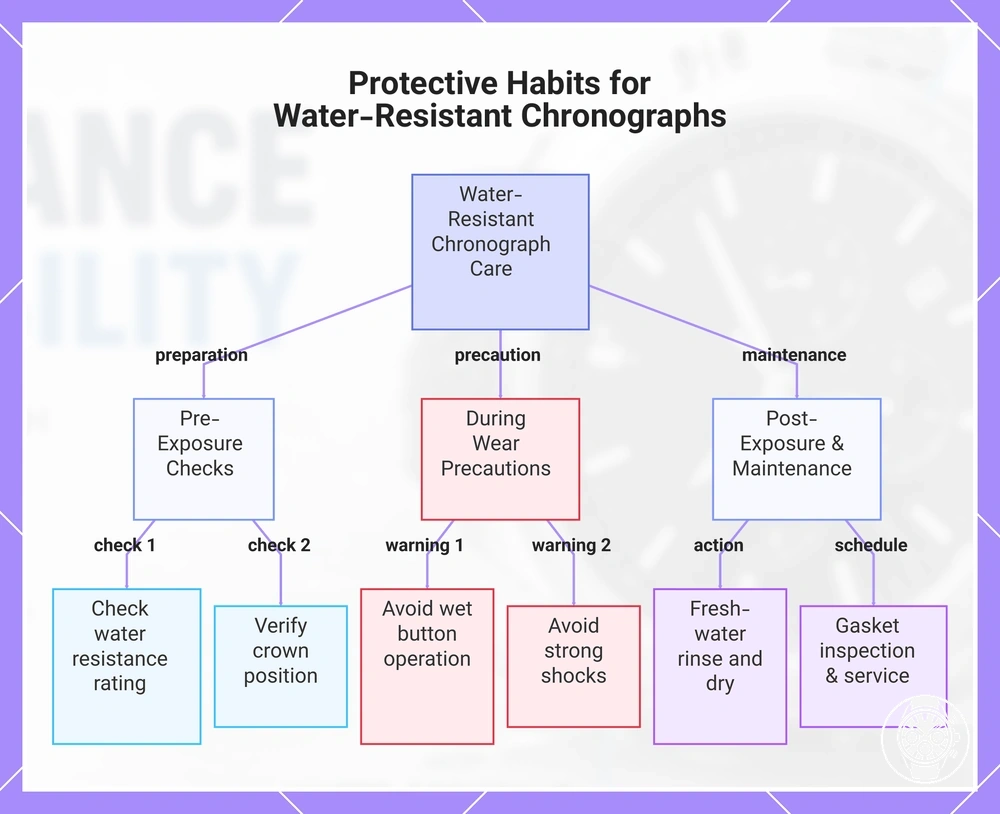
Protective habits for a durable water-resistant chronograph are prevention actions matched to exposure: complete crown checks before water contact, use pusher avoidance in wet conditions, rinse and dry after permitted saltwater exposure, maintain strap care, and arrange gasket inspection according to the watch's service requirements. Citizen Watch specifies that a crown should be fully pressed in and a screw-lock crown securely locked, while Seiko states that ageing gaskets and deformation from accidental shock can reduce water resistance. These protective habits support the rating and durability conditions already established for the watch rather than increasing its stated water-resistance capability.
Organise the actions into before exposure, during wear, after exposure, and periodic maintenance.
Use the care routine at the point when each risk occurs; Seiko recommends periodic water-resistance checking, while its general service guidance recommends servicing about every three years but states that frequency depends on climate and individual care, so that interval is not universal to every chronograph. Organise the actions into before exposure, during wear, after exposure, and periodic maintenance.
- Before exposure: Check the case or dial marking against the planned activity. Citizen Watch specifies 3 atmospheres for minor exposure such as rain, 5 atmospheres for swimming and general washing, and 10 or 20 atmospheres for skin diving and marine sports; these standard categories do not permit operating the crown or buttons while wet.
- Before exposure: Complete crown checks by pressing a conventional crown fully into its normal position and securely locking a screw-lock crown, as specified by Citizen Watch.
- During wear: Use pusher avoidance in wet conditions. Citizen Watch and Seiko both specify that the crown or buttons should not be operated while the watch is wet because doing so can compromise the sealed condition.
- During wear: Use impact avoidance around hard surfaces. Seiko advises avoiding strong shocks such as dropping the watch on a hard surface and states that accidental deformation can affect water resistance.
- After exposure: After permitted exposure to salt water, use fresh-water rinsing followed by drying with a soft cloth; Seiko specifies this sequence after ocean use.
- After exposure: Remove moisture, sweat, and dirt with a soft dry cloth. For leather strap care, Citizen Watch specifies immediate gentle drying with a soft dry cloth when the band becomes wet with water or sweat.
- After exposure: If exposure involves chlorine rather than salt, follow the specific watch and strap manufacturer's cleaning instructions; the reviewed Citizen and Seiko evidence used here does not establish one universal chlorine-rinsing procedure for every chronograph and strap material.
- Periodic maintenance: Include gasket inspection and water-resistance checking because Seiko identifies gasket ageing as a cause of reduced water resistance and recommends periodic checking.
- Periodic maintenance: Set service intervals from model-specific documentation. Seiko gives about three years as its general servicing recommendation while explicitly qualifying the frequency by climate and individual care.
- Periodic maintenance: Before storage, remove perspiration, dirt, and moisture. Citizen Watch specifies storage away from excessively high or low temperatures and high humidity when a watch will not be used for an extended period.
Before and during exposure, protective habits should therefore follow the marked rating, crown position, pusher state, and impact conditions rather than the assumption that a water-resistant case permits every activity. Citizen Watch provides a numerical example: its standard 5-atmosphere category permits swimming but not skin diving, whereas its 10- and 20-atmosphere categories permit skin diving and marine sports but not scuba diving; wet crown or button operation remains excluded across all three categories. Seiko separately identifies strong shock as a durability risk because deformation can impair water resistance. Crown checks and pusher avoidance remain necessary whenever the watch enters permitted wet conditions.
Crown checks and pusher avoidance remain necessary whenever the watch enters permitted wet conditions.
After exposure, rinsing and drying remove residues and moisture, while periodic gasket inspection addresses a different risk: Seiko states that water resistance is not permanently guaranteed because gaskets age and watch parts can deform after accidental shock. Seiko recommends regular water-resistance checking and gives about three years as its general service interval, subject to climate and individual care, so the applicable interval should still be checked against the watch's documentation. More detailed maintenance guidance can help translate these inspection requirements into a model-specific care schedule. Persistent internal moisture, visible deformation, or an uncertain sealing condition is therefore a reason to seek inspection rather than assume that routine rinsing or drying has corrected the sealing condition.
More detailed maintenance guidance can help translate these inspection requirements into a model-specific care schedule.
For practical next steps, choose or maintain a durable water-resistant chronograph by matching its documented rating to the intended exposure, confirming usable crown and pusher conditions, selecting strap care appropriate to moisture exposure, and checking the manufacturer's gasket inspection and service intervals. Between inspections, use appropriate drying, storage, and impact avoidance, and treat any manufacturer interval as model- and condition-specific when its documentation says so. These criteria provide decision support based on exposure, component condition, and documented maintenance requirements rather than a product ranking.
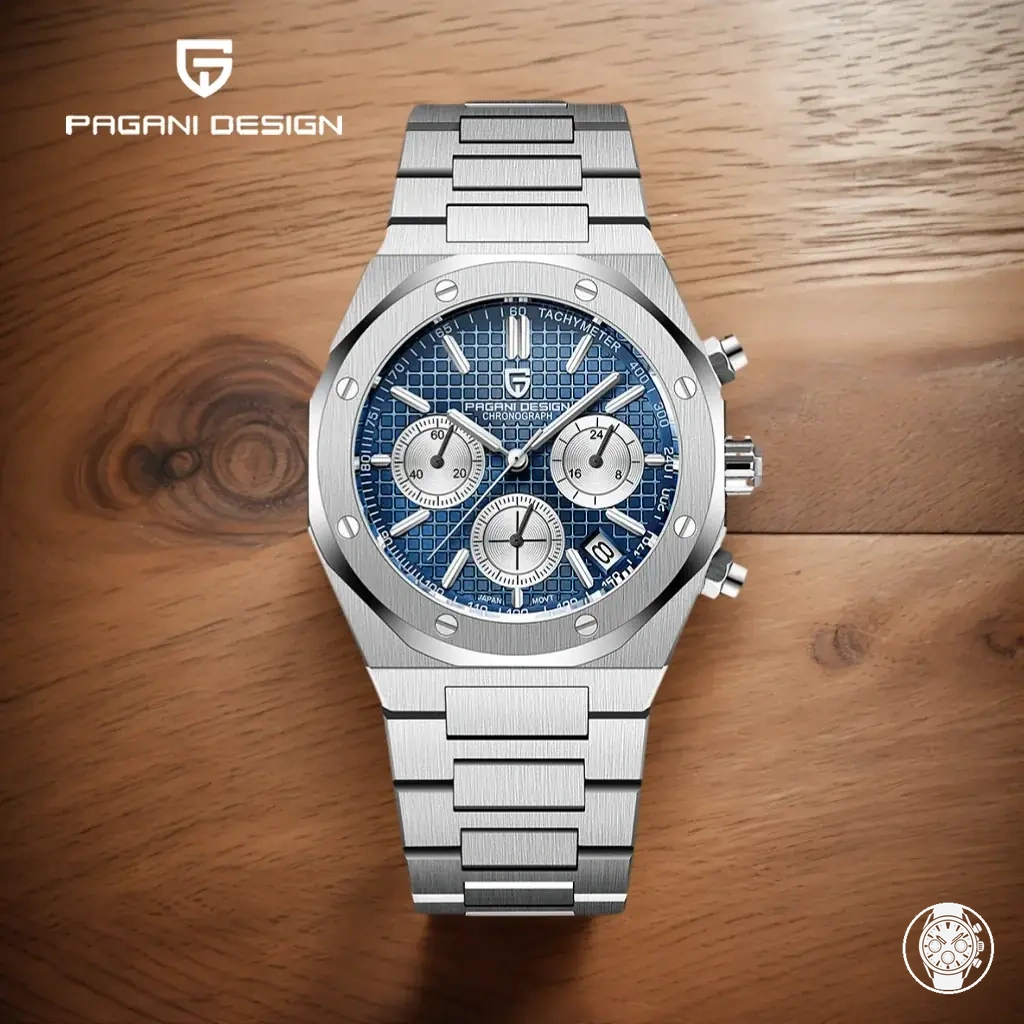
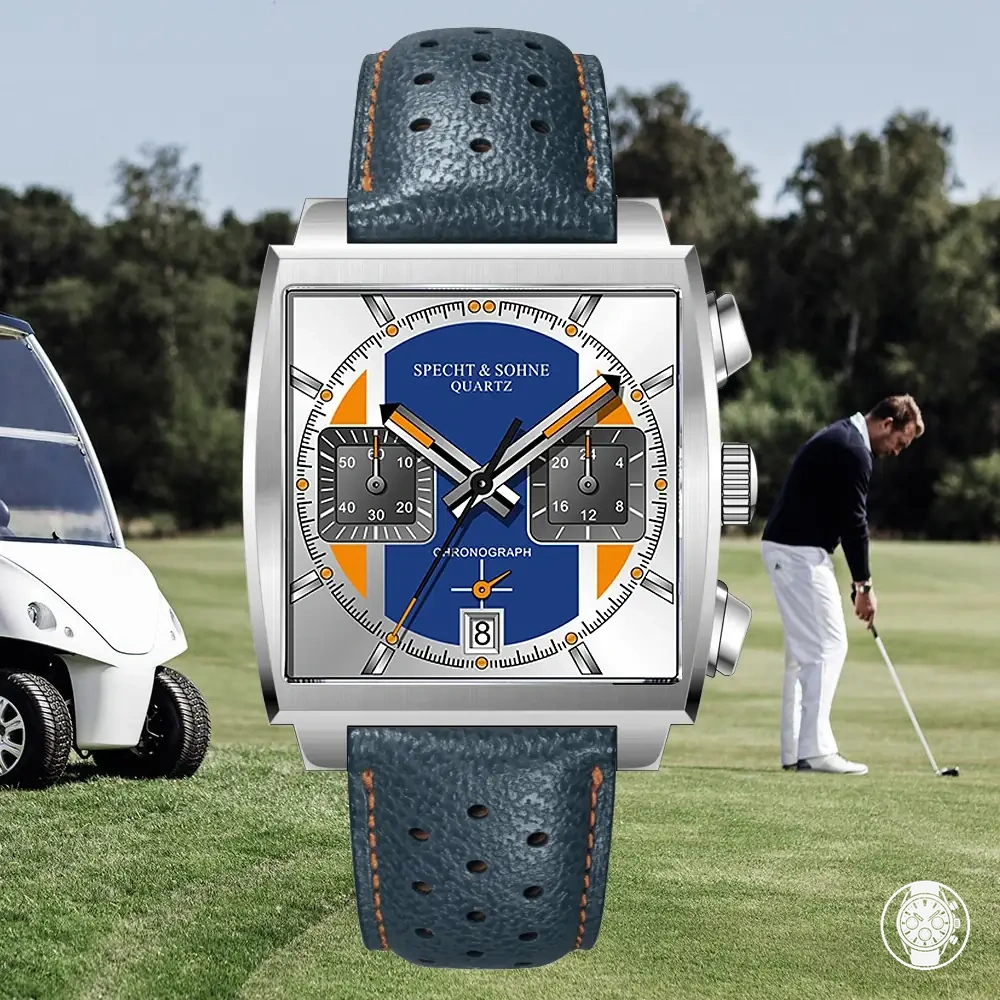
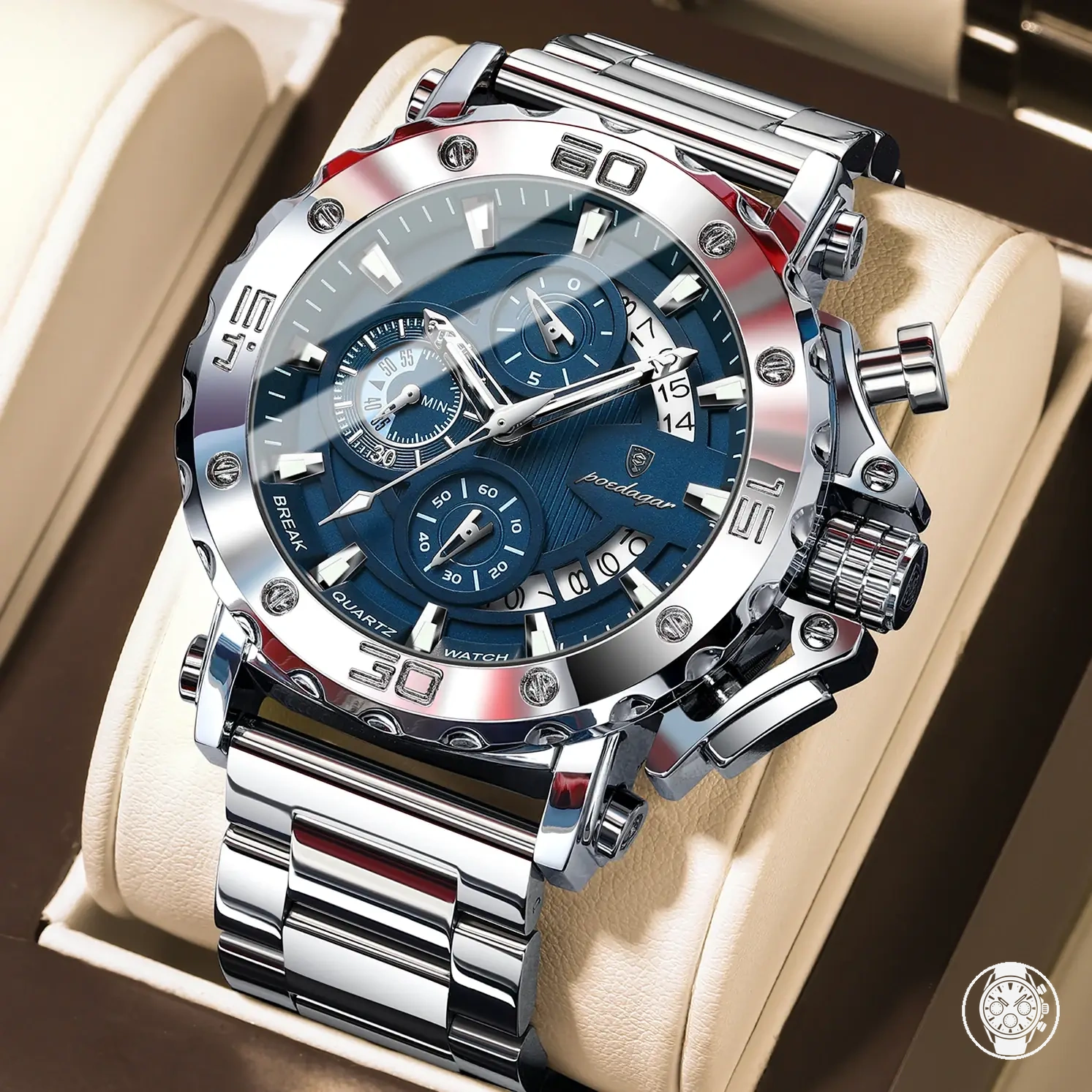
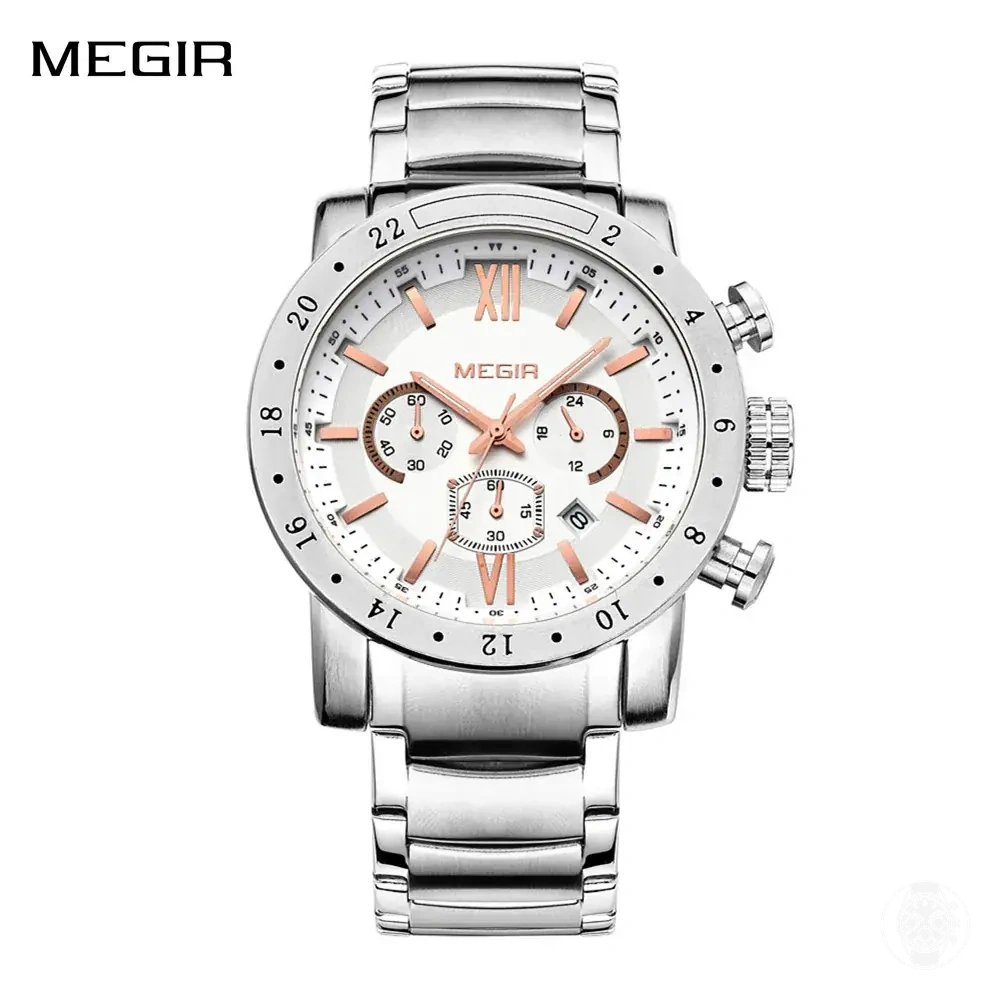
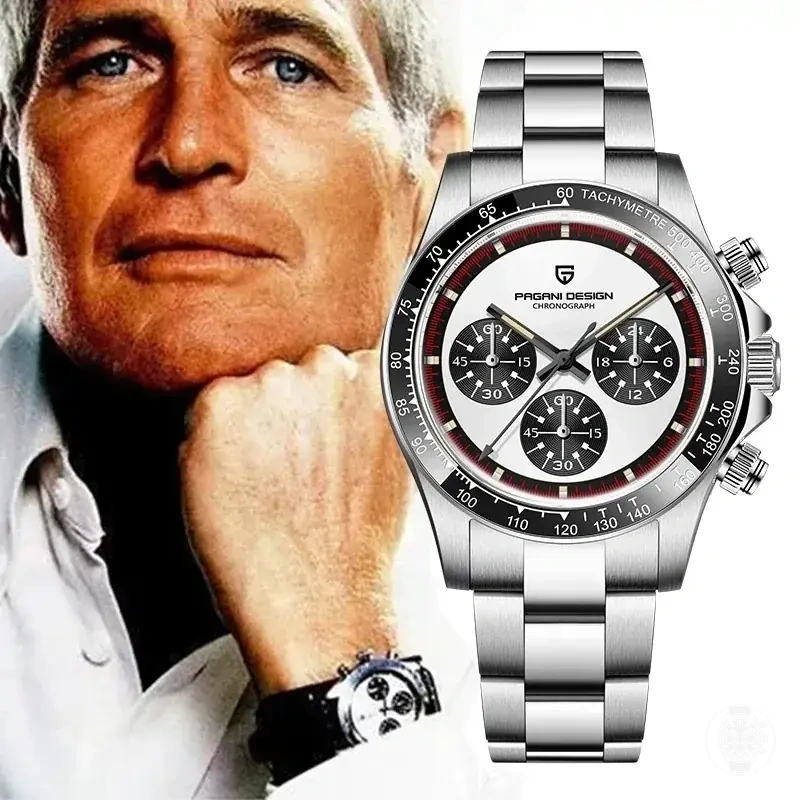
The products below are useful examples for comparing available options.
The products below are useful examples for comparing available options. Before buying, check that the compatibility criteria, key features, and product details match your needs.
This chart shows the key protective habits before, during, and after exposure to maintain water resistance and durability of a chronograph.