
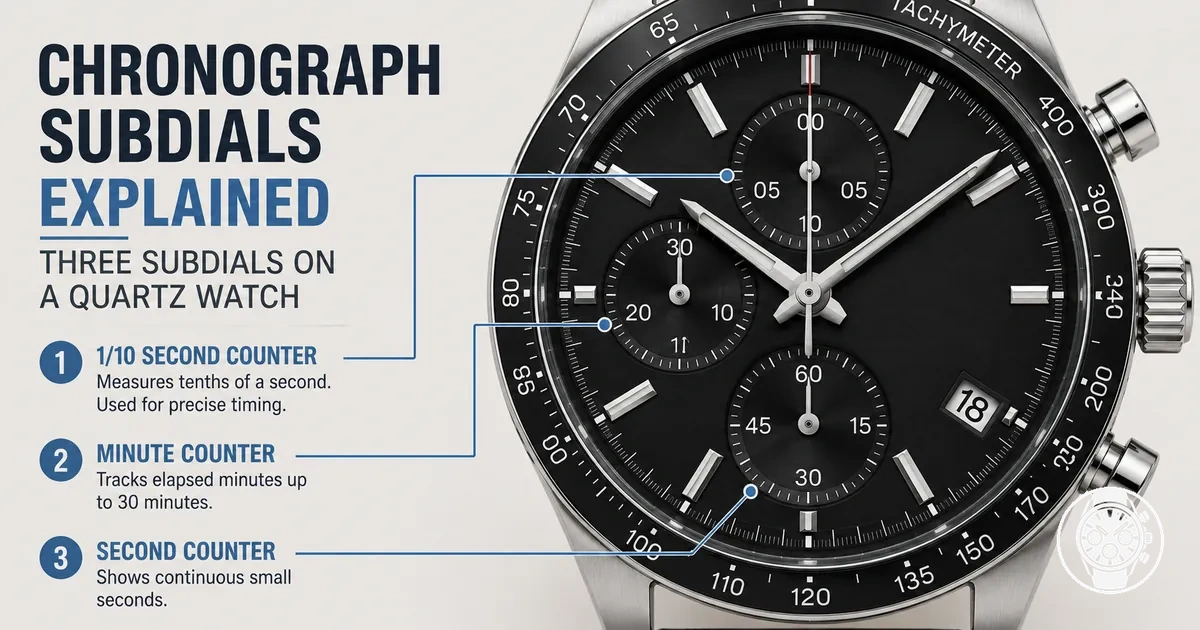
Men’s Quartz Chronograph Watch Subdials Explained
Men’s quartz chronograph watch subdials are small displays within the main dial that separate functions such as elapsed time, running seconds, or 24-hour time. A subdial is therefore a model-dependent display element: its meaning is determined by the function assigned by the movement and interpreted through its label and scale rather than by a universal position on the dial.
Subdials can include a minute counter for elapsed chronograph minutes, a running-seconds display for normal timekeeping, or a 24-hour subdial.
Subdials can include a minute counter for elapsed chronograph minutes, a running-seconds display for normal timekeeping, or a 24-hour subdial. Citizen’s B620 quartz chronograph instruction manual identifies a chronograph minute hand, chronograph second hand, second hand, and 24-hour hand, while Citizen’s 0520 analog quartz instruction manual documents the same four display roles. These manufacturer-defined examples provide context for men’s quartz chronograph watches: the displayed measure should be read from the relevant label, scale, and movement configuration because the layout assigned to those functions is not fixed across movements.
This is why two watches with three subdials can look similar while their individual counters represent different measures.
For example, Citizen specifies that the B620 chronograph measures elapsed time up to 60 minutes in 0.2-second increments, so its chronograph minute display has a different role from the watch’s continuously running seconds or 24-hour display. This is why two watches with three subdials can look similar while their individual counters represent different measures. Detailed chronograph use, reset procedures, and full parts coverage are separate contexts; first establish what a subdial is and what its scale represents before interpreting each individual function.
Table of Contents
What Chronograph Subdials Are and What They Measure
Chronograph subdials are small dial displays within the main dial that show separate time-related measures on a chronograph watch. A subdial's measured attribute may be elapsed minutes, running seconds, or 24-hour time, depending on the movement and display layout.
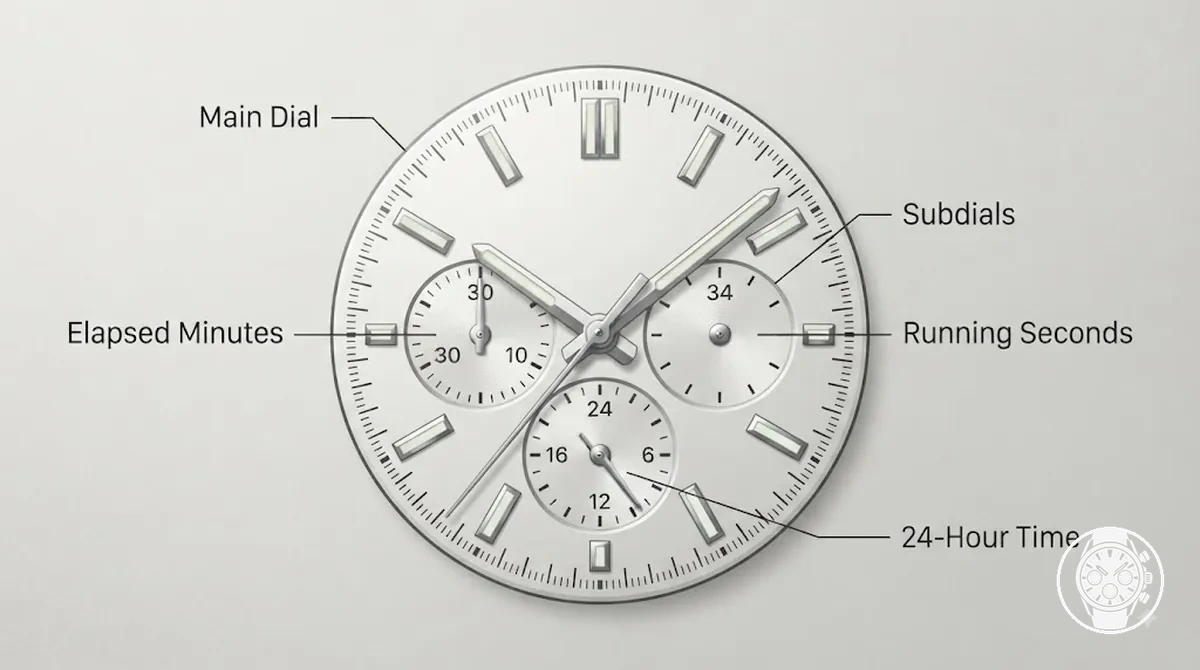
Chronograph subdials and what they measure become clearer when each small display is related to the main dial and chronograph function. Citizen's B620 documentation, for example, identifies a chronograph minute hand for elapsed minutes, a separate normal second hand for running seconds, and a 24-hour hand for 24-hour time; Citizen also specifies that the B620 chronograph measures up to 60 minutes in 0.2-second increments, with a maximum displayed elapsed time of 59 minutes 59.8 seconds. Subdials are display elements within the wider chronograph parts and functions, rather than the complete watch mechanism. The position, label, scale, and function assigned to a given subdial can differ by movement and model, so its displayed value should be interpreted from that watch's documented configuration.
Core Subdial Functions on Men’s Quartz Chronographs
Core subdial functions on men’s quartz chronographs commonly fall into three function families: an elapsed-time counter or minute counter for accumulated chronograph time, small seconds for running seconds, and a 24-hour display for current time across a 24-hour cycle. On an individual watch, the labels and scale markings determine the displayed value because the movement configuration assigns each register its function.
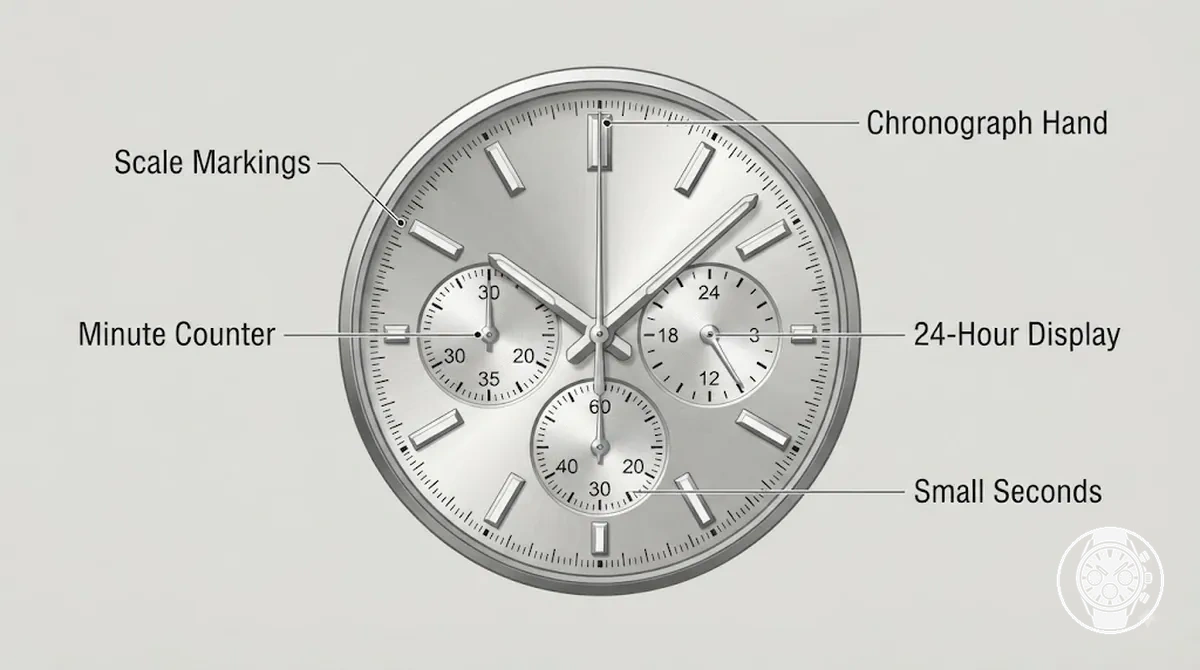
Two similar-looking watches can therefore use their subdials differently even when both contain three registers. As a model-specific numerical example of these function families rather than a universal layout, Seiko’s official instructions for quartz calibre 8T63 identify a small seconds hand, a 24-hour hand, and a stopwatch minute hand, while specifying stopwatch measurement up to 60 minutes in 1/5-second increments; the practical reading outcome is that the reader must match each register’s visible clue to its assigned function before interpreting its value. The table applies that clue-to-function logic without assigning a fixed dial position.
| Subdial type | Visible clue | What it may show | Reading note |
|---|---|---|---|
| Elapsed-time counter | Minute counter scale associated with chronograph operation | Accumulated minutes while the chronograph is active | Read the hand against the minute scale to determine accumulated time. |
| Small seconds | Seconds scale with a continuously advancing hand during normal operation | Running seconds for normal timekeeping | Use the continuous display as a movement indication rather than assuming it records elapsed chronograph minutes. |
| 24-hour display | Scale covering a 24-hour cycle | Current time on a 24-hour basis, distinguishing the AM and PM halves of the day | Read it as time of day only when the movement configuration assigns the register that function. |
Model-dependent variation: These function families do not establish fixed subdial positions; verify the movement configuration, labels, and scale markings for the specific watch before assigning a reading outcome.
Elapsed Minute Counters
An elapsed minute counter tracks accumulated minutes while chronograph timing is active, with its numbered scale or tick range converting the minute-register hand position into an elapsed-time value. Seiko’s official instructions for quartz calibre 8T63 specify a stopwatch minute hand and a stopwatch measurement range of up to 60 minutes in 1/5-second increments, providing a model-specific example of a minute counter used during active chronograph timing.
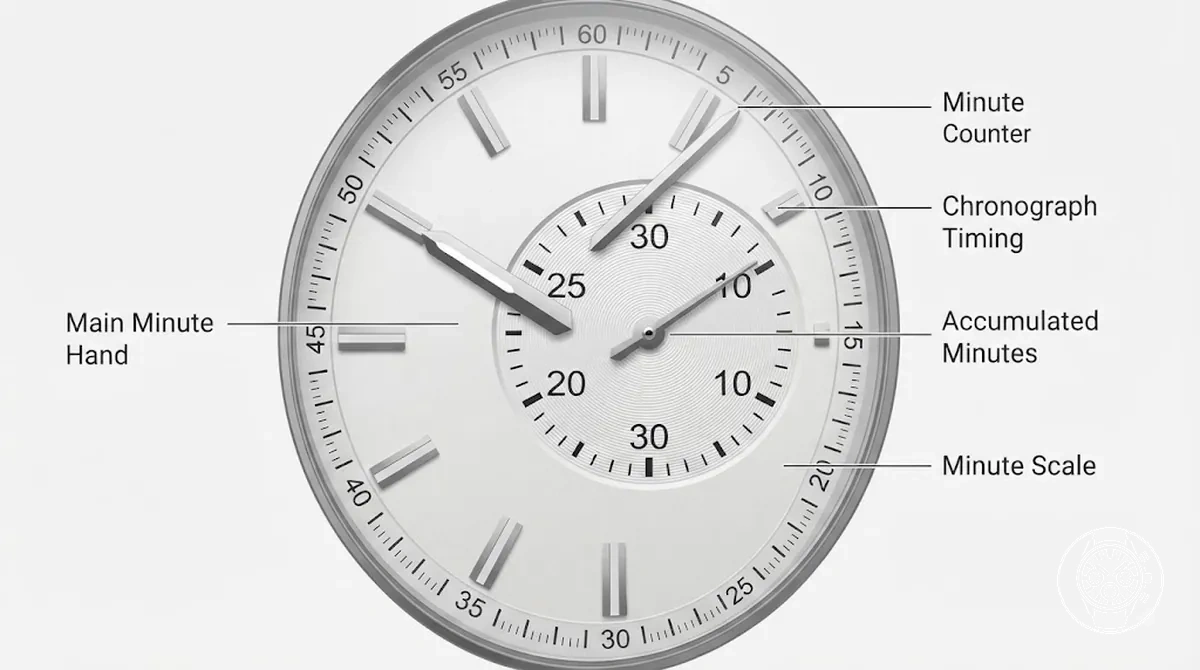
For example, on the Seiko 8T63, a stopwatch minute hand pointing to the 20-minute position represents 20 accumulated minutes within that model’s 60-minute chronograph range. The main minute hand remains the separate display for normal clock minutes, so the elapsed minute counter should be interpreted from its chronograph scale rather than confused with the main minute hand.
Small Seconds Displays
A small seconds display usually shows the watch’s continuous seconds for normal timekeeping, while elapsed chronograph seconds are recorded by a separate chronograph display. Seiko’s official instructions for quartz calibre 8T63 identify the small second hand separately from the stopwatch second hand and specify that the stopwatch second hand measures in 1/5-second increments, making the distinction between running seconds and elapsed chronograph seconds explicit.
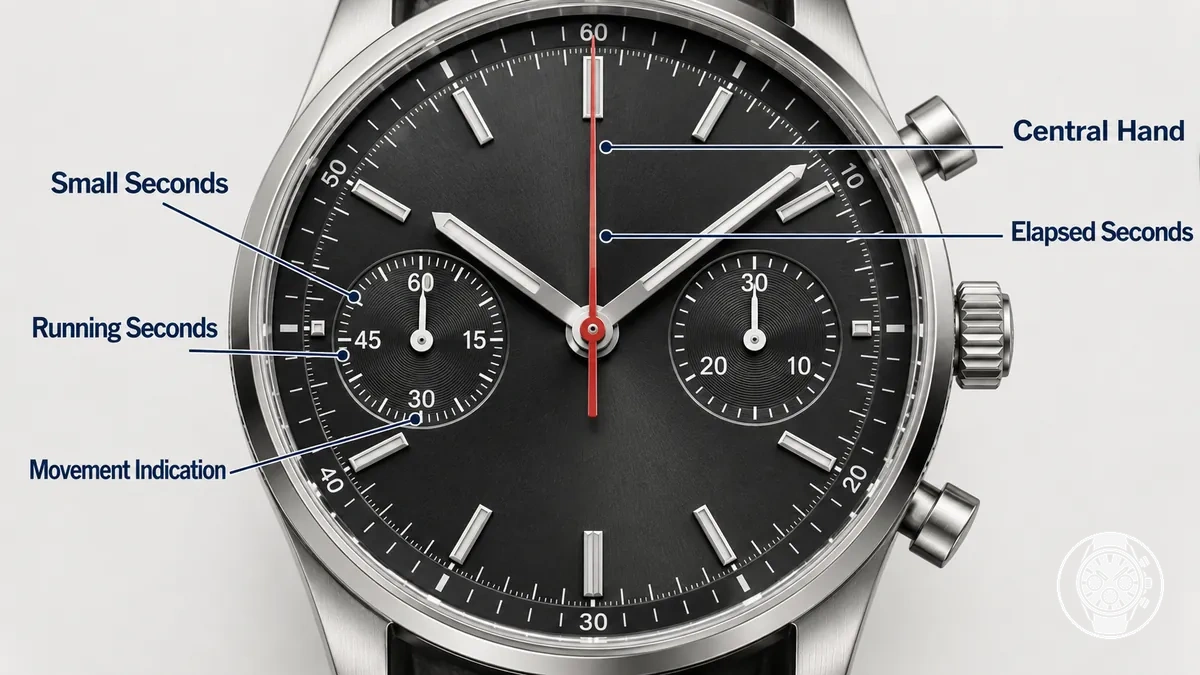
- Running seconds: On Seiko calibre 8T63, the small seconds display advances in one-second steps during normal timekeeping, so it provides an active movement indication rather than an elapsed-time reading.
- Elapsed chronograph seconds: On the same calibre, the central chronograph hand measures stopwatch timing in 1/5-second increments and completes one revolution in 60 seconds, so its displayed outcome is elapsed chronograph time rather than the watch’s running seconds.
Qualified diagnosis: Movement of the small seconds display alone is not definitive evidence of normal battery or movement condition. Seiko specifies that calibre 8T63 changes the small second hand from one-second steps to two-second intervals when the battery approaches its end, so the observed movement pattern must be interpreted according to the specific calibre rather than treated as a universal diagnosis.
24-Hour Subdials
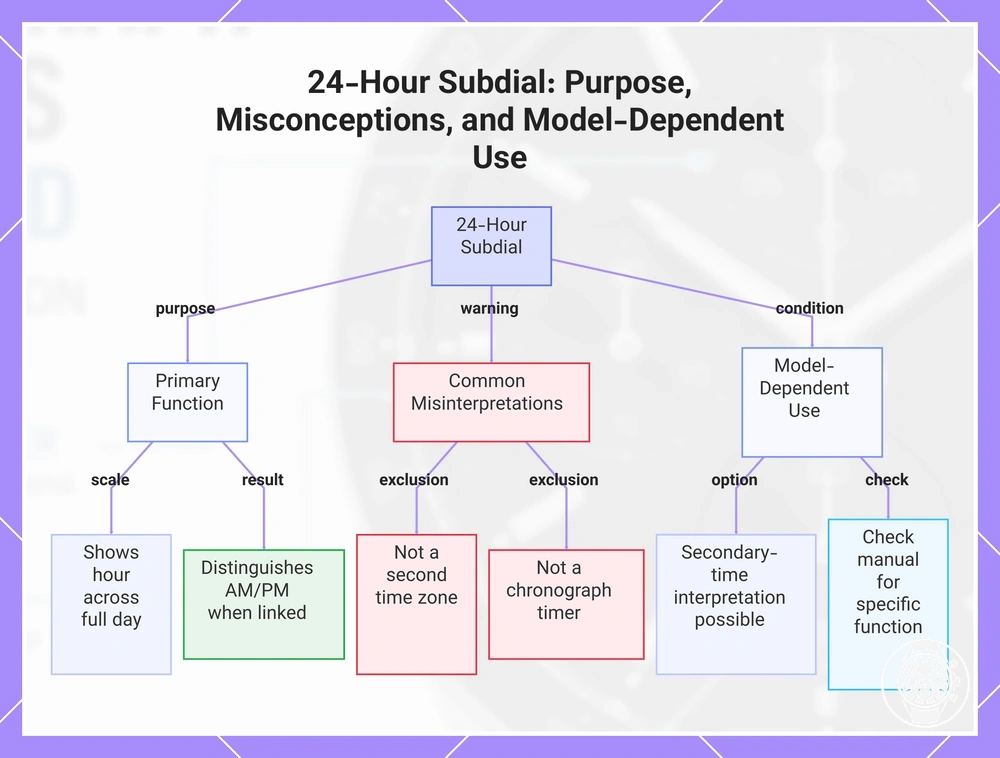
A 24-hour subdial uses a 24-hour scale to show an hour position across a full day and, when linked to the watch's current time, distinguishes AM PM; any secondary-time interpretation is model-dependent. Citizen's B620 instruction manual identifies its 24-hour hand separately from the chronograph minute and chronograph second hands, so that model's 24-hour display is not an elapsed-time counter. Citizen's F50, F51 and F52 instructions likewise direct the wearer to use the 24-hour hand to check whether the current time is AM or PM. A separately adjustable 24-hour register may instead support a secondary-time interpretation on a watch designed for that function, but a 24-hour subdial should not be assumed to be a second time zone or part of the chronograph timer from its scale alone.
Citizen's F50, F51 and F52 instructions likewise direct the wearer to use the 24-hour hand to check whether the current time is AM or PM.
This chart explains the primary function of a 24-hour subdial, clarifies common misinterpretations, and notes that secondary-time use depends on the watch model.
Three-Subdial Layouts and Position Patterns
A three-subdial layout can use different position patterns and assigned functions from one movement configuration to another. The top subdial, left subdial, right subdial, or bottom subdial is therefore a position attribute rather than sufficient evidence of function; the visible label and scale are stronger clues because they identify the value the register is designed to display.
The final interpretation remains model-specific because dial position by itself does not identify what the subdial measures.
For example, two similar-looking three-dial layouts can place three registers around the same main dial while giving corresponding positions different functions. On the first watch, a register with a 0–60 minute scale could be assigned to elapsed chronograph minutes; on the second, a similarly positioned register with a 0–60 seconds scale could show running seconds instead. These values are illustrative rather than manufacturer specifications, but they demonstrate the safe reading sequence: position → label or scale → assigned function. The final interpretation remains model-specific because dial position by itself does not identify what the subdial measures.
| Subdial position | What to check first | Why position alone is not enough |
|---|---|---|
| Top subdial | Label, scale range, and hand behaviour | The assigned function must be identified from the register's visible clues and the specific movement configuration. |
| Left subdial | Label, numbered scale, and hand behaviour | A left dial position identifies location, not the time value or chronograph function being displayed. |
| Right subdial | Label, scale divisions, and hand behaviour | A right dial position can correspond to a different assigned function when the movement configuration changes. |
| Bottom subdial | Label, scale range, and hand behaviour | A bottom dial position requires the same label-led and scale-led interpretation before assigning its function. |
The position pattern becomes easier to interpret after identifying the surrounding hands and registers within the broader chronograph parts and functions context.
How Subdial Labels and Scales Change the Meaning
Subdial labels, scale ranges, numerals, and tick marks usually identify a chronograph subdial's measured attribute more reliably than its position. A 24-hour scale can indicate current time across a 24-hour cycle, a minute scale can indicate elapsed minutes, and a seconds scale can indicate running or elapsed seconds according to the watch configuration. Citizen's official B620 documentation supports this visible-evidence distinction by identifying separate 24-hour, chronograph-minute, normal-seconds, and chronograph-seconds displays.
Subdial labels, scale ranges, numerals, and tick marks usually identify a chronograph subdial's measured attribute more reliably than its position.
For example, a reader who sees numerals extending to 24 can test a 24-hour interpretation, while markings extending to 60 require another clue before the displayed value is assigned to minutes or seconds. Citizen specifies that the B620 chronograph measures up to 60 minutes in 0.2-second increments and uses a separate 24-hour hand, while Seiko's official calibre 8T63 instructions distinguish its small second hand from a stopwatch second hand that measures in 1/5-second increments and a stopwatch minute hand within a 60-minute timing capacity. These manufacturer examples show why the reading decision should follow visible label or scale → measured attribute → displayed value → movement-specific confirmation.
| Visible label or scale | Measured attribute | Likely value shown | Reading caution |
|---|---|---|---|
| 24-hour scale with numerals spanning a full-day cycle | Current time on a 24-hour basis | Hour position within a 24-hour cycle; Citizen identifies the B620 24-hour hand as its 24-hour time display. | The 24-hour scale supports an AM PM interpretation on that configuration, but the scale alone does not establish a separately adjustable second time zone. |
| Minute scale associated with chronograph timing | Elapsed minutes | Accumulated chronograph minutes; Citizen specifies a maximum elapsed-time display of 59 minutes 59.8 seconds for the B620. | Confirm that the register is the chronograph minute counter rather than interpreting a 60-based scale from its position alone. |
| Seconds scale with 60 divisions or seconds-style tick marks | Running seconds or elapsed chronograph seconds | Seconds within a 60-second cycle; Seiko calibre 8T63 distinguishes a small second hand from a stopwatch second hand measuring in 1/5-second increments. | A 60-based seconds scale does not by itself distinguish normal running seconds from elapsed seconds; use the printed label, hand behaviour, and movement documentation to confirm the function. |
How Subdials Work with the Main Chronograph Hand
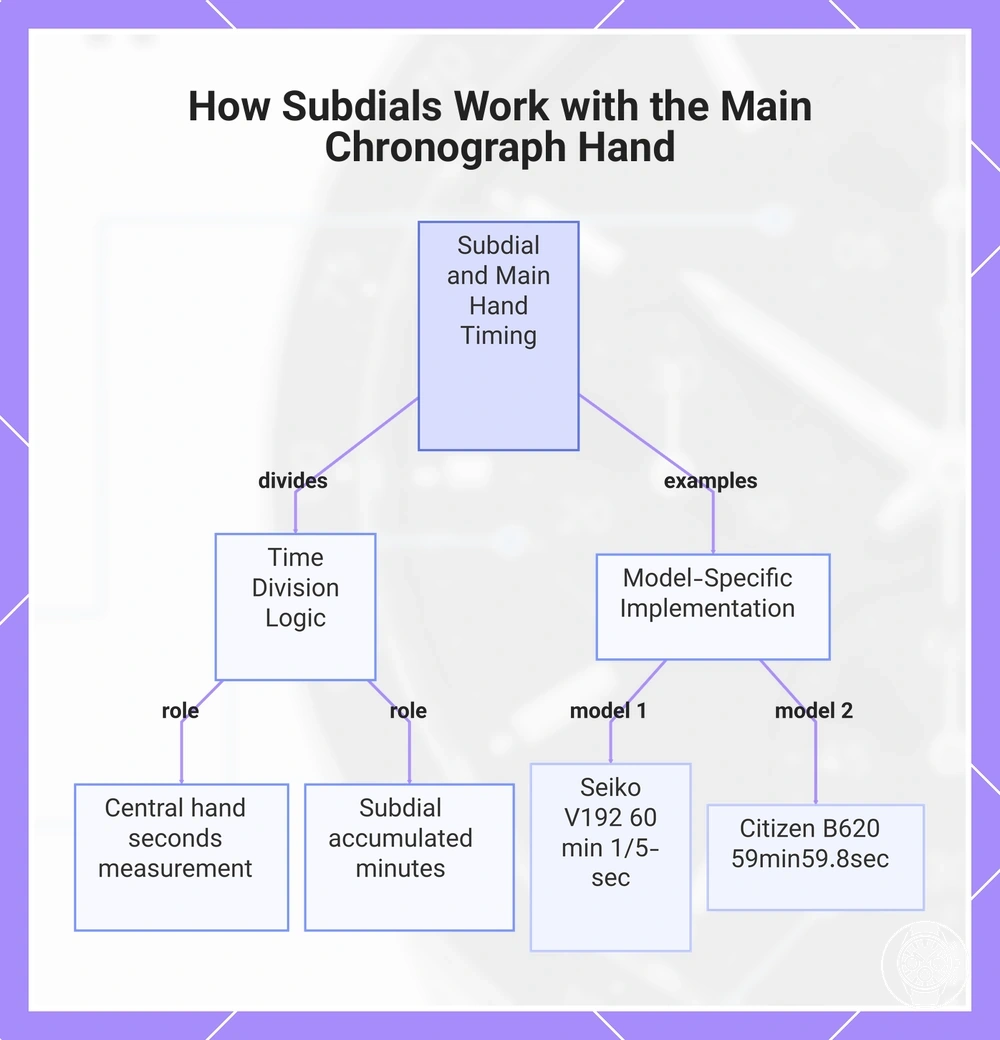
The main chronograph hand and a subdial counter divide elapsed-time information across the dial: the central chronograph hand can provide the seconds measurement while a subdial counter provides an accumulated measure such as elapsed minutes. Seiko specifies this timing role for calibre V192: its central chronograph hand measures 1/5-second increments and its stopwatch minute hand advances in one-minute increments, so elapsed time is split across displays.
Seiko specifies this timing role for calibre V192: its central chronograph hand measures 1/5-second increments and its stopwatch minute hand advances in one-minute increments, so elapsed time is split across displays.
During a timed interval on Seiko V192, the central chronograph hand represents the seconds component while the minute counter accumulates completed minutes, with a measurement capacity of up to 60 minutes in 1/5-second increments. Seiko also specifies Button A for start/stop and Button B for split/reset, illustrating how pusher operation produces a display change in the timing state without changing the distinct meaning of the seconds and minute displays. The exact counter assignment and pusher functions remain model-dependent; for example, Citizen specifies a maximum elapsed-time display of 59 minutes 59.8 seconds for calibre B620 and assigns its upper-right button to start/stop and its lower-right button to reset while the chronograph is stopped.
Timing flow: pusher operation changes the timing state → central chronograph hand displays the seconds measurement → subdial counter records its assigned accumulated measure → the displays combine into the elapsed-time reading.
This relationship between display roles provides the basis for learning how to use chronograph subdials while keeping model-specific operating sequences separate from the reading logic.
This relationship between display roles provides the basis for learning how to use chronograph subdials while keeping model-specific operating sequences separate from the reading logic.
This chart shows how the main chronograph hand and subdial counter divide elapsed-time information, with model-specific examples.
This chart shows how the main chronograph hand and subdial counter divide elapsed-time information, with model-specific examples.
How to Read Chronograph Subdials During Elapsed-Time Timing
To read chronograph subdials during elapsed-time timing, check the timer state, read the central chronograph hand for its assigned seconds value, and combine it with the accumulated value on the active subdial. Seiko specifies for calibre V192 that the central stopwatch hand measures in 1/5-second increments and the stopwatch minute hand advances in one-minute increments, with elapsed timing measurable up to 60 minutes; other movement configurations can assign different functions to their visible counters.
Use this same display-reading logic when learning how to use chronograph subdials , then follow the numbered sequence below.
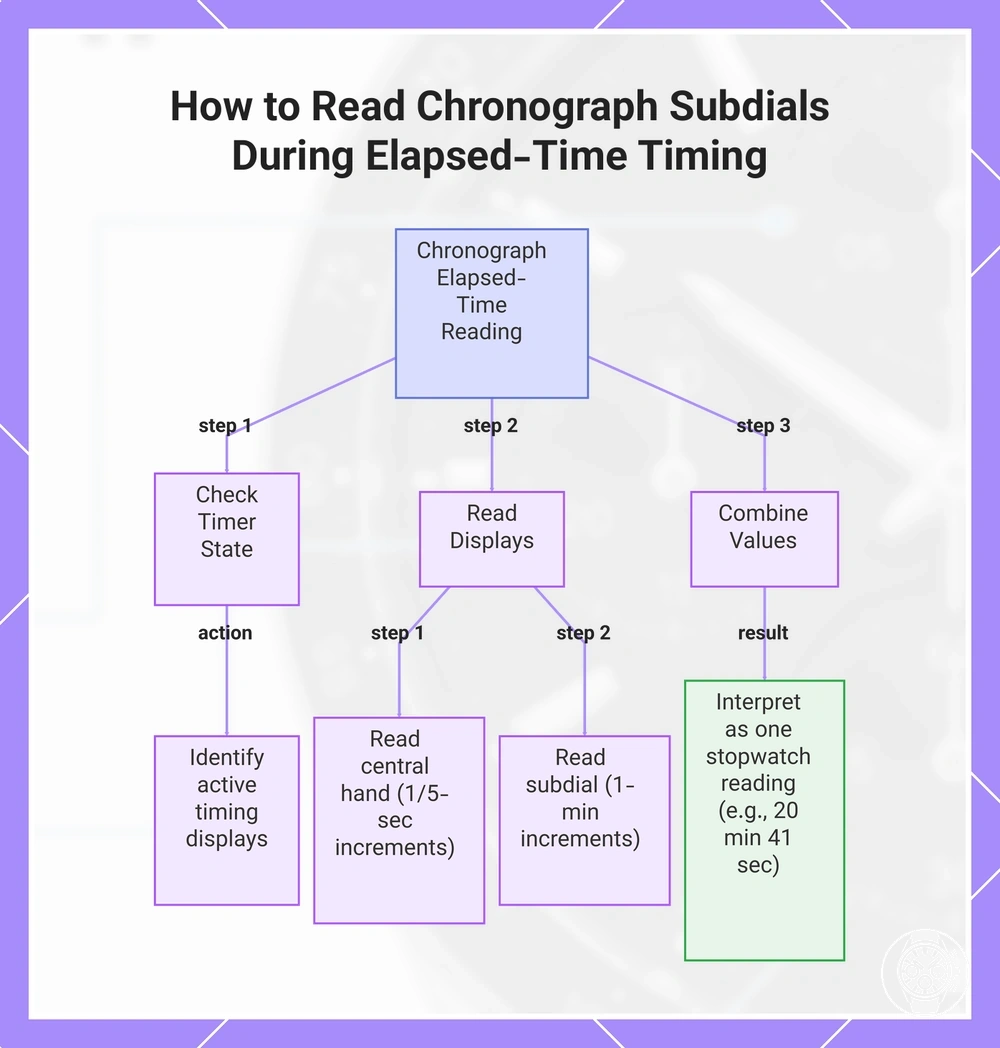
For a timing example, Seiko's V192 instructions illustrate a stopwatch reading of 20 minutes 41 seconds: the minute counter shows 20 accumulated minutes and the central chronograph hand shows 41 seconds, giving a displayed elapsed value and reading outcome of 20 minutes 41 seconds. Use this same display-reading logic when learning how to use chronograph subdials, then follow the numbered sequence below.
- Check the timer state. Identify the chronograph displays participating in the current elapsed-time reading, then separate those active timing displays from normal timekeeping hands.
- Read the central chronograph hand. Check its chronograph scale for the seconds component and combine that value with the active subdial counter; on Seiko V192, Seiko specifies 1/5-second measurement increments for the central stopwatch hand.
- Read the active subdial. Check the counter assigned to accumulated elapsed time and combine its value with the central hand's seconds reading; on Seiko V192, Seiko specifies that the stopwatch minute hand advances in one-minute increments.
- Combine the displayed values. Interpret the accumulated counter and central seconds value as one stopwatch reading; in Seiko's documented V192 timing example, 20 minutes on the minute counter plus 41 seconds on the central hand produces a reading outcome of 20 minutes 41 seconds.
This chart shows the three main steps to read chronograph subdials for elapsed-time timing, including a Seiko V192 example.
Common Confusion Between Running Seconds, 24-Hour Time, and Chronograph Counters
The most common interpretation mistake is treating running seconds, 24-hour time, and chronograph counters as if every moving subdial were a timer counter. Citizen identifies separate normal-seconds, 24-hour, chronograph-minute, and chronograph-seconds displays on calibre B620, so movement behavior and assigned function provide the correct interpretation rather than motion alone.
The comparison below separates an always-running display from a timer counter by stopped or started behavior, value meaning, and reading outcome.
Running seconds show the seconds component of current time, 24-hour time shows the current hour across a 24-hour cycle, and chronograph counters show elapsed values when the timer is started. Citizen specifies that the B620 chronograph measures elapsed time up to 59 minutes 59.8 seconds and stops automatically after 1 hour of continuous operation, while its ordinary time display continues independently. The comparison below separates an always-running display from a timer counter by stopped or started behavior, value meaning, and reading outcome.
| Display type | What it does when timing is stopped | What it means | Common mistake |
|---|---|---|---|
| Running seconds | Continues advancing as part of normal timekeeping; Citizen B620 identifies the normal second hand separately from the chronograph seconds display. | Shows the seconds component of current time. | Assuming continued movement means the chronograph is still started. |
| 24-hour time | Continues representing current time rather than freezing as an elapsed counter; Citizen B620 identifies a separate 24-hour hand. | Shows the current hour on a 24-hour scale and supports AM/PM interpretation. | Reading the 24-hour display as an elapsed-hours timer counter. |
| Chronograph counters | Preserve the elapsed reading when timing is stopped and change again when timing is started; Citizen B620 documents a maximum displayed elapsed value of 59 minutes 59.8 seconds. | Show elapsed stopwatch values such as chronograph minutes and fractional seconds according to the movement configuration. | Assuming a stationary elapsed counter is an always-running display or evidence of a fault. |
Misaligned hands are a separate display-position issue rather than a change in value meaning; use the dedicated guidance to reset misaligned chronograph hands when that issue applies.