Men’s Quartz Chronograph Watch Meaning
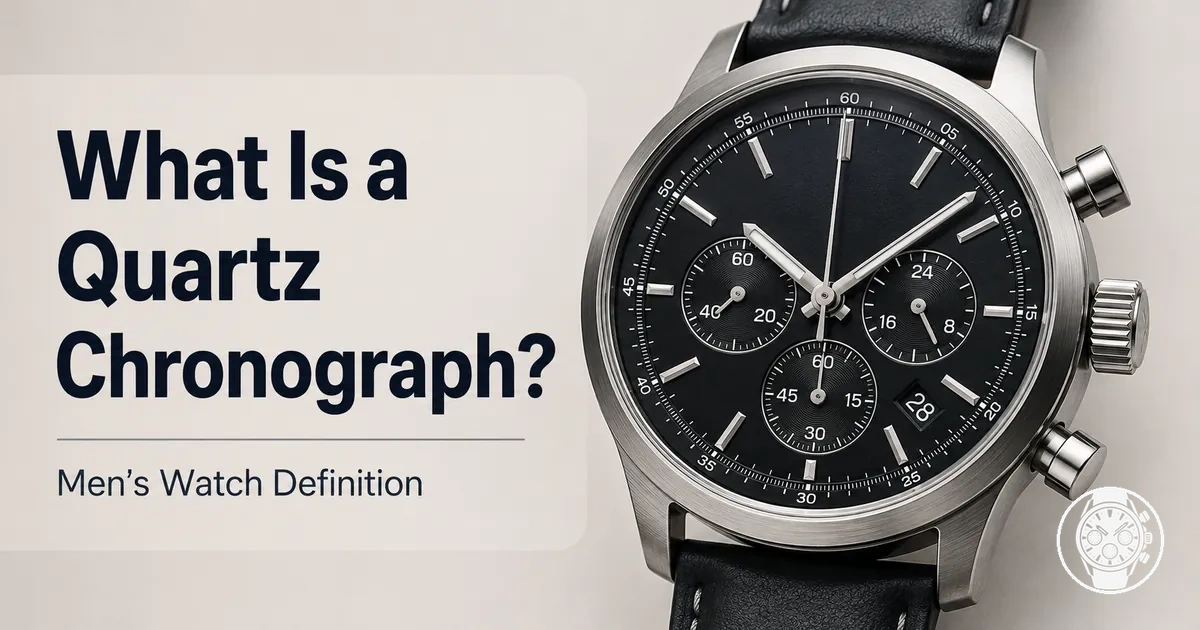
A men’s quartz chronograph watch is a battery-powered analogue watch that combines a quartz movement for regular timekeeping with a chronograph function for measuring elapsed time like a stopwatch. Seiko describes a chronograph as a watch with a stopwatch function, so the core meaning combines a quartz movement type with an additional timing function.
Together, these characteristics define the functional scope of men’s quartz chronograph watches .
The quartz movement uses a battery as its power source and an energised quartz crystal oscillator to regulate timekeeping; Citizen identifies 32,768 Hz as the ordinary quartz oscillator frequency. The chronograph function measures elapsed time separately, with the result displayed by dedicated timing hands or subdials and controlled by pushers according to the watch's configuration. Together, these characteristics define the functional scope of men’s quartz chronograph watches.
For everyday timing, the regular analogue display can continue showing the time while the chronograph records a separate elapsed interval.
For everyday timing, the regular analogue display can continue showing the time while the chronograph records a separate elapsed interval. For example, Seiko specifies that its quartz Calibre 8T63 chronograph measures elapsed time for up to 60 minutes in 1/5-second increments, using a stopwatch minute hand and a 1/5-second hand; this allows a wearer to time an activity without using the normal time display as the measurement.
Likewise, a regular analogue watch without that elapsed-time function is not a chronograph merely because its hands display the time.
A quartz watch is not automatically a chronograph: quartz identifies the movement type, while chronograph identifies the stopwatch function. Likewise, a regular analogue watch without that elapsed-time function is not a chronograph merely because its hands display the time.
Table of Contents
What Makes a Watch a Quartz Chronograph?
A watch is a quartz chronograph when it combines a quartz movement with a chronograph function. The two qualifying elements are battery regulation for quartz timekeeping and stopwatch capability for measuring elapsed time.
A watch is a quartz chronograph when it combines a quartz movement with a chronograph function.
Citizen explains that a quartz watch uses a battery as its power source and a quartz crystal oscillator to regulate timekeeping; its technical guidance identifies 32,768 Hz as the ordinary quartz oscillator frequency. The chronograph function is a separate timing feature: Seiko defines a chronograph as a watch with a stopwatch function for measuring elapsed time. On an analogue dial, chronograph hands or subdials can display that elapsed time and pushers can control the timing function, although the display arrangement varies by model.
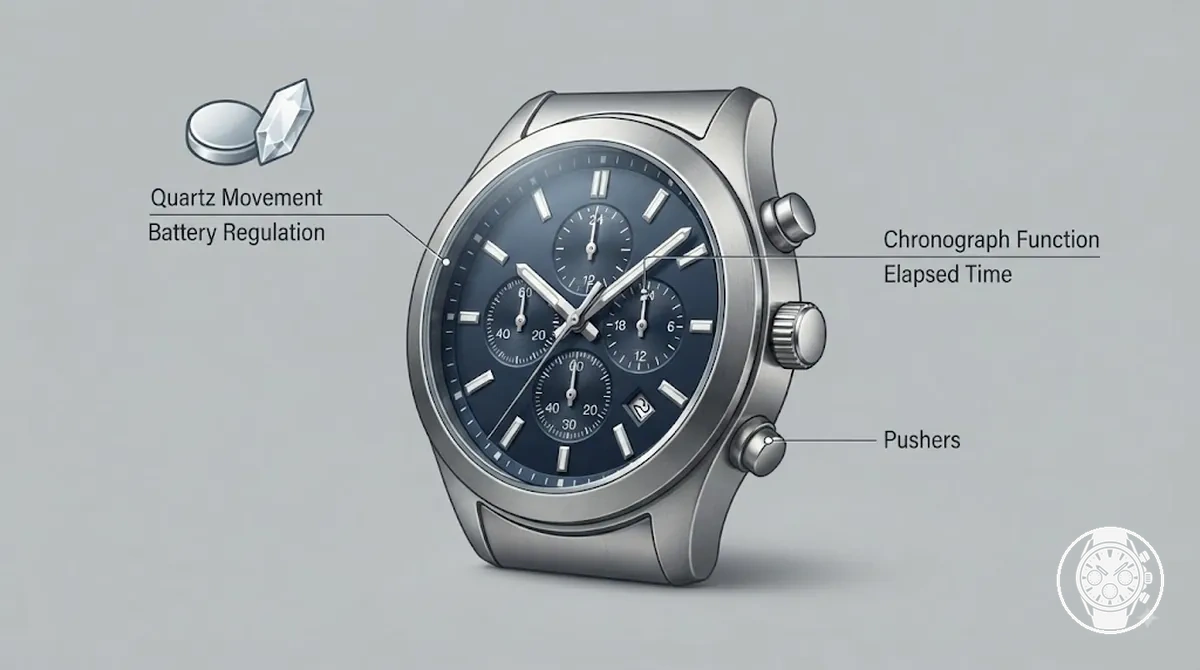
A plain quartz watch is therefore not a quartz chronograph unless it also has stopwatch capability. For example, a quartz chronograph can use the same 32,768 Hz quartz regulation described by Citizen for ordinary quartz timekeeping while adding a separately controlled chronograph function; the added elapsed-time function, rather than quartz regulation alone, is what places the watch in the quartz chronograph category.
How Quartz Movement Powers Chronograph Timing
A quartz movement supports normal timekeeping and chronograph timing by using battery power and electrical regulation to control the hands that display time and measured elapsed time. The high-level power-to-display chain is quartz movement → battery power → electrical regulation → circuit control → motor output → hands or subdial output → timing result.
The battery supplies electrical energy, while the circuit uses the quartz oscillator as its timing reference and controls motor output.
The battery supplies electrical energy, while the circuit uses the quartz oscillator as its timing reference and controls motor output. Citizen identifies 32,768 Hz as the ordinary quartz oscillator frequency, while Seiko specifies that its quartz Calibre Y182 uses a 32,768 Hz crystal oscillator, a C-MOS-LSI integrated circuit and four step motors to drive three normal timekeeping hands plus separate stopwatch minute and 1/5-second hands. In that model, quartz regulation and circuit control are therefore converted by the motors into visible normal timekeeping and chronograph timing output.
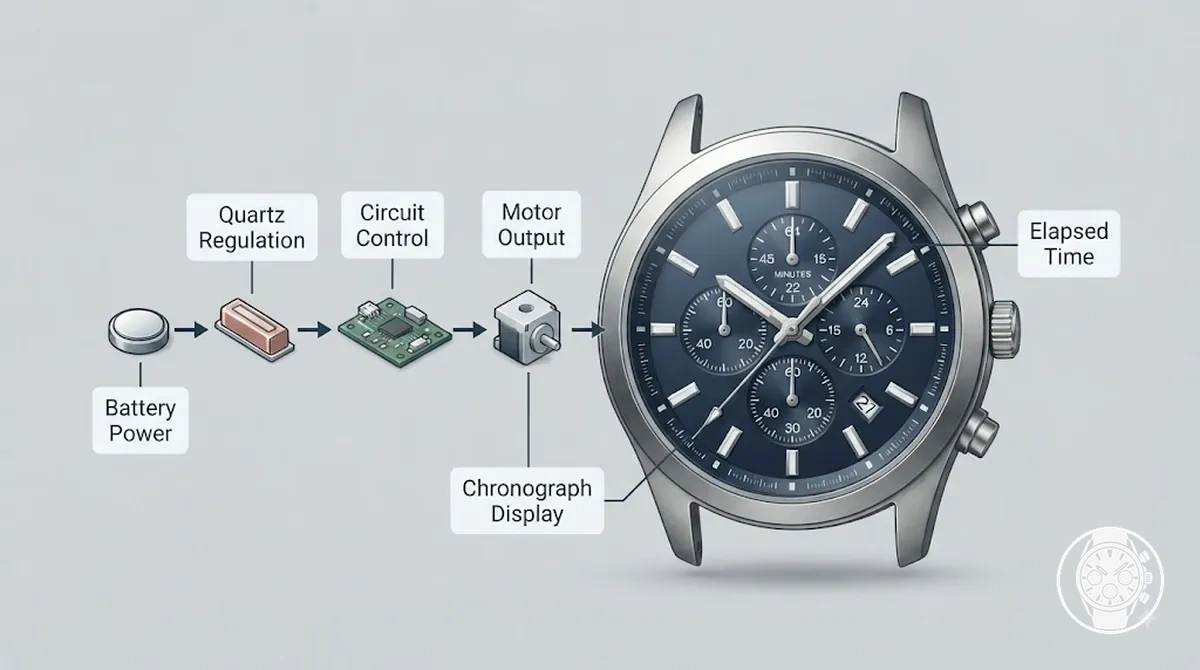
During a timed event, model design determines which hands or subdials show elapsed seconds, minutes or other timing units, so the display arrangement and timing capacity are movement-specific. For example, Seiko specifies that Calibre 8T63 measures up to 60 minutes in 1/5-second increments, whereas its Y182 documentation specifies up to 30 minutes in 1/5-second increments; these separate model-specific specifications illustrate how similar quartz regulation can produce different chronograph displays and timing limits, while related quartz movement and accuracy characteristics also need to be assessed for the particular movement and model.
Battery Power and Quartz Regulation
The battery supplies electrical energy to the quartz movement's circuit, while quartz regulation provides the timing reference used for the timekeeping output. Citizen's technical explanation of quartz watches states that an ordinary quartz oscillator vibrates at 32,768 Hz, giving the circuit a regular reference from which the movement can regulate its time display.
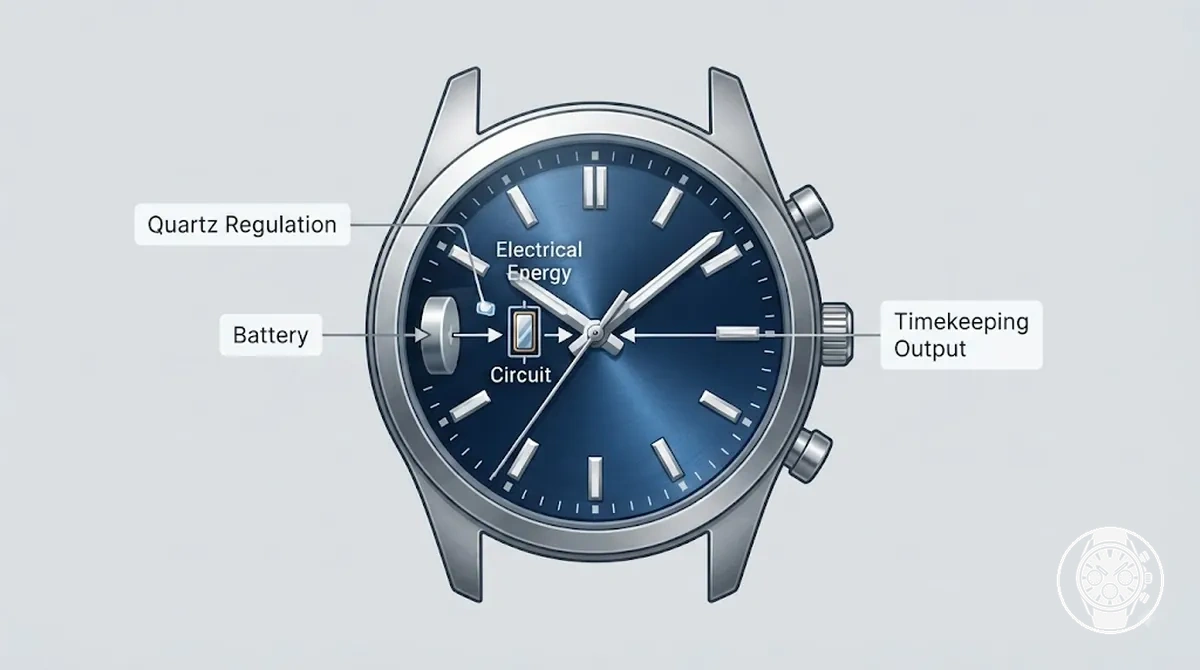
Battery capacity, chronograph power demand and resulting battery duration are movement- and feature-specific rather than one universal value; no single battery-life figure is established here for all quartz chronograph movements. This distinction keeps Battery Power and Quartz Regulation focused on how electrical energy supports regulated timekeeping, rather than implying a common battery duration or maintenance interval across different movements.
Stopwatch Measurement on an Analogue Dial
Stopwatch measurement on an analogue dial is the chronograph timing output that displays elapsed time through a chronograph hand, a subdial, or both, while regular time remains separately readable. The measurement units can include elapsed seconds, fractions of a second, and elapsed minutes; which hand or subdial carries each value is determined by the movement's display layout rather than by one universal analogue layout.
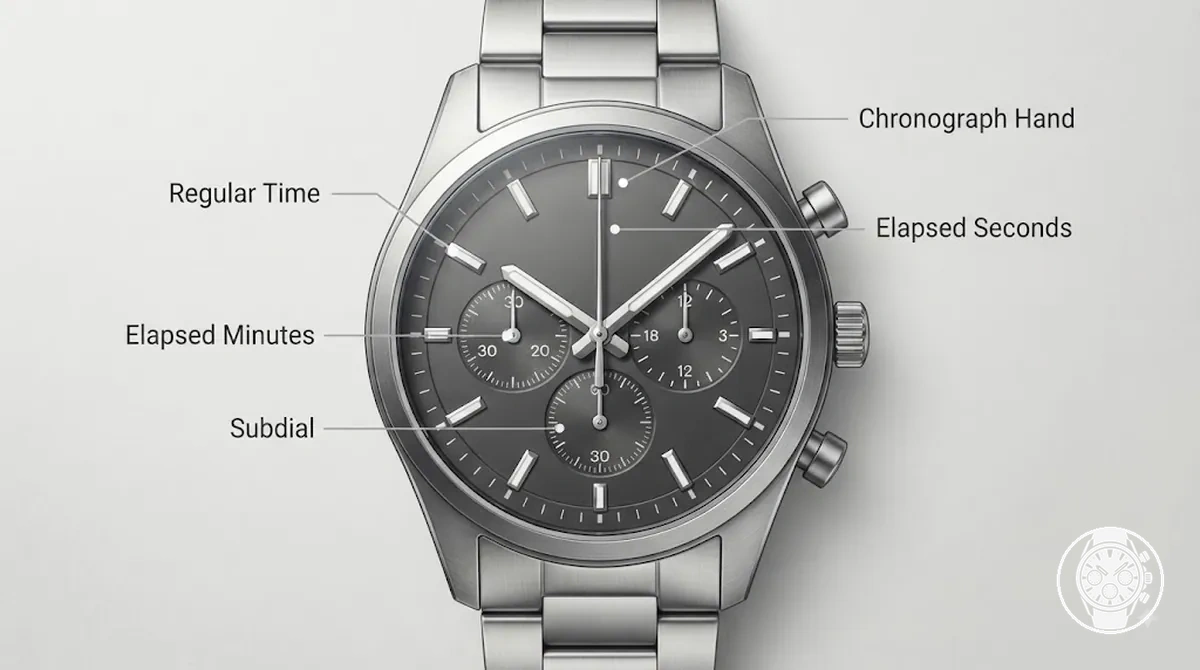
For example, Seiko specifies that quartz Calibre 8T63 measures chronograph time for up to 60 minutes in 1/5-second increments, using a stopwatch 1/5-second hand and stopwatch minute hand, while separate hour, minute and small-second hands display regular time. In this model-specific display layout, the wearer can distinguish elapsed seconds and elapsed minutes from regular time; other chronograph movements can assign those timing values to different hands or subdials.
What the Chronograph Function Is Used For
The chronograph function is used to measure elapsed time separately from normal timekeeping, giving the watch a stopwatch function while the current time remains readable. Seiko describes a chronograph as a watch function that measures elapsed time while indicating the current time; the pushers provide controls for the timing measurement and its readable result.
The chronograph function is used to measure elapsed time separately from normal timekeeping, giving the watch a stopwatch function while the current time remains readable.
In everyday timing situations, the chronograph function helps measure how long a task or short event lasts rather than requiring the wearer to calculate the difference between two clock times. For a sourced numerical example, Seiko's 8R46/8R48 instructions illustrate a 5,000-metre run with an elapsed-time result of 20 minutes 41 seconds, while Citizen specifies that its B620 chronograph displays elapsed time up to 59 minutes 59.8 seconds and continues to show normal time while the chronograph is operating. These examples show both the practical purpose and an important limitation: timing capacity and measurement resolution are model-specific rather than universal chronograph values.
- Cooking: Time a cooking stage so its elapsed duration can be checked independently of the current clock time.
- Exercise: Measure the duration of a workout or interval when elapsed time is the useful result.
- Parking: Track how much of a defined parking period has elapsed while normal timekeeping remains available.
- Short events: Measure a meeting, break, journey segment, or similar everyday activity from its start to its stopping point.
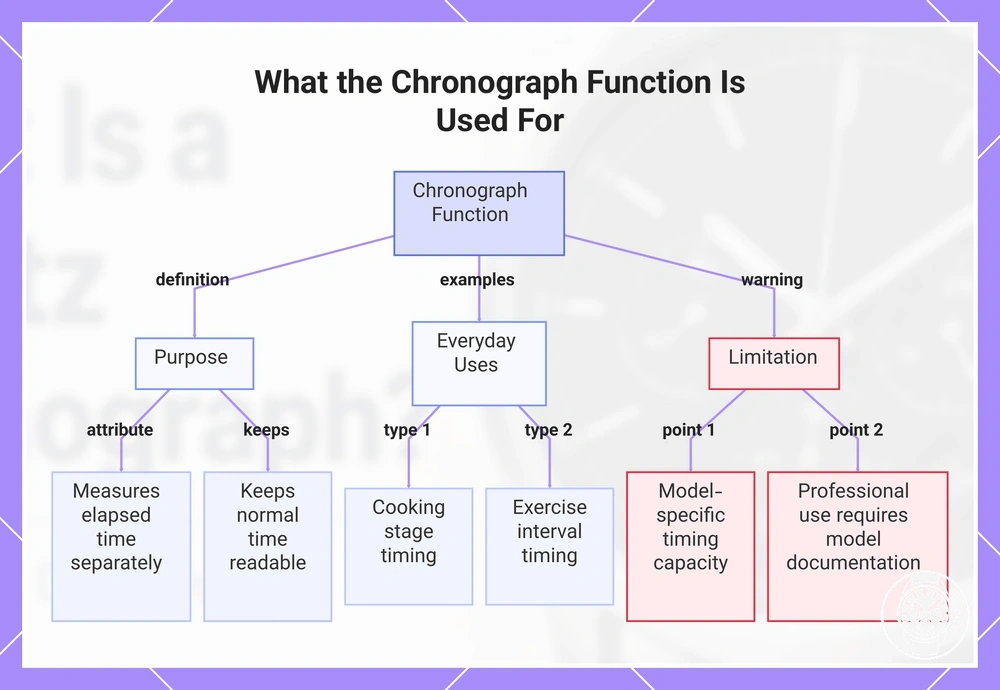
The chronograph function is useful for casual timing, but that does not establish every chronograph as suitable for professional timing. The relevant model documentation should specify the timing capacity, measurement increment and operating limits needed for a more specialised use.
The chronograph function is useful for casual timing, but that does not establish every chronograph as suitable for professional timing.
This chart explains the chronograph function's purpose, common everyday uses, and important limitation regarding model-specific timing capacity.
Subdials, Pushers, and Timing Displays
Visible chronograph features include subdials and chronograph hands that provide timing displays, plus pushers that act as control inputs for the chronograph function. Subdials are small display elements within the main dial, but their displayed value is model-specific: a subdial can indicate elapsed time, regular seconds, or a 24-hour indicator rather than having one fixed function across all chronographs.
Visible chronograph features include subdials and chronograph hands that provide timing displays, plus pushers that act as control inputs for the chronograph function.
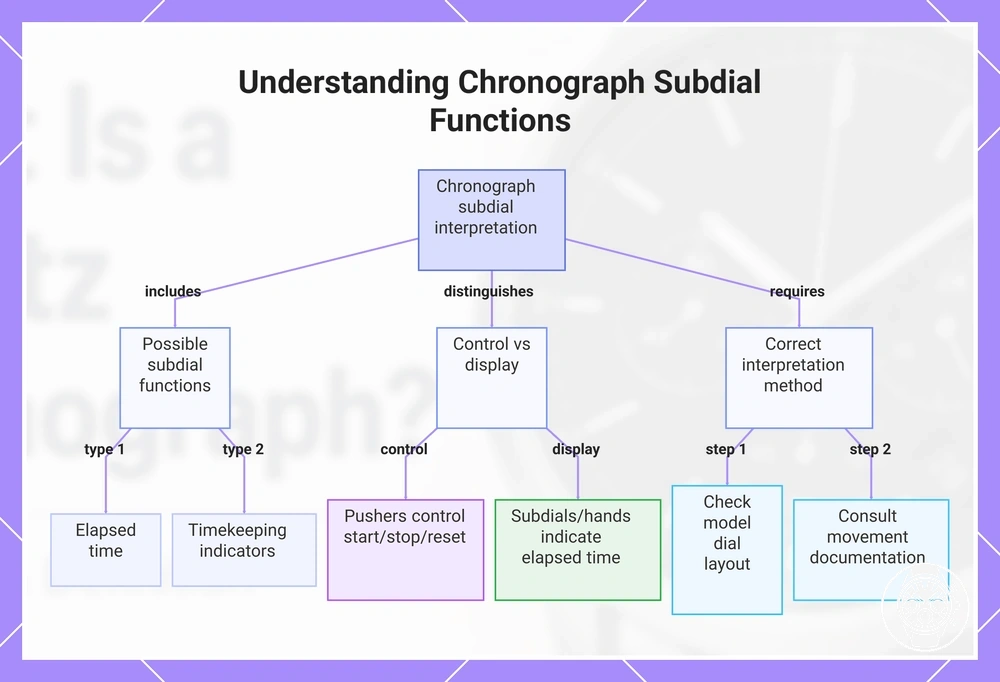
To read a quartz chronograph, distinguish the control action from the displayed result: pushers control actions such as start, stop, and reset, while the relevant chronograph hands and subdials indicate elapsed time. Seiko specifies that its quartz Calibre 8T63 uses a stopwatch 1/5-second hand and stopwatch minute hand to measure up to 60 minutes in 1/5-second increments, while separate hour, minute, and small-second hands indicate regular time. In this model, the user can identify the readable chronograph result by following the dedicated stopwatch hands rather than assuming that every small dial records elapsed time.
A multi-subdial watch does not have one fixed assignment for every small dial; the correct interpretation comes from the model's dial layout and movement documentation.
A multi-subdial watch does not have one fixed assignment for every small dial; the correct interpretation comes from the model's dial layout and movement documentation. Recognising the parts of a chronograph watch helps distinguish control inputs such as pushers from display elements, while checking what the subdials mean clarifies whether a particular subdial displays elapsed time, regular seconds, a 24-hour indicator, or another model-specified value.
This chart explains how to interpret chronograph subdials, distinguishing control inputs from display elements and emphasizing model-specific functions.
This chart explains how to interpret chronograph subdials, distinguishing control inputs from display elements and emphasizing model-specific functions.
Subdials for Seconds and Elapsed Time
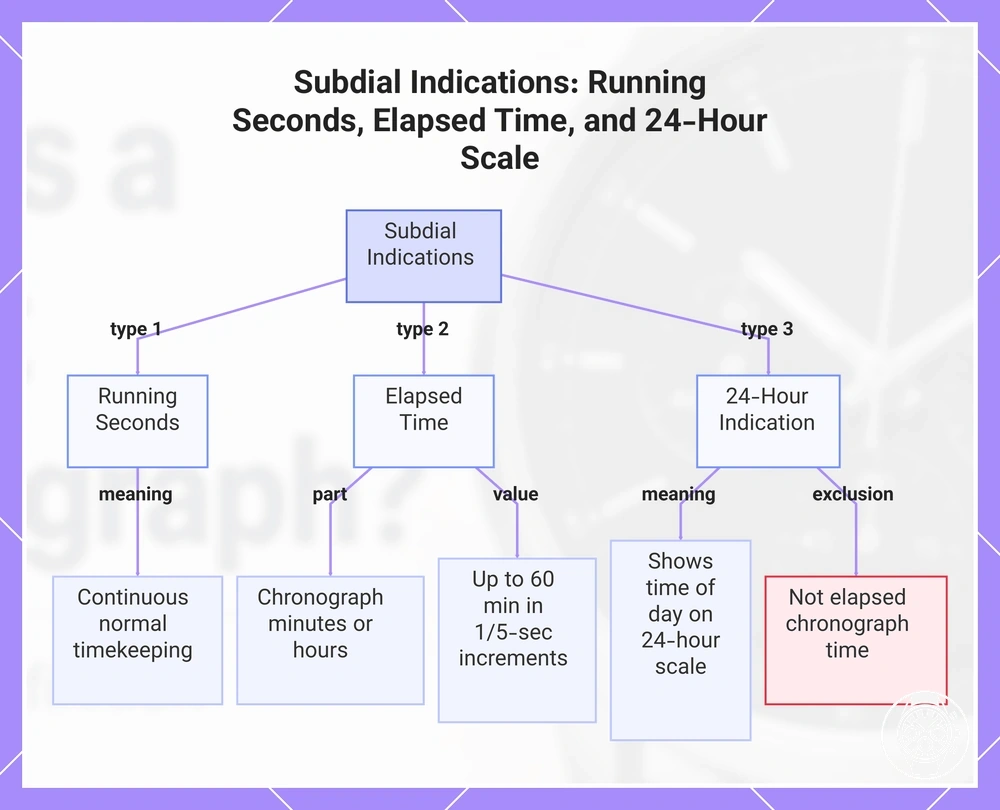
A subdial can show a different assigned measurement depending on the watch layout: possible values include running seconds, elapsed time in chronograph minutes or chronograph hours, and a 24-hour indication. The reading implication is model-dependent, so the subdial's scale and the watch documentation determine which value is being shown.
The reading implication is model-dependent, so the subdial's scale and the watch documentation determine which value is being shown.
For example, Seiko specifies that quartz Calibre 8T63 uses a small-second hand for running seconds and a separate stopwatch minute hand for elapsed time, with the chronograph measuring up to 60 minutes in 1/5-second increments. This model-specific layout illustrates the key contrast: running seconds indicate continuous normal timekeeping, while the stopwatch minute hand indicates accumulated chronograph minutes; a subdial assigned to a 24-hour indication instead shows time of day on a 24-hour scale, not elapsed chronograph time.
This chart shows the three main types of measurements a watch subdial can display and how to interpret them based on model-specific documentation.
This chart shows the three main types of measurements a watch subdial can display and how to interpret them based on model-specific documentation.
Pushers for Start, Stop, and Reset
Pushers control the chronograph function separately from the normal time display: start begins elapsed-time measurement, stop halts that measurement so the elapsed time remains as the visible result, and reset returns the chronograph indication to its starting position. Seiko's instructions for quartz Calibre 8T63 document this start, stop, and reset control logic while the watch's regular timekeeping continues independently.
Seiko's instructions for quartz Calibre 8T63 document this start, stop, and reset control logic while the watch's regular timekeeping continues independently.
For example, Seiko specifies that Calibre 8T63 can measure up to 60 minutes in 1/5-second increments, with its pushers controlling the chronograph response and its stopwatch hands providing the visible result. Exact pusher positions, sequences, and responses can differ by movement design, so this control arrangement should be treated as model-specific rather than universal.
Quartz Watch, Chronograph Watch, and Regular Watch Differences
The difference between a quartz watch, chronograph watch, and regular watch is what each term describes: a quartz watch describes a movement type, a chronograph watch describes a timing function, and a regular watch describes a basic time display without a stopwatch feature. The categories are not mutually exclusive because movement, function, and display format are separate attributes of a watch.
A quartz watch uses a quartz-regulated movement for timekeeping and does not automatically include chronograph timing.
A quartz watch uses a quartz-regulated movement for timekeeping and does not automatically include chronograph timing. A chronograph watch has a stopwatch feature for measuring elapsed time; Seiko defines a chronograph by this stopwatch function rather than by one particular movement type. In this comparison, regular watch is the simplified display category: it indicates ordinary time without a chronograph timing function.
| Term | What it describes | Main signal | What it does not automatically mean |
|---|---|---|---|
| Quartz watch | Movement type | Quartz-regulated timekeeping | It does not automatically mean the watch has a stopwatch feature. |
| Chronograph watch | Timing function | Stopwatch feature for measuring elapsed time | It does not automatically identify the movement type. |
| Regular watch | Basic time-display format in this comparison | Ordinary time display without chronograph timing | It does not identify a specific movement type. |
The misconception is that quartz watch and chronograph watch identify competing categories; the correct distinction is that one watch can belong to both because quartz describes its movement while chronograph describes its timing function. For a numerical example, Citizen specifies its quartz Calibre 052 with a chronograph that measures up to 59 minutes 59 seconds in 1-second units, demonstrating that a quartz movement and chronograph function can coexist in one watch. This movement-versus-function boundary also explains the distinction when a chronograph compared with regular watches is considered.
What a Men’s Quartz Chronograph Does Not Mean
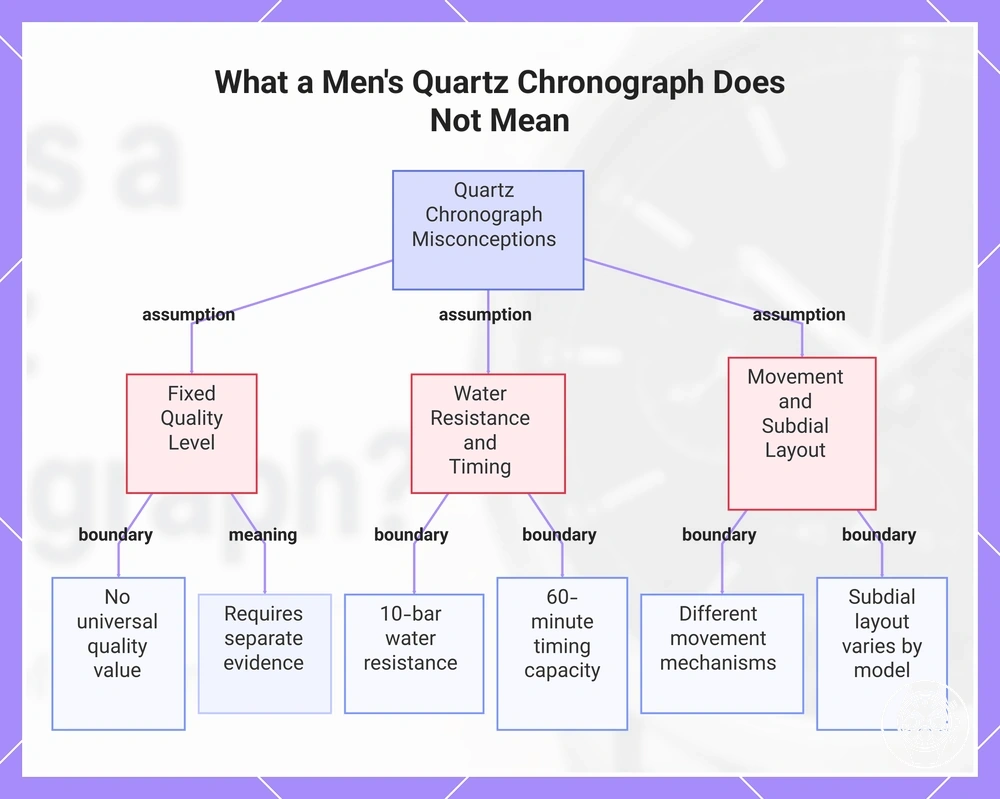
A men’s quartz chronograph does not mean a fixed level of quality, water resistance, professional timing capability, or subdial layout, and it does not mean automatic movement. Those attributes have separate model-specific values or classifications, so they should not be inferred from the term alone.
Those attributes have separate model-specific values or classifications, so they should not be inferred from the term alone.
The correct boundary is that quartz identifies the movement mechanism and chronograph identifies the elapsed-time function; neither establishes the other attributes in this section. Seiko’s official specifications illustrate this model variation: the SSB425 uses quartz Calibre 8T63, has 10-bar water resistance, and measures elapsed time for up to 60 minutes in 1/5-second increments, while Seiko classifies Calibre 8R48 as an automatic chronograph movement. These values demonstrate that water resistance, timing capacity, timing resolution, and movement mechanism are separately specified characteristics rather than universal meanings of quartz chronograph.
- Assumption: quartz chronograph means a particular quality level. Correct boundary: quality has no fixed value established by the term itself. Practical meaning: a quality level requires separate evidence about the particular model rather than an inference from quartz chronograph wording.
- Assumption: quartz chronograph means a particular water resistance. Correct boundary: water resistance is a separate model specification; Seiko specifies 10 bar for the SSB425. Practical meaning: the 10-bar value applies to that model and should not be generalised to other quartz chronographs.
- Assumption: quartz chronograph means automatic movement. Correct boundary: quartz movement and automatic movement are different mechanism classifications; Seiko identifies the SSB425’s 8T63 as quartz and separately identifies Calibre 8R48 as automatic. Practical meaning: the presence of a chronograph function does not convert a quartz movement into an automatic movement.
- Assumption: quartz chronograph means professional timing. Correct boundary: timing suitability requires model-specific evidence; Seiko specifies a maximum chronograph measurement of 60 minutes in 1/5-second increments for the SSB425. Practical meaning: those values define that model’s timing capacity and resolution, not a universal professional timing classification.
- Assumption: every quartz chronograph has the same subdial layout. Correct boundary: subdial layout is subject to model variation and is not universal across quartz chronographs. Practical meaning: each hand and subdial should be interpreted from the documentation for the particular movement or watch rather than from dial position alone.
The safe definition boundary is therefore limited: the term quartz chronograph does not mean that quality, water resistance, professional timing suitability, automatic movement, or a particular subdial layout is present. Those attributes require separate model specifications or documentation before a value or classification can be assigned.
Those attributes require separate model specifications or documentation before a value or classification can be assigned.
This chart shows the attributes that should not be inferred from the term 'men's quartz chronograph' and explains that each attribute requires separate model-specific evidence.
Core Takeaway Before Comparing or Choosing One
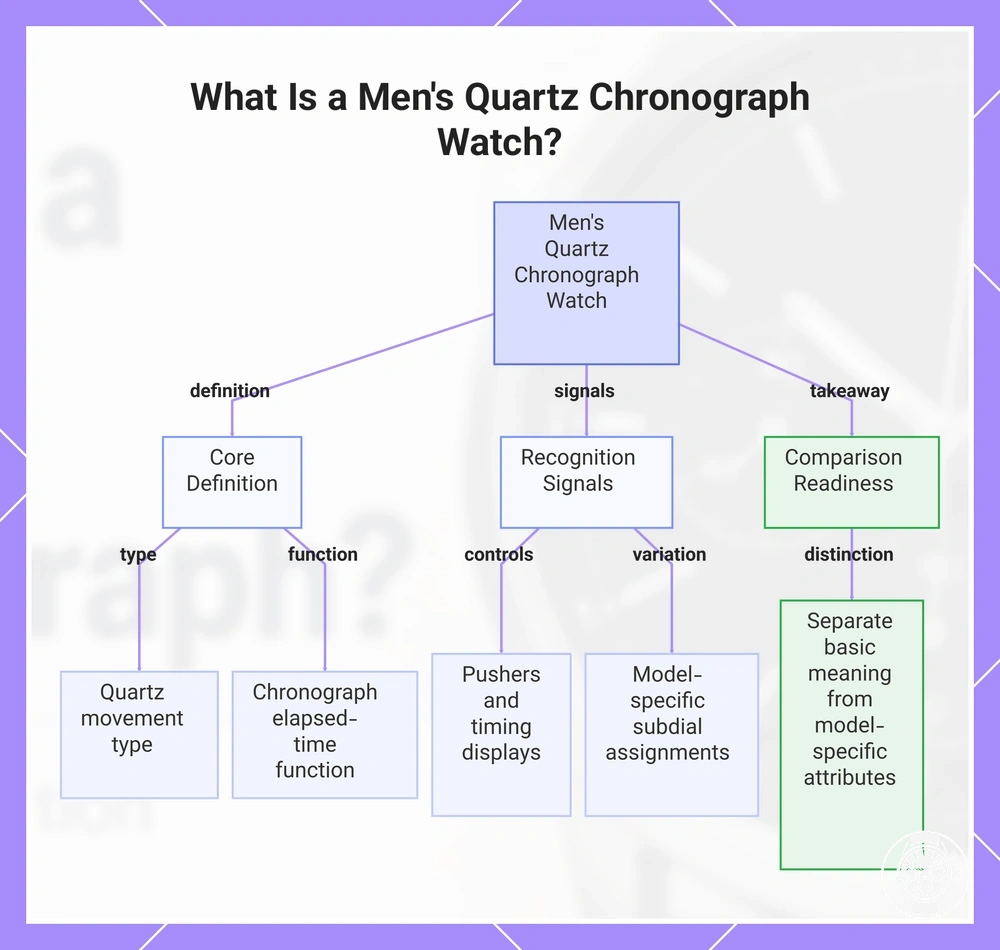
The core takeaway is that a men’s quartz chronograph watch combines a quartz, battery-powered movement type with a chronograph function that measures elapsed time while normal timekeeping remains available. Its recognition signals include visible controls such as pushers and chronograph display elements such as dedicated hands or subdials, while the exact function assigned to each display element is model-specific.
Before comparing or choosing one, use these boundary distinctions to separate the basic meaning of the watch from attributes that require model-level checking.
Before comparing or choosing one, use these boundary distinctions to separate the basic meaning of the watch from attributes that require model-level checking. Purpose, movement expectations, dial readability, and fit can shape the choosing context, but water resistance, timing capacity, and individual subdial assignments are separate specifications rather than values established by the term men’s quartz chronograph watch.
- Meaning: Quartz identifies the movement type, while chronograph identifies the elapsed-time function.
- Function: The chronograph function provides stopwatch-style elapsed-time measurement alongside normal timekeeping.
- Visible controls: Pushers provide chronograph control inputs, while the relevant hands and subdials display timing information.
- Layout variation: Subdial and hand assignments are model-specific, so their functions should be identified from the particular watch or movement documentation.
- Comparison readiness: Once these recognition signals and boundary distinctions are clear, further comparison can focus on purpose, movement expectations, dial readability, and fit without treating them as part of the basic definition.
This chart shows the core meaning, recognition signals, and boundary distinctions of a men's quartz chronograph watch to help you understand it before comparing or choosing one.