
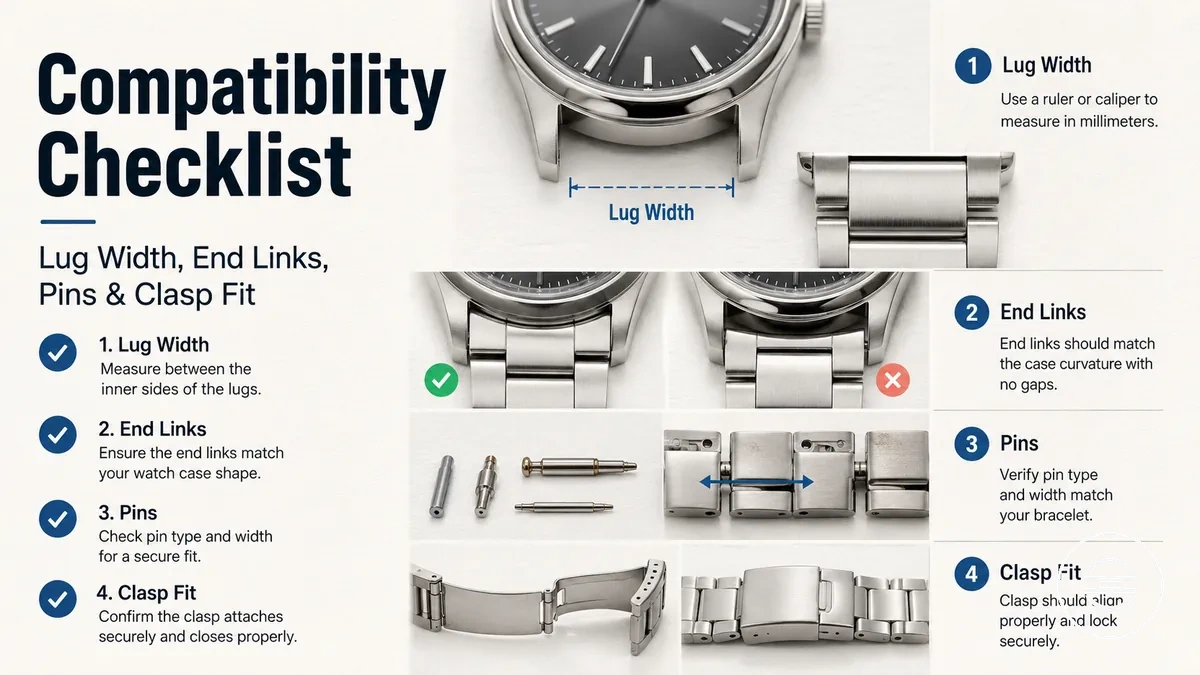
Metal watch band compatibility checklist
Metal watch band compatibility depends on whether a replacement bracelet matches the watch case, attachment hardware, end shape, and wearable fit. A matching appearance alone does not confirm compatibility. Verify these conditions before buying to reduce the risk of an incorrect fit.
Begin by checking the lug width, then confirm that the spring bars or quick release hardware can attach securely to the case lugs. The end links should suit the watch case shape and available clearance, while the bracelet length and clasp position should support a comfortable fit. Seller listings and model claims can help identify suitable options, but your own measurements should be verified before relying on them.
Use the checklist below as a decision aid before comparing replacement options. Compatibility can vary by watch model, even when two watches appear similar, so the first step is always to confirm the key fit conditions.
- Lug width: Verify that the bracelet width matches the distance between the case lugs.
- Spring bars: Confirm that the pin style and attachment method are suitable for the watch case and end links.
- Quick release clearance: Check that the release lever can operate without interference from the case shape.
- End links: Make sure the end-link design aligns with the case lugs and available clearance.
- Wearable fit: Confirm that the bracelet length and clasp adjustment are appropriate for the intended wrist.
- Model verification: Compare the seller listing with your watch details and measurements before buying.
What makes a metal watch band compatible
A compatible metal watch band is one whose lug width, attachment method, band ends, and wearable fit match the watch case and the wearer's needs. Compatibility depends on how these fit conditions work together rather than on appearance alone. Whether a specific replacement band fits a watch remains condition-based.
What makes a metal watch band compatible becomes clearer when the labelled fit points on the watch case and band are viewed together. The lugs, spring bars or quick release pins, band ends, bracelet length, and clasp position must suit the case shape, attachment method, and wrist comfort needs. A visual match, brand wording, or broad compatibility label does not prove fit by itself. For a broader explanation of bracelet styles and terminology, see metal watch bands.
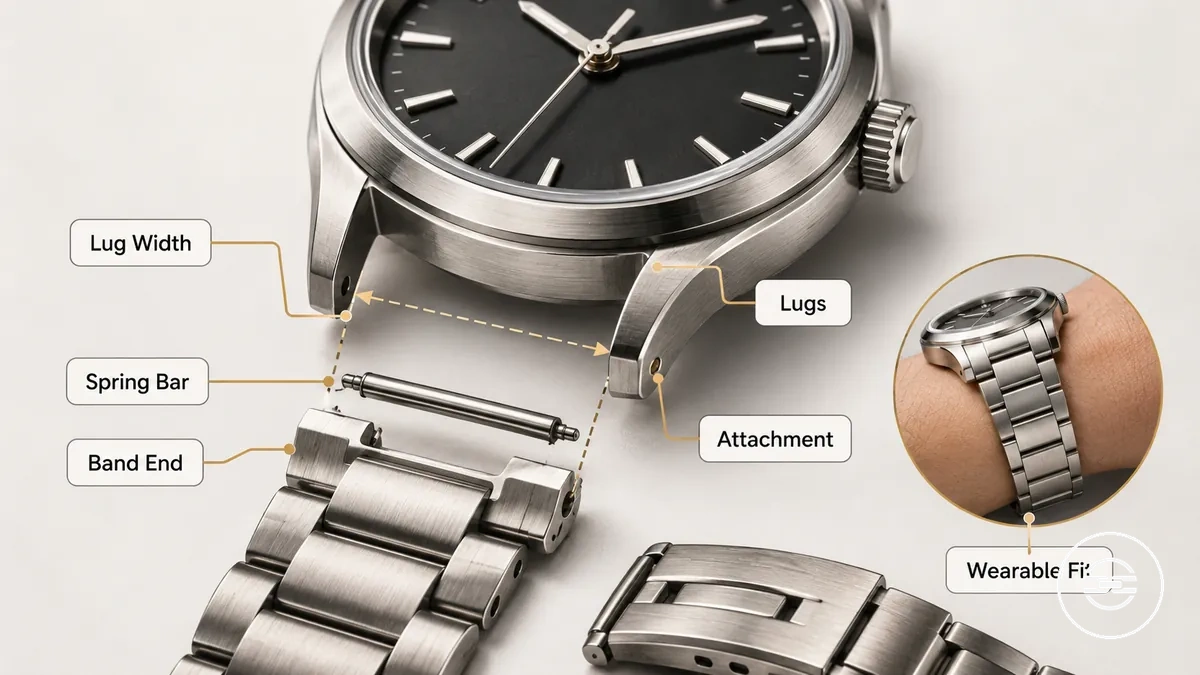
- Lug width: The band width should correspond to the space between the watch lugs.
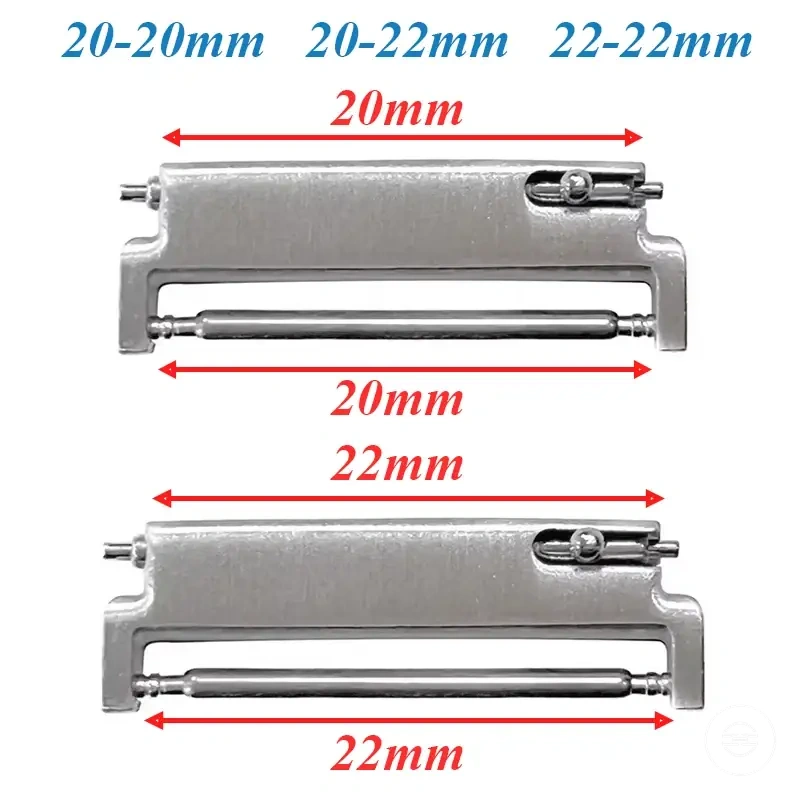
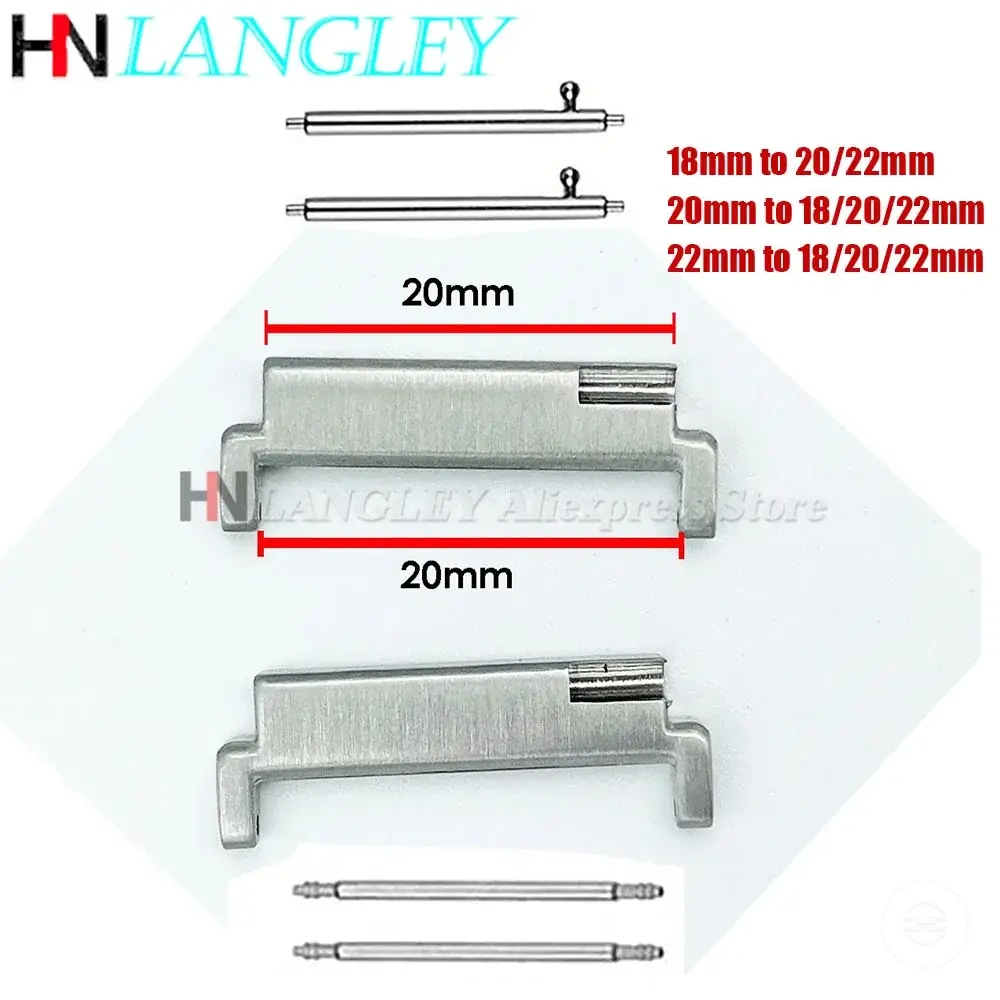
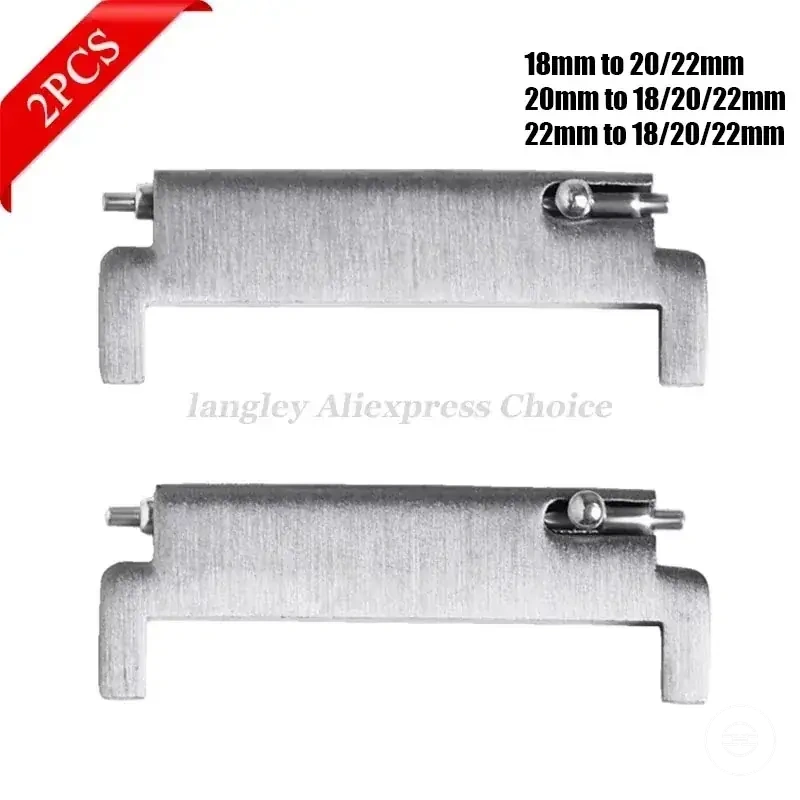
- Attachment method: Spring bars or quick release pins should suit the attachment hardware used by the watch case.
- Band ends: The end shape should provide suitable clearance around the case and lugs.
- Wearable fit: Bracelet length and clasp position should support a comfortable wrist fit.
Watch case measurements that control band fit
Watch case measurements are key compatibility inputs for judging whether a metal watch band may fit a watch. Check the relevant case dimensions before comparing replacement bands, but remember that measurements narrow compatibility risk rather than prove full fit.
Watch case measurements that control band fit organise the dimensions a reader should verify before assessing bracelet compatibility. The table connects each measurement with its likely fit outcome while recognising that end shape, spring bars, and bracelet construction still require separate checks.
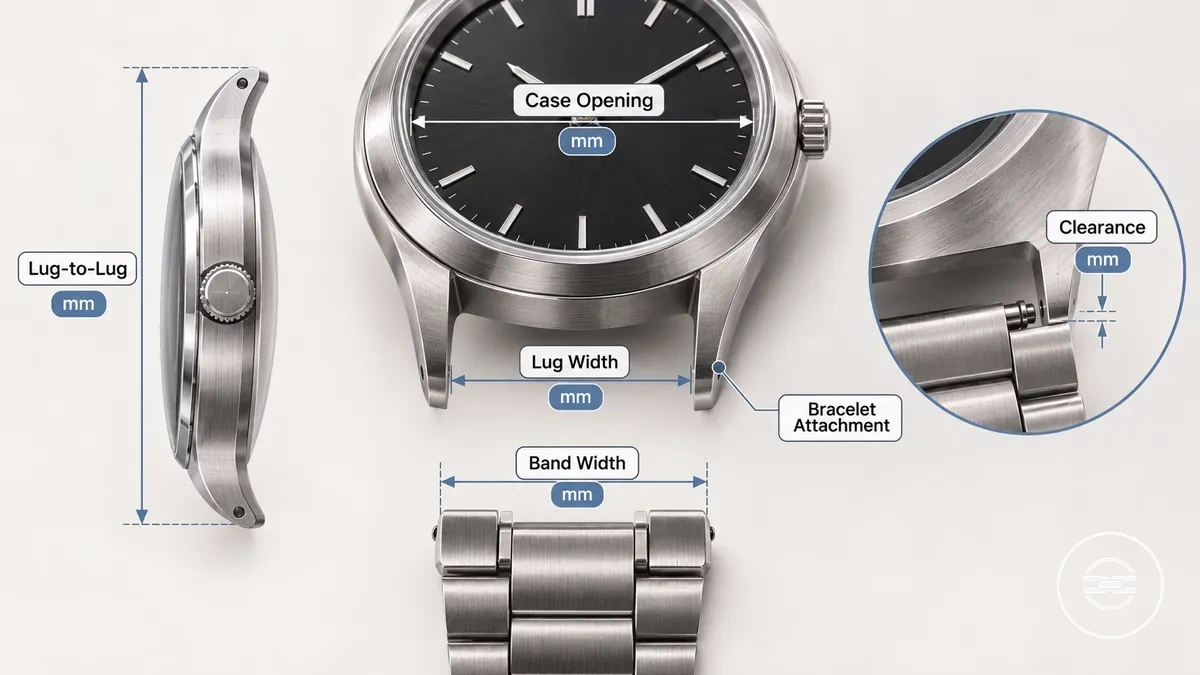
| Measurement | What to check | Compatibility risk | Next condition to verify |
|---|---|---|---|
| Lug width | Compare the space between the lugs in millimetres with the band width. | A mismatch may prevent the band from seating correctly. | Check the spring bars and attachment method. |
| Band width | Confirm that the replacement band corresponds to the measured lug width. | The same nominal width may still fit poorly when the bracelet construction differs. | Verify the band ends. |
| Case opening | Check the available space around the attachment area. | Limited space may reduce clearance for the bracelet end. | Review the case shape and end-link design. |
| Lug-to-lug space | Assess the area available for bracelet articulation near the case profile. | Restricted movement may affect the fit outcome. | Confirm bracelet articulation. |
| Clearance | Check for sufficient space around the bracelet end after attachment. | Insufficient clearance may create rubbing risk or limit movement. | Check the overall watch case profile. |
The table shows how each measurement value supports a compatibility decision rather than acting as a standalone answer. Two bands with the same band width may fit differently when their band ends or bracelet construction require different clearance. Use these criteria with the remaining compatibility checks, and refer to metal watch band sizing for broader sizing guidance.
Lug width and band width match
Lug width and band width should match for the band to fit between the watch lugs correctly. Compare both measurements in millimetres before relying on the size label, and treat the width match as the first local gate rather than the final compatibility decision.
Lug width and band width match is shown in the annotated image by highlighting the matching width points. The illustration identifies the watch lugs, band end, width line, millimetre label, and aligned band edges used for the local width check.
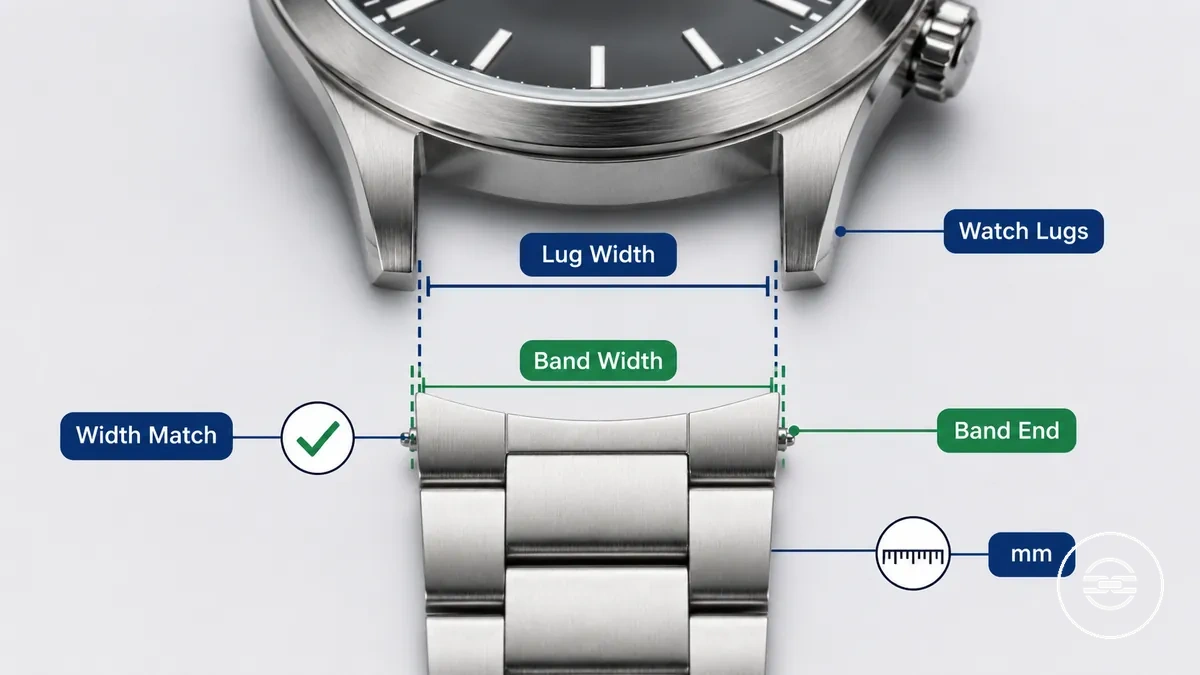
Use the size label as a reference only after confirming the measured lug width. A band width that does not correspond to the watch lugs may result in a loose fit, overhang, or installation failure depending on the direction of the mismatch. Even with the correct width match, later checks such as clearance and spring bars still influence the overall fit outcome.
Lug width and band width match can be verified with this local checklist before moving to later checks.
- Measure the lug width between the watch lugs in millimetres.
- Compare the listed band width with the measured lug width.
- Confirm the size label is consistent with the measured mm width.
- Check for mismatch signs such as loose fit, overhang, or installation failure before continuing.
Case opening and lug clearance
Case opening and lug clearance determine whether the bracelet end can sit between the watch lugs without interference. Physical fit depends on the available space, case curvature, end link thickness, and bracelet articulation rather than the size label alone. This is a physical fit condition that should be checked before judging compatibility.
Case opening and lug clearance may differ even when the lug width matches because watch case shape and bracelet construction vary. If limited case opening combines with greater end link thickness, the bracelet end may rub against the case or experience blocked movement during articulation. Check these physical conditions before deciding whether the replacement band is likely to fit.
Signs that the bracelet end may not clear the lugs include:
- The bracelet end contacts the case instead of sitting freely within the lug gap.
- Limited case opening and greater end link thickness reduce bracelet articulation.
- Rubbing appears where the bracelet end touches the case.
- Blocked movement prevents the bracelet from pivoting freely between the watch lugs.
Straight end and curved end compatibility
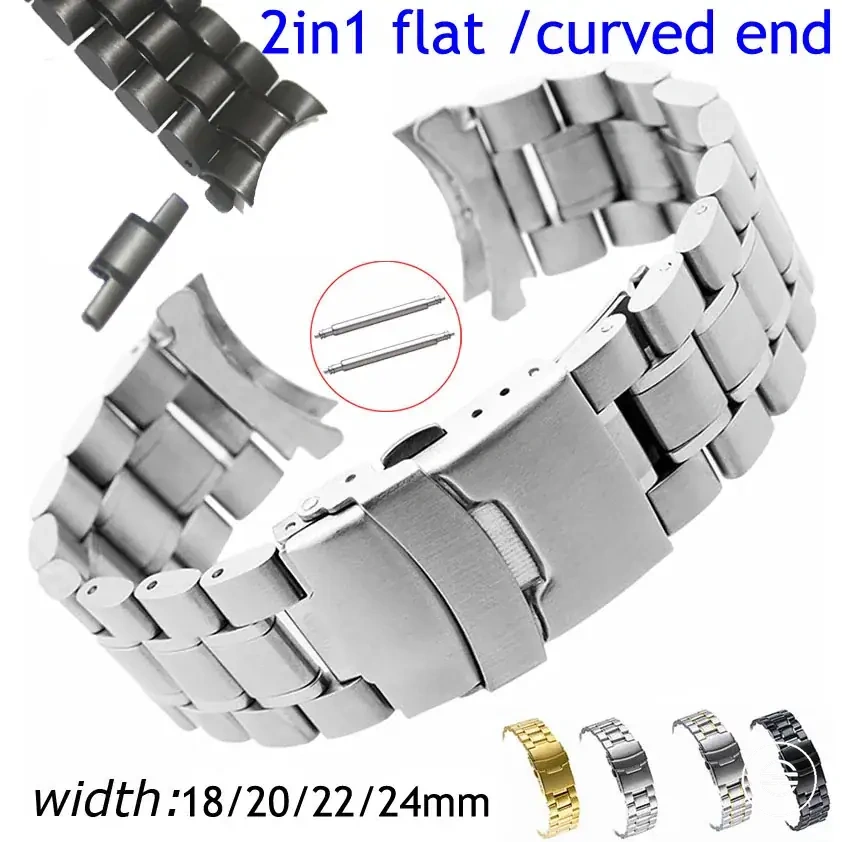
Straight end and curved end compatibility depends on how the end link shape matches the watch case rather than on appearance alone. A straight end may suit a wider range of case profiles, while a curved end may provide closer case contact when model matching is appropriate. The suitable fit path depends on the watch case and remains a compatibility condition.
Straight end bands may leave a visual gap between the bracelet and the case, but that gap does not by itself indicate an incorrect fit. Curved end bands follow the case profile more closely, which can create a cleaner look, yet this fit path often depends more on accurate model matching and sufficient installation tolerance.
Use this comparison to assess straight end and curved end compatibility before making a fit decision.
| Fit path | What to verify |
|---|---|
| Straight end | Confirm that the end link shape clears the case, allow for a possible visual gap, and check that the installation tolerance supports stable case contact. |
| Curved end | Check that the end link shape follows the case profile without interference, verify model matching, and confirm that closer case contact does not increase fit risk through limited clearance. |
Choose between a straight end and a curved end by comparing physical fit conditions rather than appearance alone. If either end shape creates unwanted case contact or relies on uncertain model matching, treat that as a fit risk.
Spring bar and quick release fit conditions
Spring bars and quick release pins determine attachment compatibility after band width and case clearance have been confirmed. The hardware must match the watch case and bracelet so the pin can seat securely, while quick release convenience does not override lug clearance or pin compatibility. Attachment compatibility depends on these hardware conditions being met.
Standard spring bars rely on the correct pin diameter, secure seating in the lug holes, and suitable shoulder access for removal. Quick release pins also require enough underside clearance for the release lever, and drilled or closed lugs may affect how easily the hardware can be accessed during a fit check.
Use the table below to compare hardware conditions before deciding whether a band is compatible with the watch case.
| Hardware type | Required condition | Fit risk | Verification cue |
|---|---|---|---|
| Standard spring bars | Correct pin diameter, aligned lug holes, and secure seating | Loose attachment if the pin does not seat fully | Confirm both pin ends engage the lug holes securely |
| Quick release pins | Adequate underside clearance, shoulder access, and compatible pin fit | Limited lever movement or incomplete seating when clearance is restricted | Check that the release lever moves freely and the pin seats securely |
Choose the hardware type by confirming that its attachment conditions match both the watch case and the bracelet. If pin diameter, lug holes, shoulder access, or underside clearance do not meet the required conditions, treat that as an attachment compatibility risk.
Standard spring bar fit
A standard spring bar seats securely only when its bar diameter matches the lug holes and its bar length spans the distance between the watch lugs correctly. The end link channel must also allow the bar to align with both lug holes. These conditions determine the local compatibility condition for secure seating.
- Bar diameter: It should pass through the end link channel and fit the lug holes without excessive looseness or resistance.
- Bar length: It should reach both lug holes while maintaining enough spring tension to seat correctly.
- End link channel: It should keep the standard spring bar aligned so both ends can engage the lug holes.
- Secure seating: Both spring bar tips should engage the lug holes fully; misalignment, shallow engagement, or side movement indicates a fit risk.
A replacement band may not seat securely if the bar diameter, bar length, or end link channel differs from the watch's dimensions. Complete the fit check by confirming that both spring bar tips remain fully engaged in the lug holes without noticeable movement.
Quick release clearance limits
Quick release pins depend on the correct width and enough lever clearance to function as intended. The quick release lever must move within the spring bar channel without contacting the lug underside or case wall. These conditions define the local compatibility condition.
Use this mini-checklist to assess the fit:
- Lever clearance: The quick release lever should move without obstruction from the lug underside or case wall.
- Pin seating: Quick release pins should seat correctly in the spring bar channel and engage both lug holes.
- Band-end movement: The band end should not block lever movement or prevent correct pin seating.
- Clearance obstruction: Contact between the lever, case wall, or lug underside may create a fit risk even when the width is correct.
A quick release band can be the right size but still fail the fit check if the lever cannot move freely because of limited underside clearance or a nearby obstruction. Confirm both lever clearance and pin seating before treating the compatibility condition as met.
Replacement bracelet checks beyond lug width
A replacement bracelet can still have compatibility issues after the lug width matches. When changing from a strap to a metal bracelet, physical fit, wearable fit, and attachment security require separate checks because the bracelet introduces fitted end links and articulated links around the case. Lug width is the starting point, not the complete compatibility condition.
After confirming lug width, evaluate these compatibility criteria:
- Physical fit: Check whether the end link thickness leaves enough case clearance for the bracelet to sit without unwanted contact.
- Bracelet articulation: Confirm that the first links can move as intended without binding against the case.
- Attachment security: Verify that the end links and pins seat correctly and remain secure during bracelet movement.
- Clasp position and total length: Check whether the bracelet length allows the clasp to sit in a balanced position on the wrist.
- Removable links: Confirm that enough removable links are available to adjust the bracelet without reducing wrist comfort.
End link thickness and attachment security affect whether the replacement bracelet fits the watch correctly; the related metal watch band end links and pins should therefore be checked at this parts boundary. When replacing a strap with a bracelet, confirm case clearance, bracelet articulation, clasp position, total length, and comfort before treating the compatibility condition as met.
End link thickness and case clearance
End link thickness changes how a replacement bracelet fits against the watch case after the lug width has been matched. Case clearance depends on the relationship between the end link, the case wall, and the lug opening, so the movement outcome can vary with case shape and bracelet construction. These conditions determine the local compatibility condition.
End link thickness can affect bracelet movement near the case wall. If the available case clearance is limited, the end link may cause rubbing, overhang, or blocked articulation at the lug opening instead of allowing free movement. For example, a replacement band with the correct lug width may still rub the case wall when end link thickness leaves insufficient clearance. Complete the fit check by confirming that movement remains free without rubbing, overhang, or blocked articulation.
Bracelet length and clasp position
Bracelet length and clasp position affect wearable compatibility even after the replacement bracelet is attached correctly. A bracelet that fits the watch may still feel unbalanced if it does not suit the wearer's wrist size or cannot be adjusted appropriately. After confirming the physical attachment, review these wearable fit criteria.
- Bracelet length: Check whether the overall bracelet length is appropriate for the intended wrist size.
- Removable links: Confirm that enough removable links are available to achieve a suitable fit without relying on excessive adjustment.
- Micro-adjustment and clasp travel: If the clasp provides micro-adjustment, verify that its adjustment range supports everyday comfort.
- Clasp position: The clasp position should remain reasonably centred under the wrist, as an off-centre clasp may reduce comfort even when the bracelet is securely attached.
- Bracelet taper: Consider whether the bracelet taper supports a balanced feel after sizing, particularly if wearable comfort changes despite correct physical attachment.
A replacement band can fit the watch correctly but still feel uncomfortable if the bracelet length or clasp position does not suit the wrist size. Complete the fit check by confirming that wearable comfort remains acceptable after adjustment rather than assuming physical attachment alone is sufficient.
Universal metal watch band fit limits
A universal metal watch band does not fit every watch simply because it carries a universal label. The label usually indicates broad size compatibility within a stated lug width range, while hardware and case shape still require separate checks. Compatibility depends on the band matching the watch at all three levels.
Universal metal watch band fit limits become clearer when the claim is separated into size, hardware, and case-shape criteria:
| Universal may mean | It does not prove |
|---|---|
| The replacement band is offered across more than one lug width range. | The selected width will fit a watch whose lug spacing has not been measured. |
| A straight end design may fit between standard lugs when the width matches. | The end will follow the case curvature or sit flush against every watch case. |
| The band may accept common spring bars or include suitable hardware. | The spring bars will match the watch's lug holes or attachment geometry. |
A universal band may work when its lug width, straight end clearance, spring bars, and relationship to the case curvature are suitable for the watch. The fit limit is that universal usually means broad size matching, not proof of compatibility with every case. Complete the fit check by confirming each condition rather than relying on the universal label alone.
Model compatibility claims to verify before purchase
Model compatibility claims should be verified against your watch before you rely on them for a replacement bracelet purchase. A seller or manufacturer claim is useful only when the supporting details match your watch, so verify before purchase using the key fit measurements and identifiers. The claim is only reliable when the compatibility condition matches your specific watch.
Use the checklist below before deciding that a watch bracelet is suitable. It helps separate a supported model compatibility claim from a broad statement that may not apply to your watch.
- Confirm the exact model number matches your watch.
- Check that the stated case size and lug width match your measurements.
- Verify the listed year range if compatibility depends on production changes.
- Compare the end link shape with your existing bracelet or watch case.
- Check whether included spring bars are supplied and suitable for your watch.
- Review the return conditions and confirm any remaining user fit constraints before ordering.
Evidence carries more weight than a compatibility claim alone. A matching model number supported by the correct case size, lug width, and year range provides a stronger basis for trusting the listing, while missing or inconsistent details are a reason to measure again.
Compatibility conditions can still vary even when a watch appears similar. Differences in end link shape, production revisions, or the included spring bars may affect fit, so compare each attribute with your watch instead of relying on appearance or a broad model description.
If every key detail matches, the model compatibility claim may be reasonable to trust. If one or more identifiers cannot be confirmed, verify before purchase by measuring again or choose a replacement band with a safer fit path and clear return conditions rather than assuming compatibility.
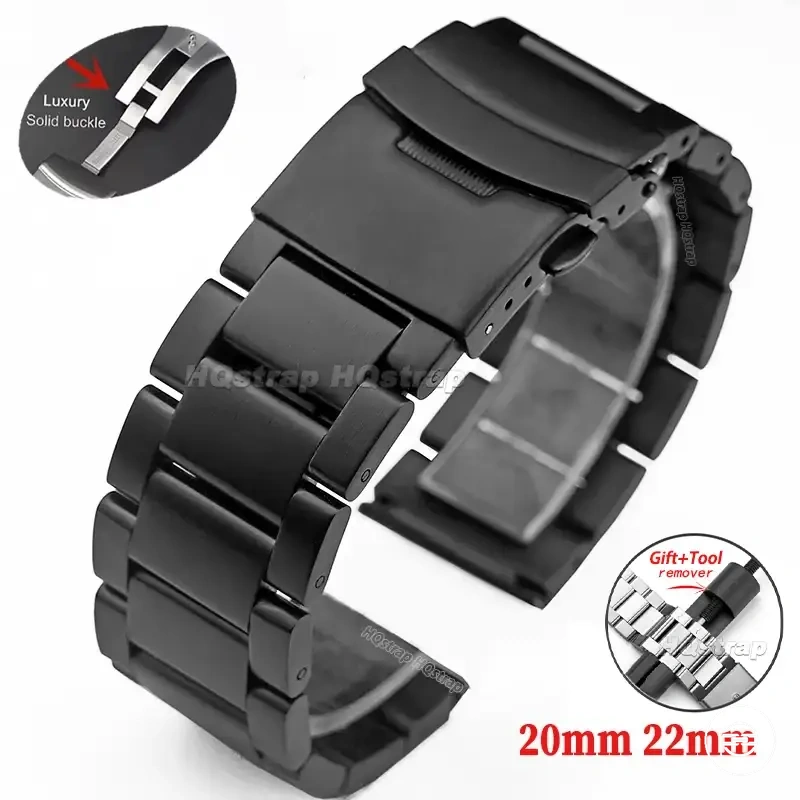
The products below are useful examples for comparing available options. Before buying, check that the compatibility criteria, key features, and product details match your needs.
Final metal watch band compatibility checks
Final compatibility checks confirm whether the replacement band matches the watch in measurement, attachment, end shape, and wearable fit. Each condition should be verified before moving toward purchase. Together, these checks establish the local compatibility condition.
Use this final checklist to confirm the main fit criteria without reopening the earlier explanations:
- Measurement: Confirm that the lug width matches the selected bracelet size.
- Case clearance: Check that the band can move near the case without unwanted contact.
- End shape: Verify that the straight or curved end suits the watch case and lug layout.
- Attachment: Confirm that the spring bar or quick release hardware matches the lug opening and attachment method.
- End link thickness: Check that the end link fits within the available space near the case.
- Bracelet length: Confirm that the available length and removable links suit the intended wrist size.
- Clasp position: Check that the clasp can sit in a comfortable and reasonably centred position after adjustment.
- Model claim: Verify that any model-specific compatibility claim is supported by clear product evidence rather than the model name alone.
A failed measurement or attachment check is a reason to remeasure before proceeding. If the lug width or hardware remains uncertain, treat compatibility as unresolved.
If the end shape, case clearance, or end link thickness prevents suitable movement or alignment, choose a different bracelet configuration rather than relying on the width match alone.
After completing the final compatibility checks, use the metal watch band buying checklist to review broader purchase criteria. When the fit conditions are confirmed, the next step is to choose a metal watch band based on the remaining decision factors.
Proceed only when the measurement, attachment, end shape, bracelet fit, and model claim evidence align. Remeasure an uncertain condition, choose a different bracelet when a fit limit remains, or continue to broader buying criteria when the compatibility checks are complete.
The products below are useful examples for comparing available options. Before buying, check that the compatibility criteria, key features, and product details match your needs.