
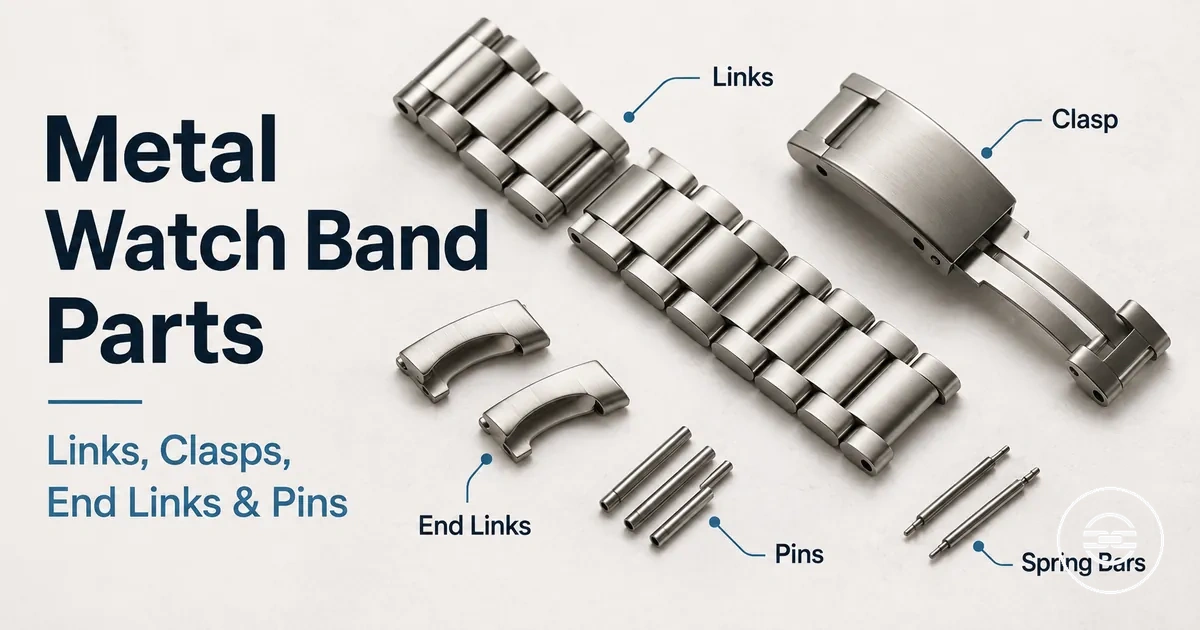
Metal Watch Band Parts and Bracelet Components
Metal watch band parts are the physical bracelet components that shape the bracelet, connect it to the watch, adjust its size, and secure it on the wrist. Links form the bracelet structure, while end links, spring bars, pins, and the clasp support attachment, sizing, and closure as fit-related components.
When a bracelet needs adjustment, a component is worn, or a replacement is being considered, identifying the correct part comes before choosing a compatible replacement. Metal watch bands are assemblies of bracelet components that work together through links, end links, spring bars, pins, and clasp hardware. Replacement fit depends on the watch model, lug design, bracelet construction, part dimensions, and the condition of the existing hardware.
Metal watch band parts are different from repair tools, complete watch bands, and watch cases. Identifying each component clearly helps distinguish physical bracelet parts before moving into detailed part descriptions or replacement considerations.
What Counts as a Metal Watch Band Part
A metal watch band part is a component used to build, attach, close, size, or service a metal bracelet. What Counts as a Metal Watch Band Part depends on the role the component performs within the bracelet. A metal watch band part is separate from a repair tool, a watch case, and a complete replacement band.
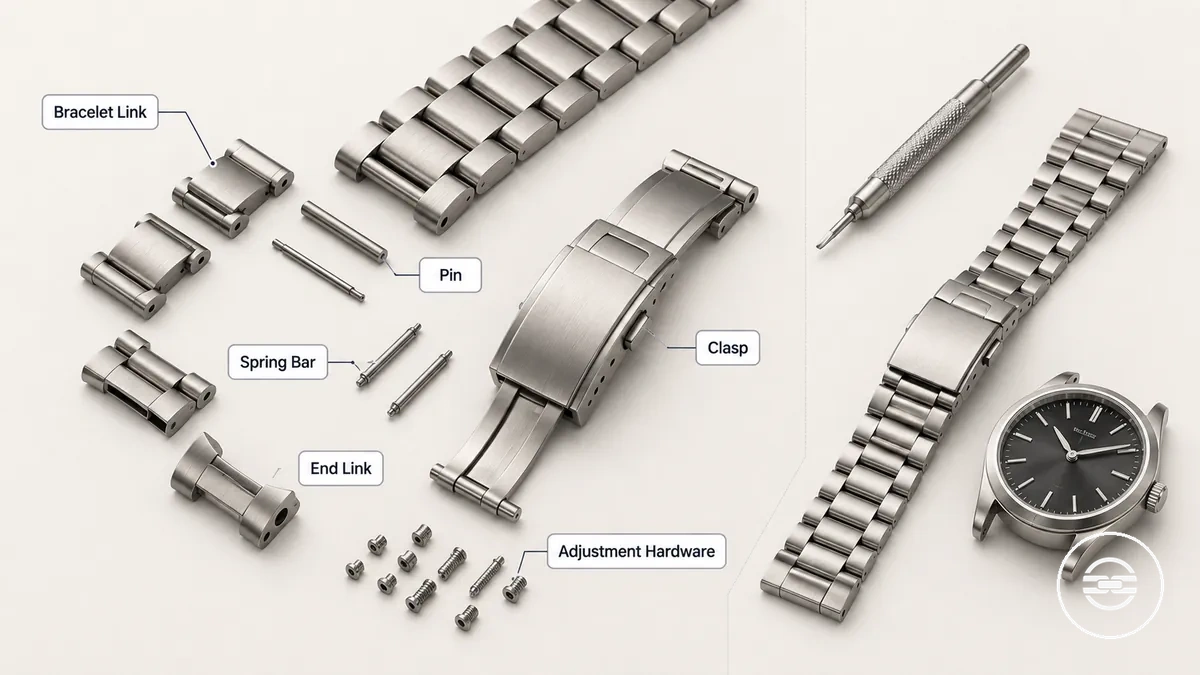
What Counts as a Metal Watch Band Part is determined by the physical role each component has within the bracelet. Casual naming may vary by seller or watch model, but the physical function remains the clearest way to distinguish included parts from adjacent items. The main part groups are:
- Bracelet link – forms the bracelet structure and supports bracelet sizing through removable links.
- Pin – connects bracelet links and helps retain removable link sections.
- Spring bar – serves as the attachment component between the end link and the watch lugs.
- End link – connects the bracelet to the lug area of the watch.
- Clasp or buckle – functions as the closure component that secures the bracelet during wear.
- Adjustment hardware – includes bracelet hardware used for clasp adjustment or bracelet sizing, depending on the bracelet design.
Bracelet Links and Link Connections
Bracelet links form the wearable length and overall structure of a metal watch band. Bracelet Links and Link Connections vary by link construction and the hardware used to join each section, which affects sizing flexibility and how the bracelet may be serviced. Together, bracelet links create the bracelet's length and structure system.
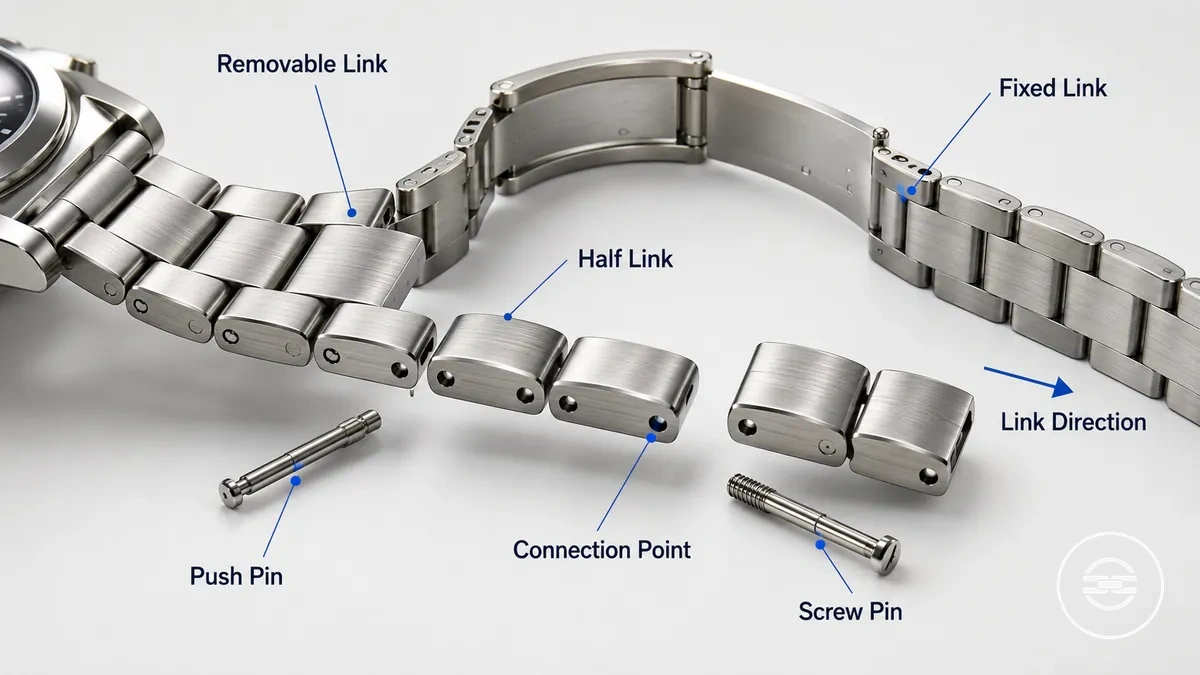
When a bracelet needs a closer fit, the link design determines whether adjustment may be possible. Removable links can often be separated through link hardware, while fixed links remain part of the permanent bracelet structure. Half links may provide finer sizing flexibility on some bracelet designs. Link connections commonly use push pins, screw pins, collars, or tubes, depending on the bracelet construction.
Bracelet Links and Link Connections explain how bracelet links and their connectors work together rather than providing a complete resizing guide. The table below organizes the main link types and connection methods by attribute and effect on fit or service. For practical adjustment guidance, see adjust a metal watch band.
| Entity or connector | Attribute | Value or condition | Fit or service effect |
|---|---|---|---|
| Removable links | Removability | Can be separated with link hardware | Supports sizing flexibility |
| Fixed links | Bracelet structure | Remain permanently connected | Limits adjustment options |
| Half links | Link length | Available on some bracelet designs | Allows finer fit adjustment |
| Push pins | Connection | Press-fit pin system | May allow removable links |
| Screw pins | Connection | Threaded fastening | May simplify servicing when correctly matched |
| Collars | Link hardware | Used with certain pin systems | Correct placement may affect secure reassembly |
| Tubes | Link hardware | Used in some bracelet constructions | Connection method varies by bracelet design |
Removable Links, Fixed Links, and Half Links
Removable links, fixed links, and half links each affect bracelet length differently. Removable links provide the primary sizing flexibility, fixed links preserve bracelet structure, and half links can provide a smaller adjustment increment when available. These three link types define the local roles within the bracelet link system.
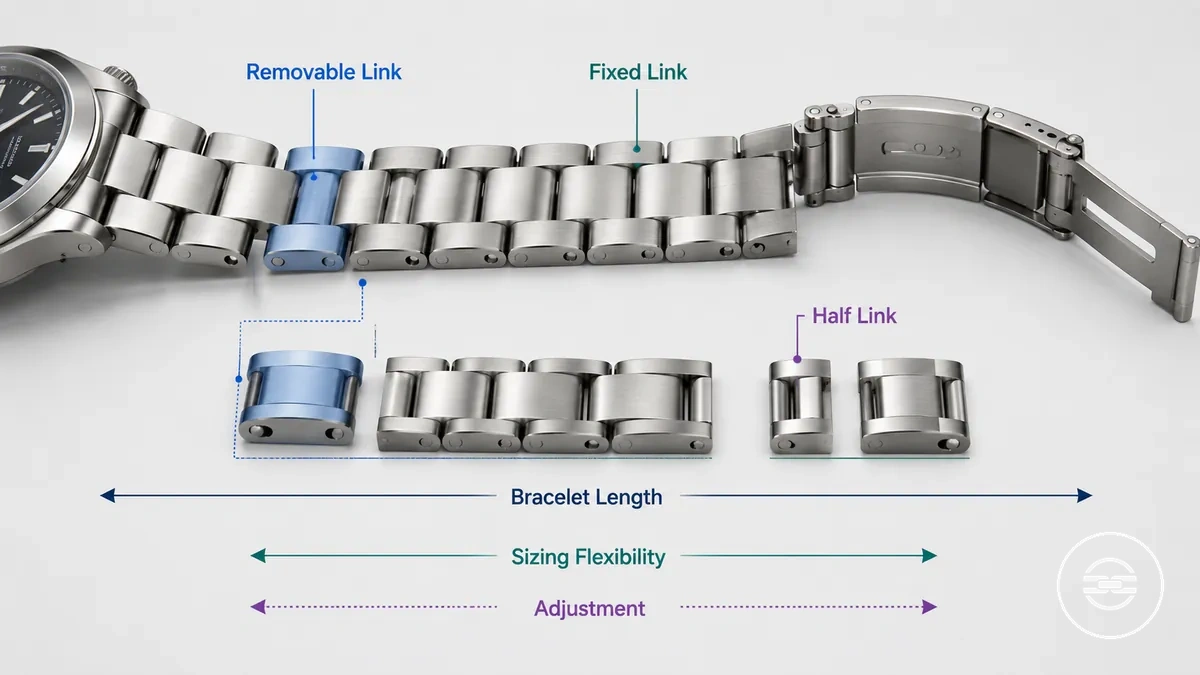
When a bracelet feels slightly loose or tight, the available link type influences how closely the fit may be adjusted. Whether a bracelet includes removable links or half links depends on its design, so the final fit can vary.
- Removable links – Support bracelet length adjustment, can often be removed, and improve sizing flexibility when the bracelet design allows.
- Fixed links – Maintain bracelet structure, are not normally adjusted, and limit changes to overall bracelet length.
- Half links – Provide a smaller adjustment increment than a standard link and may help achieve a closer wrist fit when included.
Push Pins, Screws, Collars, and Tubes
Push pins, screw pins, collars, and tubes are link connector components that hold bracelet links together. Similar-looking link systems can use different fastening methods, so connector identification is important before servicing. Common connector types include push pins, screw pins, collars, and tubes.
A bracelet may appear to use the same link connector as another model while relying on different internal hardware. Push pins commonly use friction, while screw pins use a threaded connection. Collars and tubes may be separate supporting components, so extra care is helpful because they can be misplaced and similar links can use different hardware.
Push Pins, Screws, Collars, and Tubes use different fastening methods. The comparison below highlights how each connector holds the link together and the main service considerations.
| Connector | How it holds the link | Service caution | Fit or risk effect |
|---|---|---|---|
| Push pins | Friction-fit link connector | Removal condition varies by bracelet model | Incorrect identification may complicate servicing |
| Screw pins | Threaded link connector | Threaded fastening differs by bracelet design | Can support easier serviceability when correctly identified |
| Collars | Small retaining part used in certain pin-and-collar systems | May be easy to misplace during service | Missing collars may affect secure link assembly |
| Tubes | Sleeve supporting link alignment | Construction varies between bracelet models | Connector type influences service approach |
End Links and Case Attachment
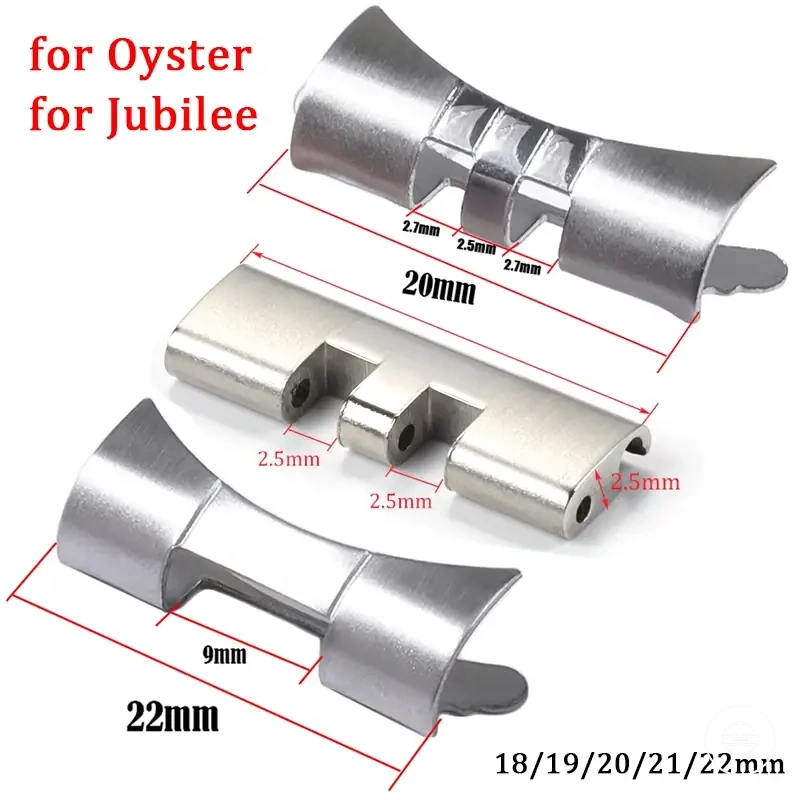
End links connect the bracelet to the watch case, and correct case attachment depends on how the end-link form matches the lugs. Lug width, curvature, and spring bar position can affect stability, visible gaps, and replacement suitability. These conditions determine how the bracelet end piece sits at the lug attachment.
When an end link sits unevenly, leaves a gap, or moves at the case, the cause may be a mismatch in shape, width, curvature, or spring bar support. A curved end link may need to follow the case contour, while a straight end link may leave more visible space depending on the lug geometry. Replacement suitability therefore depends on checking both end-link shape and lug width.
Broader metal watch band compatibility also depends on case geometry and spring bar position, not appearance alone. The table compares the main shape, width, and attachment criteria. End links are bracelet attachment parts, not ordinary removable bracelet links.
| End-link factor | Attribute or condition | What to check | Fit effect |
|---|---|---|---|
| Shape | Curved end link or straight end link | Whether the form follows the case and lug profile | A mismatch may create gaps or uneven case attachment |
| Lug width | Width of the space between the lugs | Whether the end piece matches the available lug width | An unsuitable width may reduce stability or prevent proper seating |
| Curvature | Contour of the end link against the case | Whether the curve aligns with the case shape | Different curvature may increase a visible gap or affect seating |
| Spring bar position | Location of the attachment holes and support point | Whether the end link aligns with the case attachment position | Misalignment may affect attachment stability and replacement suitability |
| End-link construction | How the end piece joins the bracelet | Whether the construction aligns with the lugs and attachment point | Construction differences may change stability and case fit |
Straight End Links and Curved End Links
Straight end links and curved end links differ by attachment shape. Straight end links end with a flat profile, while curved end links follow more of the case contour. This distinction influences the visible gap, visual integration, and replacement tolerance.
When replacing a bracelet, the end-link shape should match the watch case rather than appearance alone. A curved end link may align more closely with the case contour, while a straight end link may leave a more noticeable visible gap depending on the case shape. Compatibility depends on case geometry, lug fit, spring bar position, and bracelet design, so replacement tolerance varies between watches.
Straight end links and curved end links affect shape behavior and compatibility in different ways. The comparison below highlights their fit characteristics and compatibility risk.
| End-link type | Shape behavior | Fit advantage | Compatibility risk |
|---|---|---|---|
| Straight end links | Flat end with a straight profile | May suit watches with a simple case edge | Visible gap may vary with the case contour |
| Curved end links | Shaped to follow the case contour | May provide closer visual integration when matched to the case | Replacement tolerance depends on case geometry and bracelet design |
Solid, Hollow, and Female End Links
End-link construction affects rigidity, articulation, and fit tolerance within the bracelet attachment system. Solid end links, hollow end links, and female end links are construction variants that can influence bracelet feel.
- Solid end links (SEL): Solid end links use a solid construction that may increase rigidity and stability near the case. Their effect on weight, movement, and fit tolerance varies by bracelet design.
- Hollow end links (HEL): Hollow end links use a formed construction that may allow more movement at the attachment point. Their practical fit effect and bracelet feel depend on the end-link shape and case fit.
- Female end links: Female end links place the first bracelet connection within the end piece, which can increase articulation near the case. This construction may affect bracelet integration and movement depending on the design.
These labels describe how each end link is constructed rather than its overall quality. Rigidity, articulation, fit tolerance, and bracelet feel can differ according to the complete bracelet design.
Spring Bars and Watch Band Pins
Spring bars and watch band pins are small fastening parts that secure a watch band in different locations. Spring bars are used for lug attachment between the watch case and the bracelet or strap, while link pins fasten bracelet links together. This distinction separates lug attachment from link fastening.
A common misconception is that every watch band pin refers to the same component. In practice, retailers and users may use the term for a spring bar at the lugs or a link pin inside the bracelet. Attributes such as length, diameter, shoulder style, and release mechanism can influence fit, security, and serviceability. The meaning of a pin label therefore depends on the part's location and intended role.
Spring bars and watch band pins have different physical jobs even when similar names are used. The table below separates the common terms and their main attributes. Replacement should be based on the correct pin type and dimensions for the specific watch and bracelet.
| Part term | Main location | Key attribute | Fit or service effect |
|---|---|---|---|
| Spring bars | Lug attachment between the case and the band | Length, diameter, shoulder style, release mechanism | May affect fit, security, and service access |
| Watch band pins | Retail term that may refer to different fastening parts | Pin type and intended location | Correct identification supports suitable replacement |
| Link pins | Bracelet link connection | Pin design and bracelet compatibility | May affect link fastening and bracelet serviceability |
Spring Bar Length, Diameter, and Shoulder Style
Spring bar length, diameter, and shoulder style determine whether a spring bar can seat securely within the watch case and bracelet assembly. Lug width alone is not enough because seating also depends on tip fit, clearance, and the relationship between the spring bar and the end-link design. The key sizing attributes are spring bar length, diameter, tip fit, shoulder style, lug width, and clearance.
When a spring bar is difficult to install, remove, or seat correctly, one or more sizing attributes may not match the watch case or bracelet. Use this checklist to verify the main conditions before selecting a replacement:
- Check that the spring bar length matches the intended lug width and seating position.
- Confirm the diameter is suitable for the lug holes while maintaining appropriate clearance.
- Verify the tip fit aligns correctly with the lug holes and end-link design.
- Select the appropriate shoulder style for tool access and removability.
- Ensure overall clearance allows the spring bar to seat without interference.
These checks help evaluate seating and replacement suitability rather than guarantee a correct fit. For broader sizing criteria, see metal watch band sizing. Final fit and secure attachment depend on the watch case and bracelet end design.
Quick Release Pins and Standard Spring Bars
Quick release pins and standard spring bars both secure a watch band to the case, but they use different release methods. Their suitability depends on case clearance, end-link compatibility, and the available channel space. Quick release pins include a release lever, while standard spring bars rely on shoulder access with a suitable tool.
When a metal bracelet has limited space around the end link, a release lever may not have enough clearance to operate comfortably. Quick release pins can improve access when the bracelet design provides sufficient channel space, while standard spring bars may better suit bracelets designed for conventional shoulder access. The comparison below highlights the main trade-offs, and compatibility depends on the watch case and bracelet design.
| Attachment type | Release method | Compatibility condition | Trade-off |
|---|---|---|---|
| Quick release pins | Integrated release lever or release tab | Requires suitable case clearance, channel space, and end-link compatibility | May improve convenience, but the lever can be limited by bracelet design |
| Standard spring bars | Shoulder access with a suitable tool | Must match the lug and end-link arrangement | Can suit conventional bracelet designs, though removal typically requires tool access |
Clasps, Buckles, and Closure Components
The clasp system is the group of parts that opens, closes, secures, and sometimes fine-tunes a metal watch bracelet. These closure components control how the bracelet fastens around the wrist rather than how it attaches to the watch case. Clasp parts therefore determine closure behavior instead of case attachment.
When a bracelet is difficult to close or release, the issue may involve one closure component rather than the entire bracelet. Depending on the bracelet style, the terms clasp and buckle can overlap, even though their components may differ. Common closure hardware includes the clasp body, buckle tongue, fold-over safety pieces, push button releases, release mechanisms, and micro-adjustment holes. The table below summarizes the main clasp subparts and their roles.
| Closure component | Role | Fit or security effect | Boundary note |
|---|---|---|---|
| Clasp body | Forms the main bracelet closure | Supports bracelet closure and alignment | Different from case attachment parts |
| Buckle tongue | Engages a buckle opening or hole | May influence closure tension and fit | More common on buckle-style bracelets |
| Fold-over safety | Adds a secondary locking layer | Can provide additional security when engaged | Not present on every clasp |
| Push button | Activates the release mechanism | May provide more controlled bracelet opening | Depends on clasp design |
| Micro-adjustment holes | Allow small bracelet fit changes | Can fine-tune closure fit and comfort | Availability varies by clasp |
A common misconception is that clasp and buckle always describe different hardware. In practice, the terminology can overlap depending on the bracelet style, while the closure components remain the same concept. For a detailed comparison of clasp designs, see metal watch band clasps.
Clasp Body, Buckle Tongue, and Micro-Adjustment Holes
Clasp hardware combines locking, tension, and adjustment functions that influence closure security and small fit changes. The local clasp subparts include the clasp body, buckle tongue, safety lock, push buttons, spring-loaded parts, and micro-adjustment holes.
- Clasp body: Forms the main closure structure and supports bracelet locking and release.
- Buckle tongue: Passes through the buckle opening or hole to create holding tension on compatible buckle-style bracelets.
- Safety lock: Adds a secondary locking layer that can provide additional closure security when the clasp design includes one.
- Push buttons and spring-loaded parts: Operate the release mechanism together, although their movement and response depend on the clasp design.
- Micro-adjustment holes: Allow small clasp position changes that can help refine bracelet fit without removing bracelet links.
How Part Dimensions Affect Fit and Replacement
Part dimensions determine whether replacement parts may fit, hold securely, and function with an existing bracelet. Compatibility depends on measured conditions rather than part names alone because watch case geometry, bracelet construction, and hardware tolerances can influence the outcome. For replacement decisions, dimensions matter more than part names.
When a replacement part looks correct but does not install properly, the cause is often a difference in measurement or connector design. A successful replacement may depend on lug width, spring bar size, end-link shape, link connector type, or clasp width rather than appearance. For broader decision criteria, see metal watch band compatibility. The checklist below identifies the main compatibility conditions to verify.
How Part Dimensions Affect Fit and Replacement should be evaluated by confirming measured conditions before selecting replacement parts. The checklist verifies the key measurements that influence attachment, adjustment, and closure. For additional sizing guidance, see metal watch band sizing.
- Lug width: Measurement should match the intended attachment position to support compatibility.
- Spring bar size: Size should suit the lug holes and end-link arrangement for the intended assembly.
- End-link shape: Shape should correspond with the watch case geometry to achieve an acceptable fit condition.
- Link connector type: Connector type should match the bracelet construction to support correct attachment and adjustment.
- Clasp width: Width should correspond with the bracelet and closure hardware before replacement.
Part dimensions describe measurable compatibility criteria, while hardware tolerances define the acceptable conditions for replacement parts. Whether a part fits or holds securely depends on the combined relationship between measurements, bracelet construction, and watch case geometry.
A matching part name does not mean a replacement part is universally compatible. Measured conditions should be verified before assuming a replacement will fit or function correctly.
Replacement decisions are more reliable after each compatibility criterion has been checked. Verify lug width, spring bar size, end-link shape, link connector type, and clasp width before choosing replacement parts to reduce the risk of an unsuitable fit.
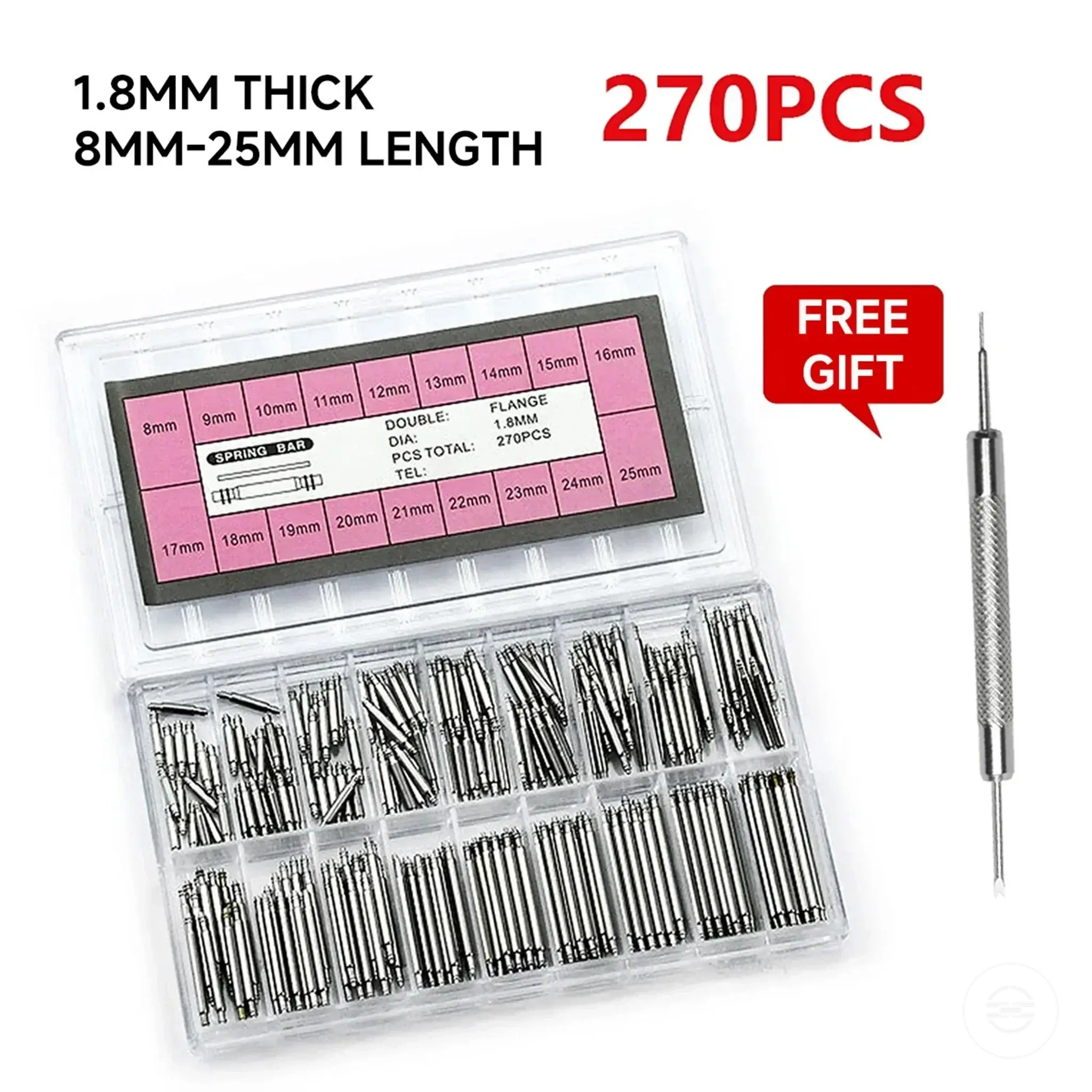
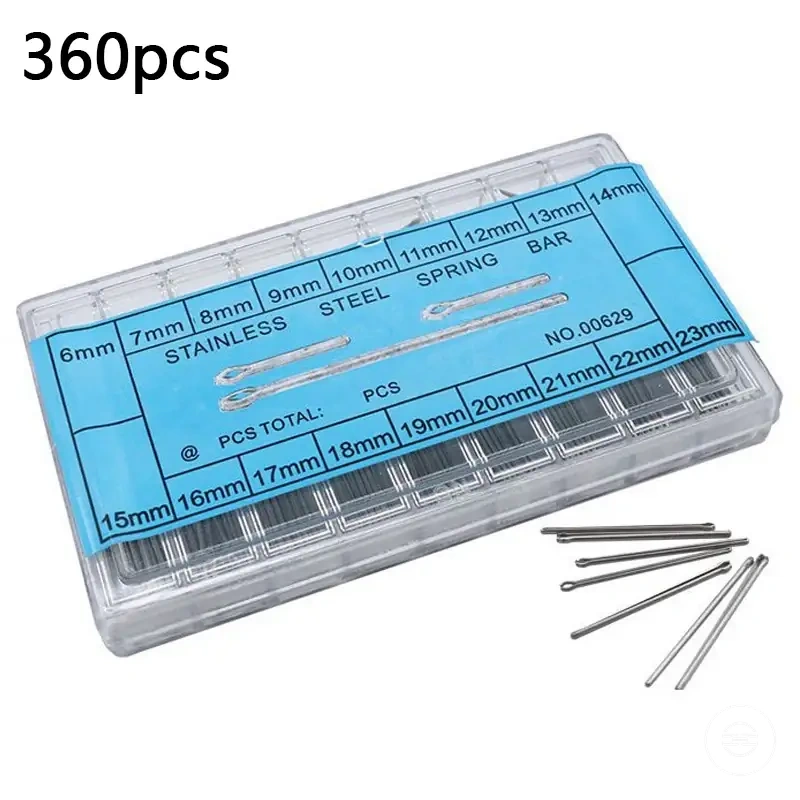
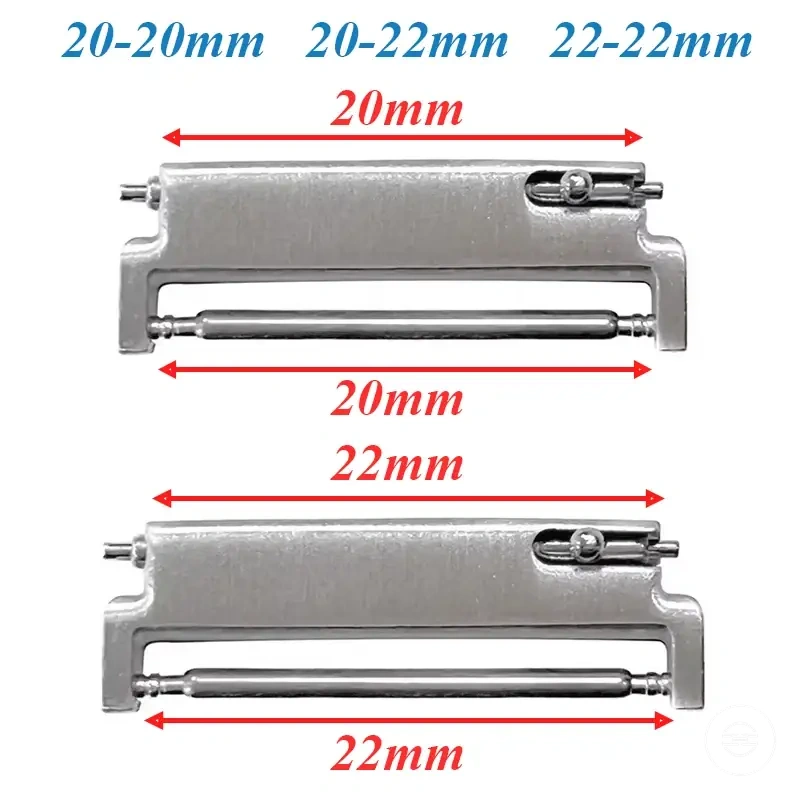
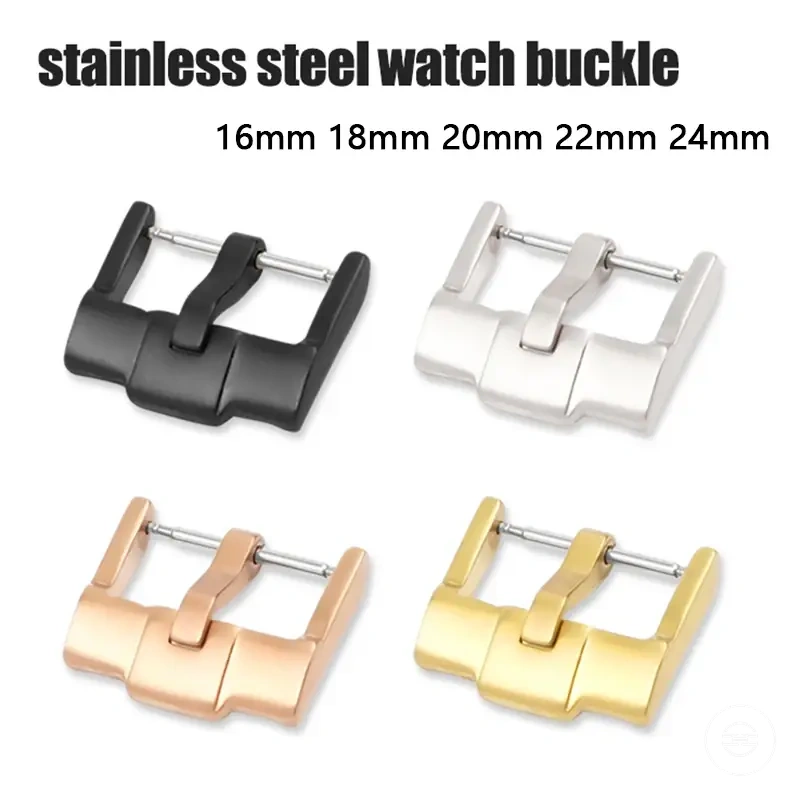
The products below are useful examples for comparing available options. Before buying, check that the compatibility criteria, key features, and product details match your needs.
Common Metal Watch Band Part Name Confusions
Part name confusion happens because sellers, watchmakers, and users may apply different retail terms or repair terms to the same area of a watch band. Pins, spring bars, links, end links, clasps, buckles, and adjustment tools each describe different functions, even when naming overlap occurs. The confusion usually comes from the service context rather than the part itself.
| Confusing terms | What each usually means | Context that changes the meaning |
|---|---|---|
| Pins and spring bars | Pins usually fasten bracelet links, while spring bars usually attach the band between the watch lugs. | The word pin may refer to link fastening or lug attachment depending on the repair or retail context. |
| Links and end links | Links adjust bracelet length, while end links connect the bracelet to the watch case. | The location determines whether the term refers to bracelet length or case attachment. |
| Clasp and buckle | Both describe closure components, although the preferred label may vary with bracelet style. | Retail terms and repair terminology may use one label more broadly than the other in closure discussions. |
| Band parts and adjustment tools | Band parts remain in the bracelet assembly, while adjustment tools are used to service those parts. | Service kits may group tools and parts together even though they perform different roles. |
A common myth is that overlapping names identify the same part. In practice, the correct meaning depends on whether the discussion concerns link adjustment, lug attachment, or bracelet closure. Choose replacement parts by their function and location rather than by name alone.