
Metal Watch Band Types and Bracelet Styles
Metal watch band types are structural forms of metal watch bracelets that influence how a band flexes, adjusts, and rests on the wrist. Different bracelet styles may share the same material while producing different movement, appearance, and wrist feel because of their construction. Structure is the organising principle that distinguishes these style families.
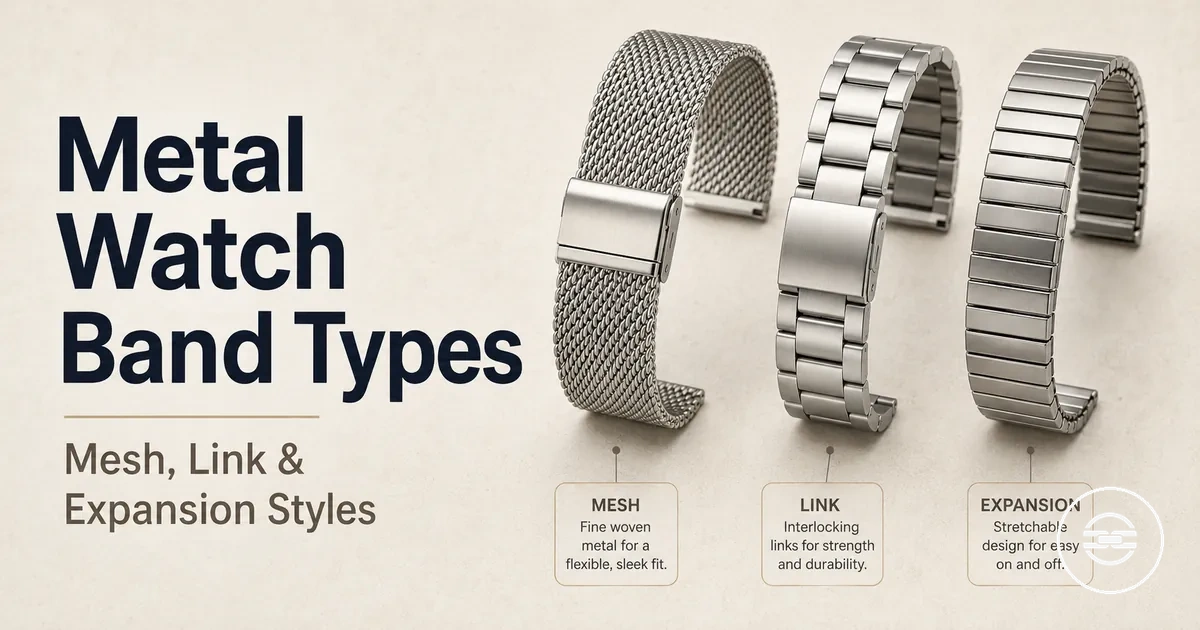
Mesh bands, including Milanese designs, use a woven construction that often creates a flexible, low-profile wrist feel. A link bracelet is built from articulated links that drape around the wrist and may be adjusted by removing links. An expansion band, also known as a stretch band, expands through flexible connected sections for easy on-off wear. These categories describe structural design rather than material, clasp type, or sizing.
Comfort, flexibility, adjustment, and style suitability can vary with bracelet construction as well as wrist shape, watch case design, clasp configuration, material, and surface finish. Mesh, link, and expansion styles each create different movement and fit characteristics, but no single structure suits every wearer or situation. Understanding these structural differences provides a practical foundation for comparing each metal watch band type in greater detail.
This overview introduces the main type families before exploring how each bracelet construction influences appearance, adjustment, and everyday use.
What Separates One Metal Watch Band Type From Another
A metal watch band type is defined by its construction pattern, flexibility, link or mesh behaviour, adjustment method, end connection, and the wrist feel created by its structure. These structural attributes establish the type boundary, while material, finish, and clasp are separate characteristics. The effect on comfort or everyday use can vary depending on how these structural elements work together.
What Separates One Metal Watch Band Type From Another becomes clearer when structure is examined before appearance. The image below highlights the key structural features that distinguish band types. Within the broader category of metal watch bands, a band type is classified by construction rather than by material or finish.
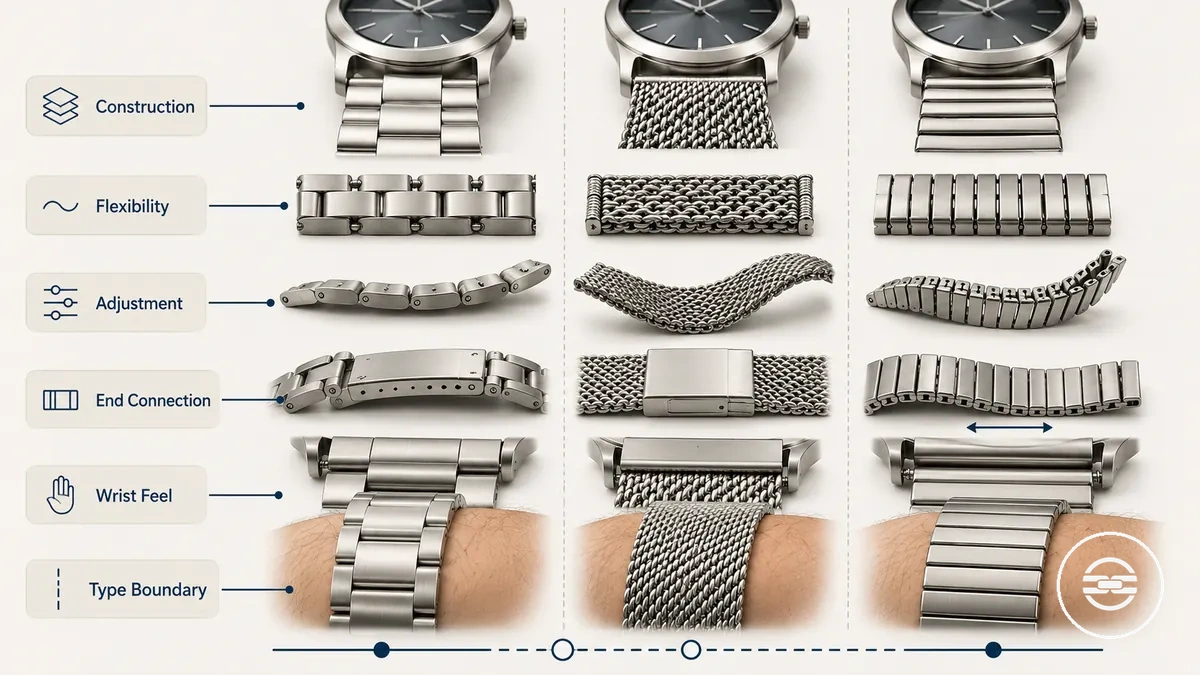
- Construction pattern: The arrangement of links, mesh, or expanding sections defines the structural type.
- Flexibility and adjustment method: These characteristics influence how the band moves and how its fit may be refined, although the final wrist feel also depends on the overall bracelet design.
- End connection: The way the bracelet joins the watch case can influence movement and stability during wear.
- Wrist feel: Structure affects how the bracelet wraps around the wrist, while overall suitability still depends on the complete watch and wearer combination.
- Type boundary: A metal watch band type identifies structural design, whereas material, finish, clasp, and sizing describe different product attributes.
Mesh and Milanese Metal Watch Bands
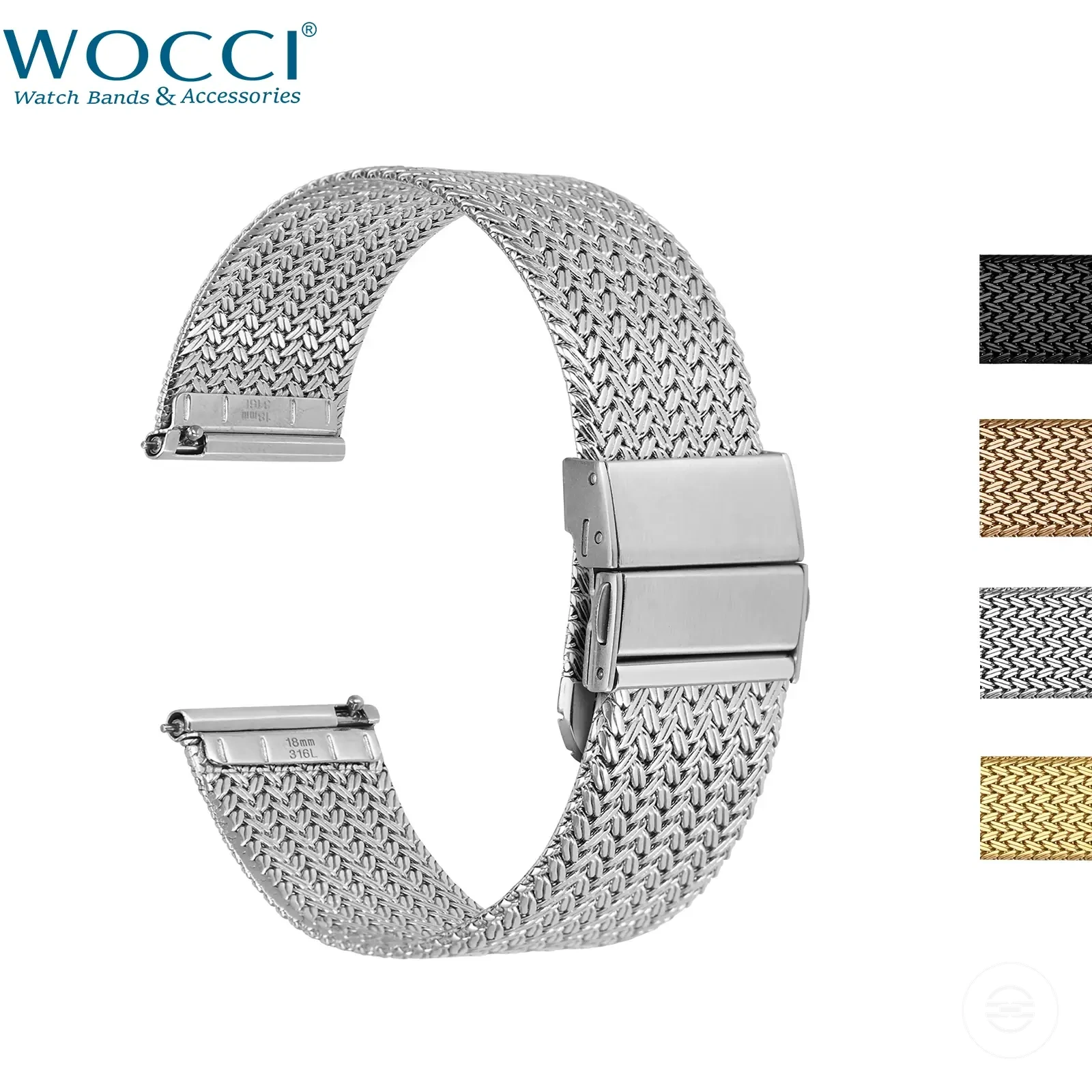
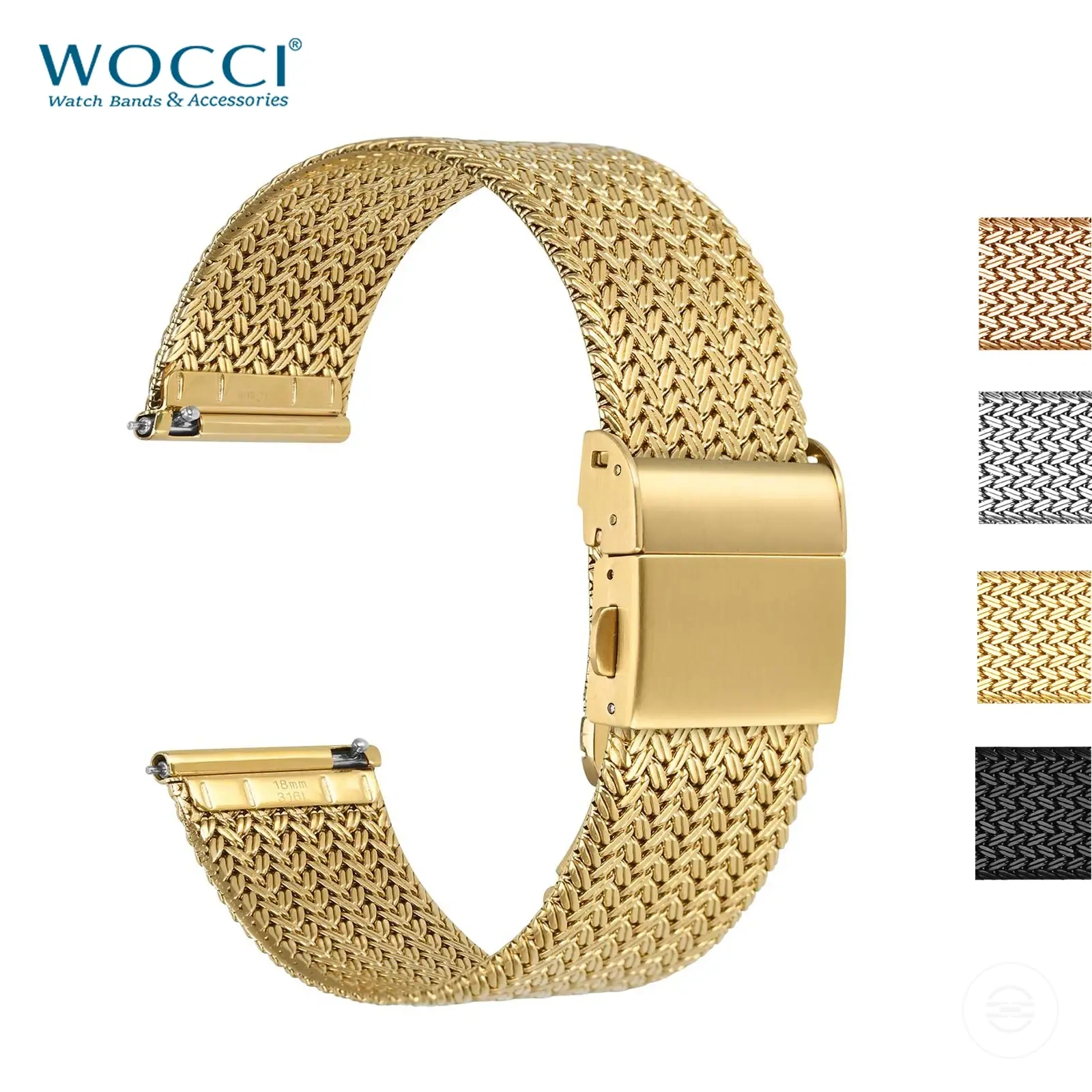
A mesh metal watch band is a bracelet made from woven metal or closely interlinked fine links that create a flexible, continuous structure around the wrist. A Milanese metal watch band is a recognised mesh style that typically combines fine flexibility with a slim, dress-casual appearance. Wrist feel, comfort, and suitability can still vary with mesh density, edge smoothness, clasp type, wrist hair, and watch weight.
Mesh and Milanese Metal Watch Bands become easier to understand when their woven construction is examined before individual features. The image below highlights the structural characteristics that influence wrist feel, appearance, and adjustment.
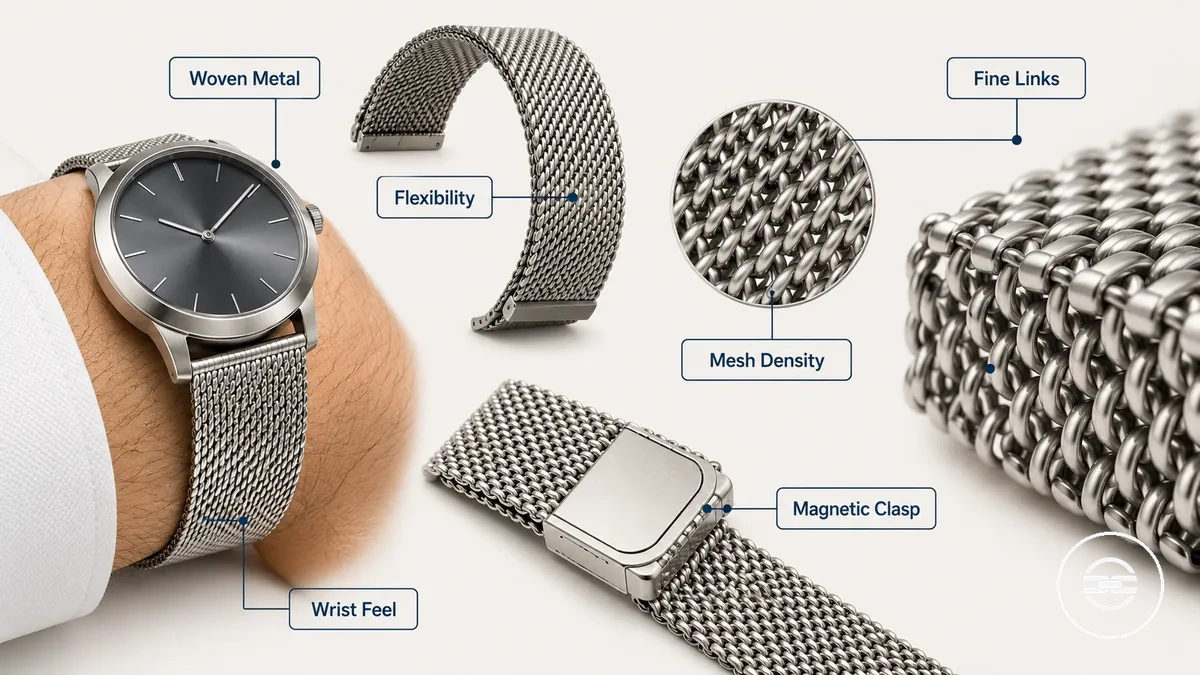
Woven metal construction allows fine links to move together, creating a bracelet that can wrap closely around the wrist with relatively low bulk. Breathability may vary with mesh density and wrist conditions, while edge smoothness can influence long-term comfort. Many Milanese designs use a magnetic clasp for adjustment, although other clasp styles are also available. Hair-pulling risk is not the same for every mesh bracelet and may depend on weave quality, edge finishing, clasp design, and the individual wearer.
| Attribute | Typical Effect |
|---|---|
| Woven metal | Creates fine flexibility and a continuous bracelet surface |
| Mesh density | May influence breathability, wrist feel, and visual texture |
| Edge smoothness | Can affect wearing comfort depending on the finish |
| Adjustment method | Often varies by clasp design, including magnetic clasp options |
If you are choosing between a Milanese mesh bracelet and a link bracelet, a mesh design may provide a smoother, more continuous wrist feel, while a link bracelet may offer a more articulated drape. This distinction reflects structural design rather than material alone. For a separate comparison of alloys and finishes, see metal watch band materials.
Link Metal Watch Bracelets
A link metal watch bracelet is made from connected metal links that articulate as the bracelet moves around the wrist. Link shape, articulation, and construction influence how the bracelet feels, drapes, and appears, while the overall result can vary with link geometry, taper, and manufacturing quality. These structural differences provide the framework for the link-style distinctions covered in the following H3 sections.
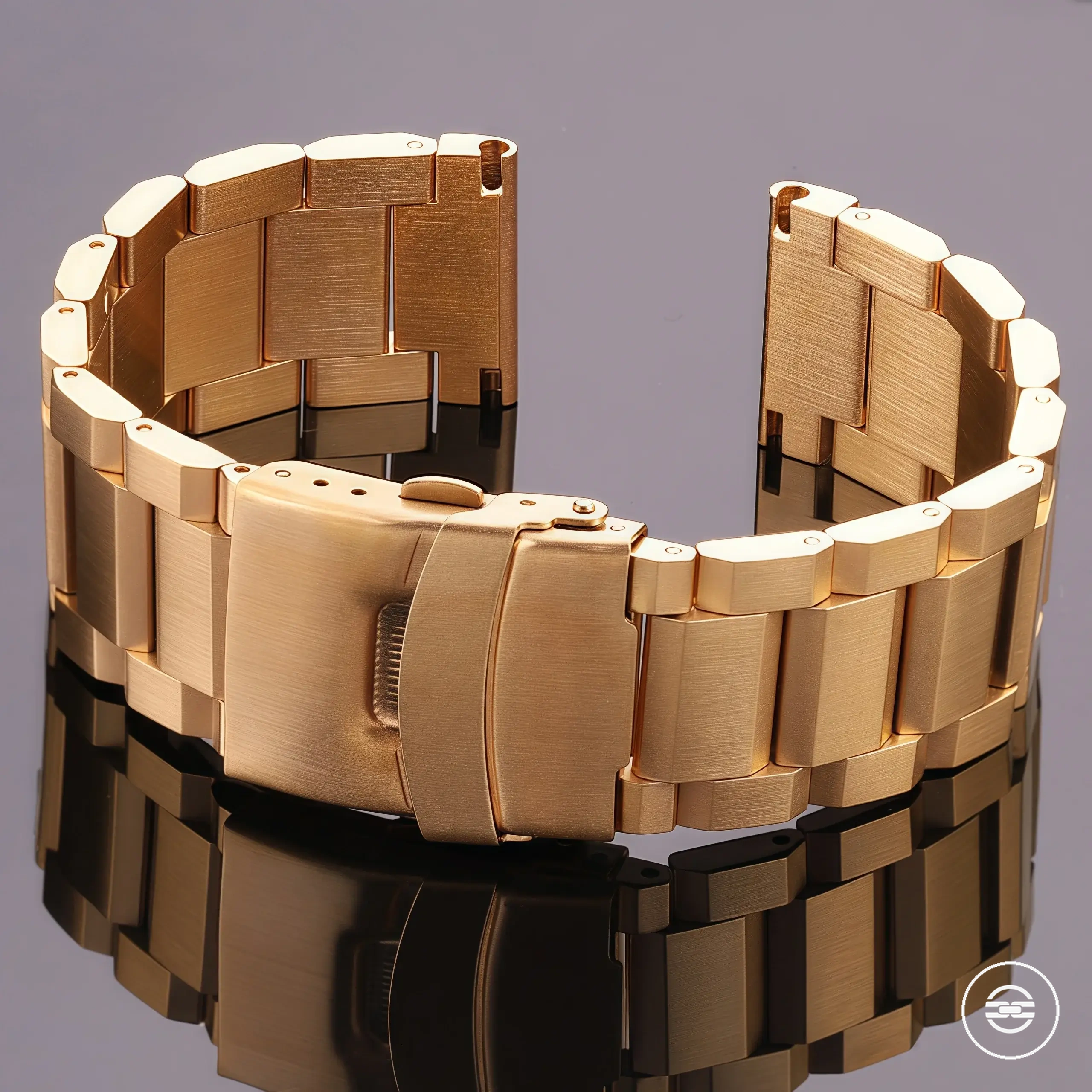
Link Metal Watch Bracelets become easier to compare when their construction is examined before individual link styles. The image below highlights the structural features that influence movement, profile, and overall bracelet behaviour.
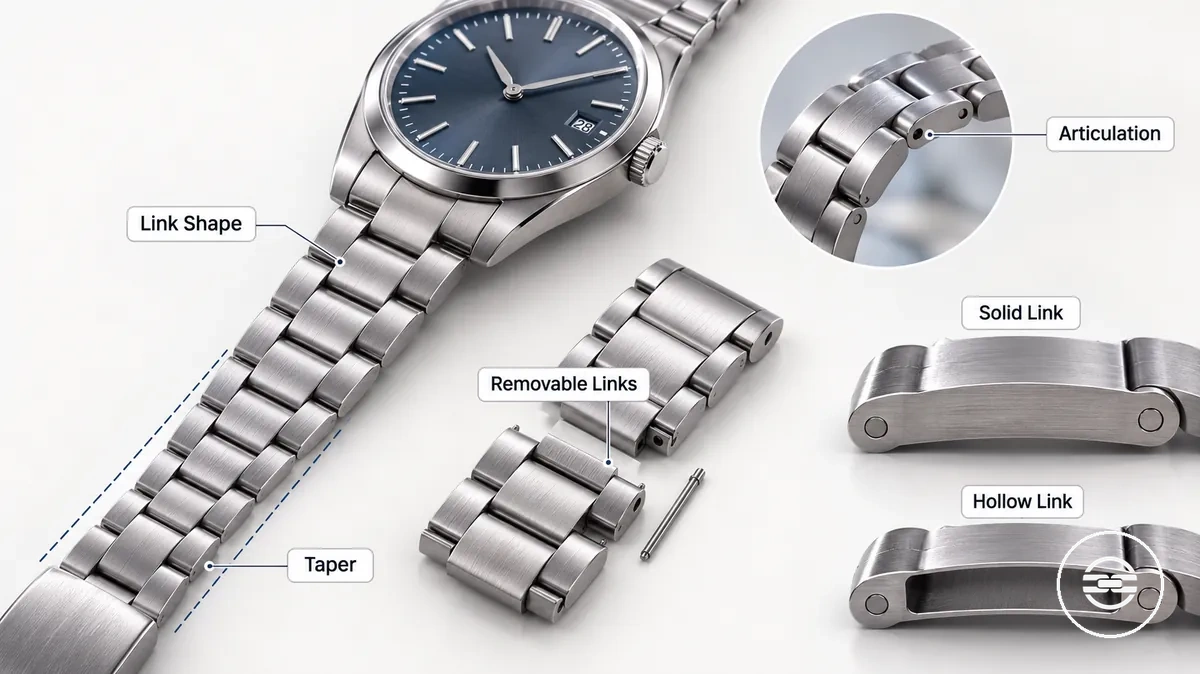
Articulation affects how freely the connected links move, while removable links allow the bracelet to be resized for a closer fit. Taper changes the bracelet width towards the clasp and can influence visual balance, perceived weight, and wrist drape. Bracelet profile also contributes to how prominently the bracelet sits on the wrist.
Construction further shapes the character of a link bracelet. A solid link and a hollow link can differ in weight and perceived rigidity, but construction alone does not determine overall quality or durability because link geometry, finishing, and assembly also play a role. The following H3 sections explain specific link-family distinctions, while detailed pin, clasp, and end-link mechanics remain outside this type-focused explanation.
Three-Link, Oyster, and H-Link Bracelet Structures
Three-link, Oyster-style, and H-link bracelet structures are a subgroup of link bracelets recognised by larger connected links that create a sport profile with greater visual mass. Their shared structure uses a center link supported by side links, allowing articulation as the bracelet wraps around the wrist. Wrist feel and overall appearance can still vary with link thickness, taper, and case design.
- Center link and side link: The shape and proportion of the center link relative to the side links influence the bracelet's visual balance and structural character.
- Articulation: Individual links move independently, and the degree of articulation can affect wrist drape and flexibility during wear.
- Sport profile: Larger link geometry often creates a sport-oriented appearance, while perceived visual mass and comfort depend on bracelet thickness, taper, and the watch it accompanies.
Jubilee, President, and Beads-of-Rice Bracelet Structures
Jubilee-style, President-style, and beads-of-rice bracelet structures are defined by small links arranged in repeating patterns that create greater surface detail and a flexible bracelet profile. Compared with larger-link structures, these small links usually produce smoother drape and a more intricate appearance, while perceived dress style and wrist feel still depend on bracelet construction, finishing, and the watch design.
Jubilee, President, and Beads-of-Rice Bracelet Structures can be compared through the shared attributes created by their repeating small-link pattern.
| Attribute | Typical Effect |
|---|---|
| Link count | A higher number of small links usually increases articulation and promotes smoother drape. |
| Surface detail | The repeating link pattern creates a more textured appearance than larger-link bracelet structures. |
| Dress style | The bracelet may appear more refined depending on finishing, proportions, and case design rather than the link pattern alone. |
| Cleaning complexity | Additional link surfaces and narrow gaps can require more careful cleaning than simpler link layouts. |
Solid Link and Hollow Link Bracelet Construction
Solid link and hollow link bracelet construction describes how individual bracelet links are made rather than defining a separate bracelet type. Solid links contain more material, while hollow links use a lighter construction that can change link mass, sound, and perceived sturdiness. These effects still depend on build quality, finishing, clasp design, and intended use.
Solid Link and Hollow Link Bracelet Construction can be compared through the attributes that influence weight, adjustment feel, durability perception, and cost-value.
| Solid Link | Hollow Link |
|---|---|
| Greater link mass can create a denser wrist feel and a more muted sound during movement. | Lower link mass can reduce bracelet weight and may produce a lighter or more noticeable sound. |
| Durability perception and adjustment feel may seem more substantial, depending on machining, finish, and clasp quality. | Durability perception and adjustment feel can vary widely with construction quality rather than hollow construction alone. |
| Cost-value may reflect the extra material and construction, but suitability still depends on the overall bracelet design. | Cost-value may favour lower weight or simpler construction, without indicating low quality by itself. |
Expansion and Stretch Metal Watch Bands
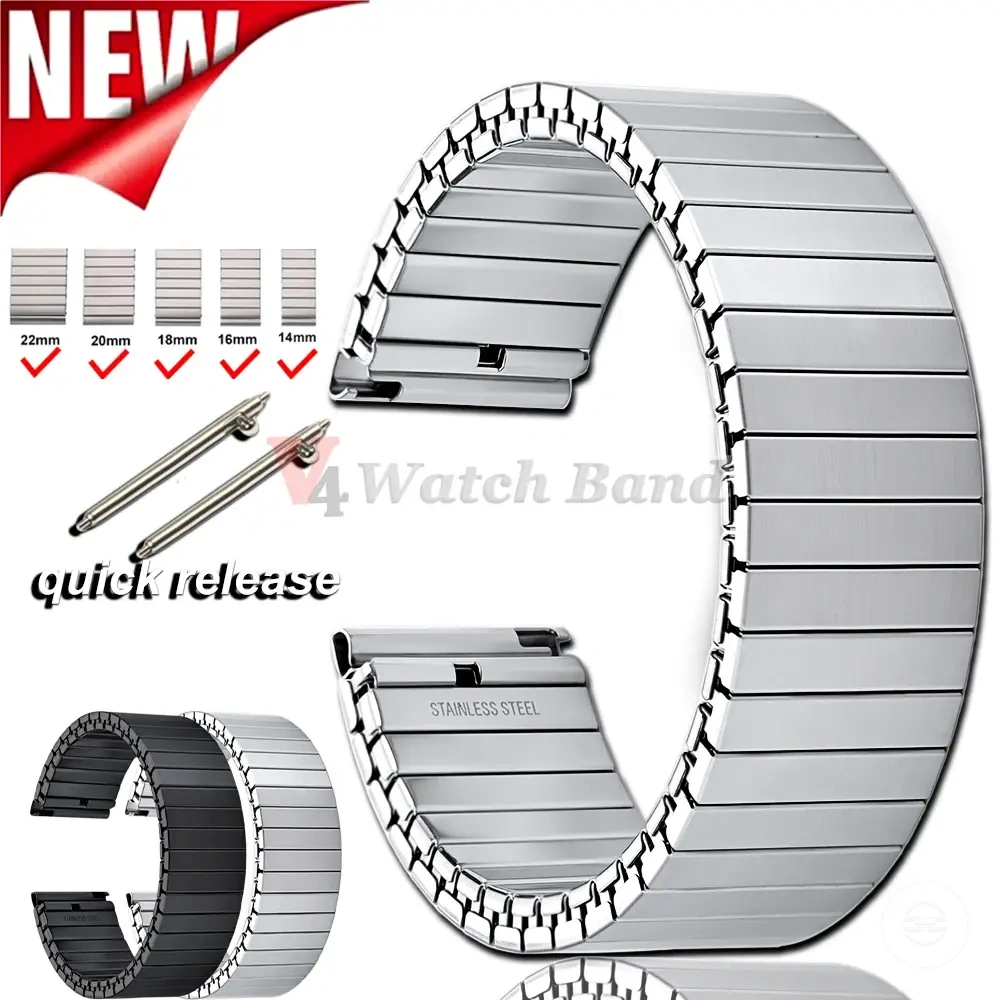
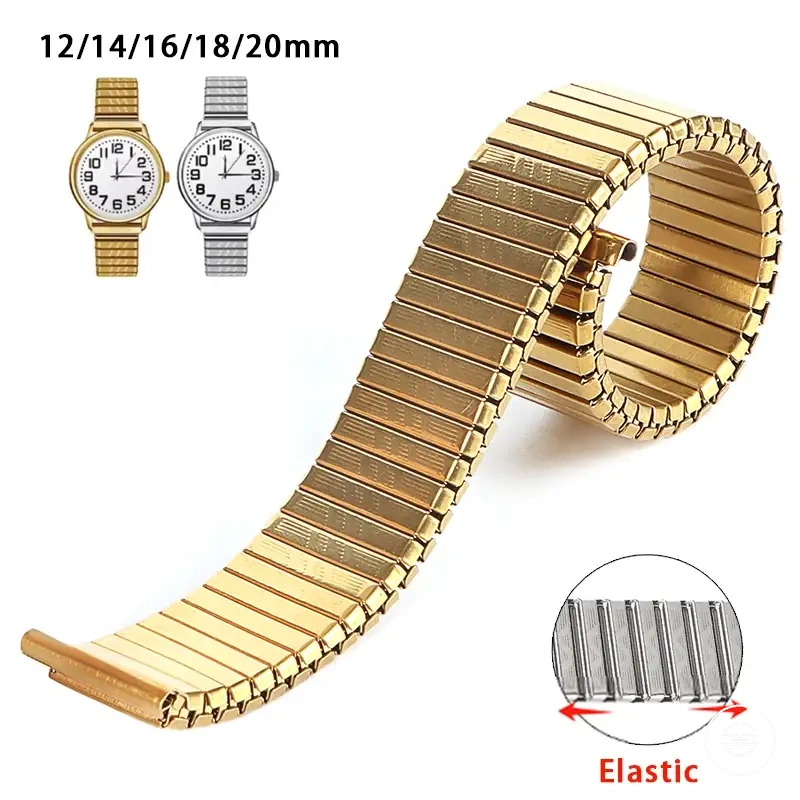
Expansion and stretch metal watch bands use a spring-loaded or elasticized metal structure that expands over the hand without a conventional clasp adjustment routine. An expansion band supports easy on-off wear within its intended stretch range, but wrist pressure, sizing, and case compatibility can still affect fit. The stretch function changes the fitting method rather than removing fit limits.
An expansion band or stretch metal band changes daily wear through its expanding structure. Stretch range affects how readily the band opens, while wrist pressure, hair-pulling risk, and long-term tension may vary with sizing, link condition, construction quality, and frequency of use.
Expansion and Stretch Metal Watch Bands can be assessed through the following fit and wear conditions, especially where easy on-off convenience must be balanced against compatibility and adjustment limits.
- Stretch range: The band should operate within its intended range because repeated overextension may affect long-term tension.
- Wrist pressure: Pressure and wrist feel depend on band size, elasticized construction, and wrist dimensions.
- Hair-pulling risk: Hair may catch between moving links depending on link spacing, surface condition, and fit.
- Case compatibility: Suitability depends on the watch case, attachment dimensions, and connection structure.
- Easy on-off: Slip-on wear can simplify daily use, although sizing and compatibility checks may still matter.
- Adjustment limits: An expansion bracelet has practical fitting limits and may not suit every wrist size or watch case.
How Metal Band Type Changes Comfort, Weight, and Wrist Movement
Comfort can change when the same watch is paired with different metal band types. Flexibility, contact area, weight distribution, and wrist movement interact with case weight, wrist size, hair sensitivity, and daily activity, so the wearing feel depends on both the band structure and the wearer. The most suitable option therefore varies with wearing conditions rather than band type alone.
How Metal Band Type Changes Comfort, Weight, and Wrist Movement can be compared through the structural attributes that influence wrist feel under different conditions.
| Band Type | Comfort Attribute | Condition | Likely Effect |
|---|---|---|---|
| Mesh band | Flexibility and broad contact area | Light to moderate case weight with a correctly adjusted fit | May distribute weight more evenly while allowing controlled wrist movement. |
| Link band | Segmented flexibility and adjustable weight distribution | Proper link adjustment and regular wrist movement | Can balance wrist feel, although comfort varies with fit, link design, and case weight. |
| Expansion band | Spring-loaded flexibility | Suitable stretch range, hair sensitivity, and wrist size | May simplify daily wear, while wrist pressure or hair-pulling risk can vary with construction and fit. |
Daily activities can change how each band type feels. A heavier case weight may benefit from stable weight distribution, while frequent wrist movement or increased hair sensitivity can make flexibility and contact area more noticeable. These effects depend on individual wearing conditions, so no single metal watch band type is universally the most comfortable.
Where Mesh, Link, and Expansion Styles Differ Most
Mesh, link, and expansion styles differ most in their structure, flexibility, adjustability, formality, and maintenance burden rather than by one being better in every situation. The most suitable band type depends on wrist feel, fit, visual style, and intended use, so the key trade-off changes with the wearing conditions.
Where Mesh, Link, and Expansion Styles Differ Most can be compared through the structural attributes that influence daily wear and long-term suitability.
| Style Family | Structure | Flexibility and Adjustability | Formality and Maintenance Burden |
|---|---|---|---|
| Mesh | Woven metal construction | Flexible, with fine adjustment when the clasp design supports it | Often suits refined visual styles; maintenance depends on weave condition and finish. |
| Link | Connected individual links | Flexibility varies by link design; adjustability may require link removal or addition | Can suit casual or formal wear depending on design; maintenance varies with the links, joints, and clasp. |
| Expansion | Spring-loaded expanding structure | Expands for slip-on wear within its adjustment limits | Can support frequent on-off use, while maintenance burden may increase if tension changes over time. |
Mesh, link, and expansion styles each involve a different trade-off. Mesh emphasizes flexibility and a continuous surface, link styles emphasize modular adjustability, and expansion styles emphasize convenience through an expanding structure. Preference depends on wrist feel, fit, and visual style rather than a single comparison criterion.
When comparing these style families, match the structure to the intended use instead of looking for one winner. Formality, adjustment needs, maintenance burden, or easy daily wear can each change which band type suits a particular watch and wearer.
The products below are useful examples for comparing available options. Before buying, check that the compatibility criteria, key features, and product details match your needs.
Type Limits for Fit, End Links, and Adjustment
Fit limits depend on both the metal watch band structure and the watch case connection. A suitable band type may still fail to fit when the lug width, end links, spring bars, or adjustment range do not match the case and wrist requirements. Type suitability alone therefore does not confirm case compatibility.
Type Limits for Fit, End Links, and Adjustment can be checked through the connection and adjustment conditions that determine whether a band can attach and fit as intended.
The following metal watch band parts criteria show where compatibility limits commonly occur.
- Lug width: The band connection must correspond with the spacing at the watch case; otherwise, the band may not attach correctly.
- Straight end or curved end: A straight end may leave a different case gap, while a curved end depends more closely on the case shape and end-link design.
- Removable links: Link bands depend on the available removable links and clasp adjustment range to reach a suitable wrist fit.
- Clasp or stretch adjustment: Clasp positions and expansion structures provide different adjustment limits, which may restrict fit for certain wrist sizes.
- Spring bars: Compatibility depends on the spring bars matching the case connection and the band-end structure.
- Case-style constraints: Integrated, recessed, or closely shaped case connections may limit which end links and band types can be used.
A band type can be suitable in concept yet remain incompatible when a curved end does not follow the case profile, a straight end cannot clear the case, or the available adjustment range cannot produce an appropriate fit. These checks define the type-specific boundary without replacing a full sizing or compatibility assessment.
Matching Metal Watch Band Types to Watch Style and Use
A metal watch band type is most suitable when its structure matches the watch style and intended use case. A dress watch, sport watch, or everyday wear setup may each benefit from different structural trade-offs, while small wrists, larger cases, and visual balance can change which type feels and looks more appropriate. Selection therefore depends on matching criteria rather than a universal choice.
Matching Metal Watch Band Types to Watch Style and Use can be organized by the structural characteristics that influence appearance, wrist feel, and practical daily use.
- Dress watch: A finer band structure may complement a more formal watch style when visual balance is the priority.
- Sport watch: A band type with a structure suited to active everyday use may provide a more appropriate match, depending on the case design and wrist feel.
- Everyday wear: Choose a band type that balances flexibility, adjustment needs, and routine comfort for the intended use case.
- Small wrists: Slimmer band structures or greater adjustment flexibility may help maintain visual balance when the watch case is compact.
- Larger cases: Broader or more substantial band structures may create a more balanced appearance when matched to a larger watch case.
- Easy on-off needs: Expansion styles or convenient clasp designs may suit frequent removal, depending on wrist size and adjustment range.
Watch style and use case should remain the primary decision variables. A band type that suits one dress watch may not create the same visual balance on a larger sport watch, while everyday wear may favor different structural trade-offs depending on wrist feel and suitability.
If your decision still depends on broader style preferences or wearing priorities, you can choose a metal watch band using more detailed matching criteria. This keeps the decision focused on type-level selection logic instead of treating any band type as universally suitable.
The products below are useful examples for comparing available options. Before buying, check that the compatibility criteria, key features, and product details match your needs.