
How to Clean a Metal Watch Band Safely at Home
Cleaning a metal watch band starts with mild soap, warm water, a soft brush, and a microfiber cloth. Use gentle pressure, control moisture, and dry thoroughly when the watch case, finish, and water resistance allow routine cleaning.
A watch bracelet can trap sweat, odour, residue, and grime between its links, inside mesh, and around the clasp. This buildup may remain even when the surface appears clean. Gentle cleaning with mild soap, warm water, and a soft brush can help remove residue while reducing scratch risk.
A removable metal watch band is often easier to clean away from the watch case. When the band remains attached, keep water exposure controlled and avoid allowing moisture to collect around the crown or case. The suitable cleaning approach depends on the watch's condition, water resistance, coatings, and any existing damage.
Routine cleaning means removing normal surface dirt and residue from stainless steel, coated finishes, polished surfaces, links, mesh, and the clasp as part of regular maintenance. It does not include rust repair, link repair, or finish restoration. Check the band, finish, attachment points, and nearby watch case before starting the cleaning process.
What to Check Before Washing a Metal Watch Band
Washing a metal watch band is only appropriate after checking water exposure, attachment, finish condition, and visible damage. What to check before washing a metal watch band includes water, finish, and damage risks that determine whether the band can be rinsed, should be removed first, or should remain dry. Avoid using water until these checks are complete.
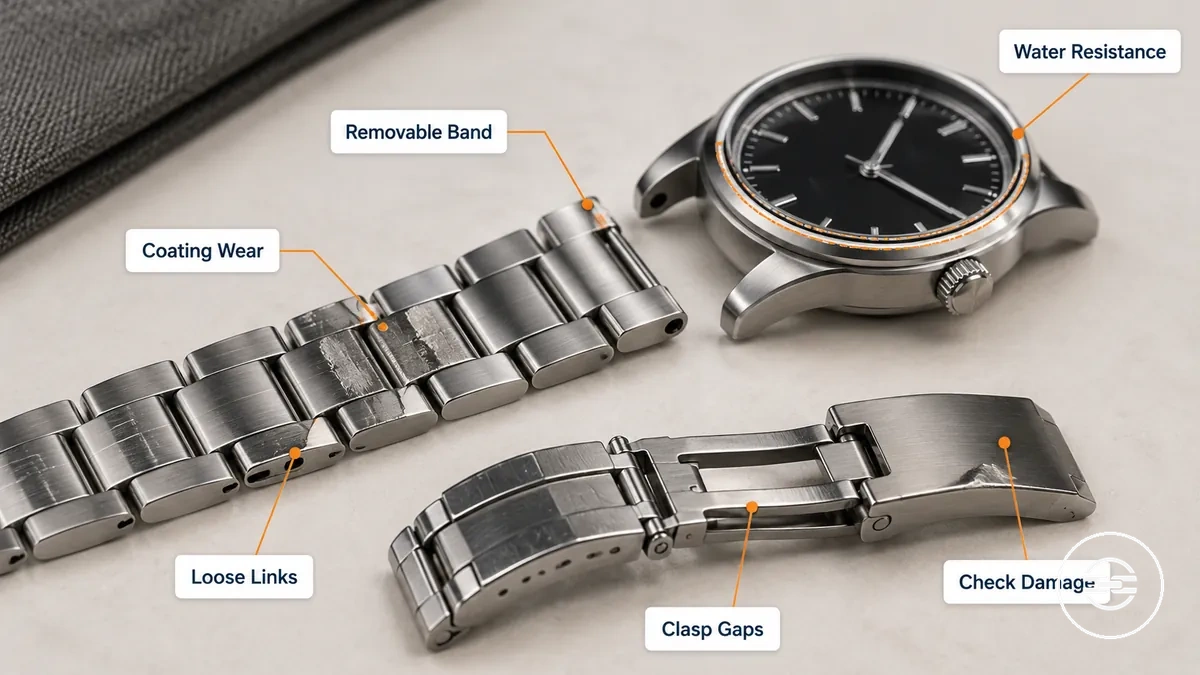
Water resistance of the watch case and whether you have a removable band can change the appropriate cleaning method. Removing the bracelet before washing may reduce moisture around the crown and make cleaning access easier when the attachment allows it. If the band must remain attached, use controlled water exposure instead of soaking the watch. These checks apply before routine cleaning across many metal watch bands.
If you notice coating wear, loose links, heavy grime, clasp gaps, or visible damage, washing may need extra caution or a different approach. Vintage bands and worn finishes can also require gentler handling because water, brushing, or soaking may increase cleaning risk. Review the points below before deciding to rinse or soak any part of the band.
Manufacturer care notes can provide model-specific guidance for finishes, attachment methods, or cleaning limits. When those instructions differ from a general cleaning approach, follow the manufacturer guidance for the watch and bracelet.
What to check before washing a metal watch band:
- Watch case and water resistance: Confirm whether controlled rinsing is appropriate before exposing the attached watch to water.
- Removable band: Check whether the bracelet can be removed safely, as this may reduce water exposure around the watch case.
- Coating wear or polished surfaces: Look for worn finishes that may need gentler cleaning and less brushing.
- Loose links and clasp gaps: Inspect for movement, visible damage, or trapped residue that could change how the band is cleaned.
- Grime level: Check whether dirt is limited to the surface or packed between links or mesh, which may require more controlled brushing instead of soaking.
- Manufacturer care notes: Review any available cleaning guidance before washing the specific watch or band.
Safe Cleaning Tools and Mild Cleaners for Metal Watch Bands
Safe cleaning tools and mild cleaners for metal watch bands should be soft, non-abrasive, and suitable for the band’s finish type. A soft brush, microfiber cloth, and mild soap can support routine maintenance when moisture control is appropriate. Avoid harsh cleaners or abrasive products unless the finish is known to tolerate them.
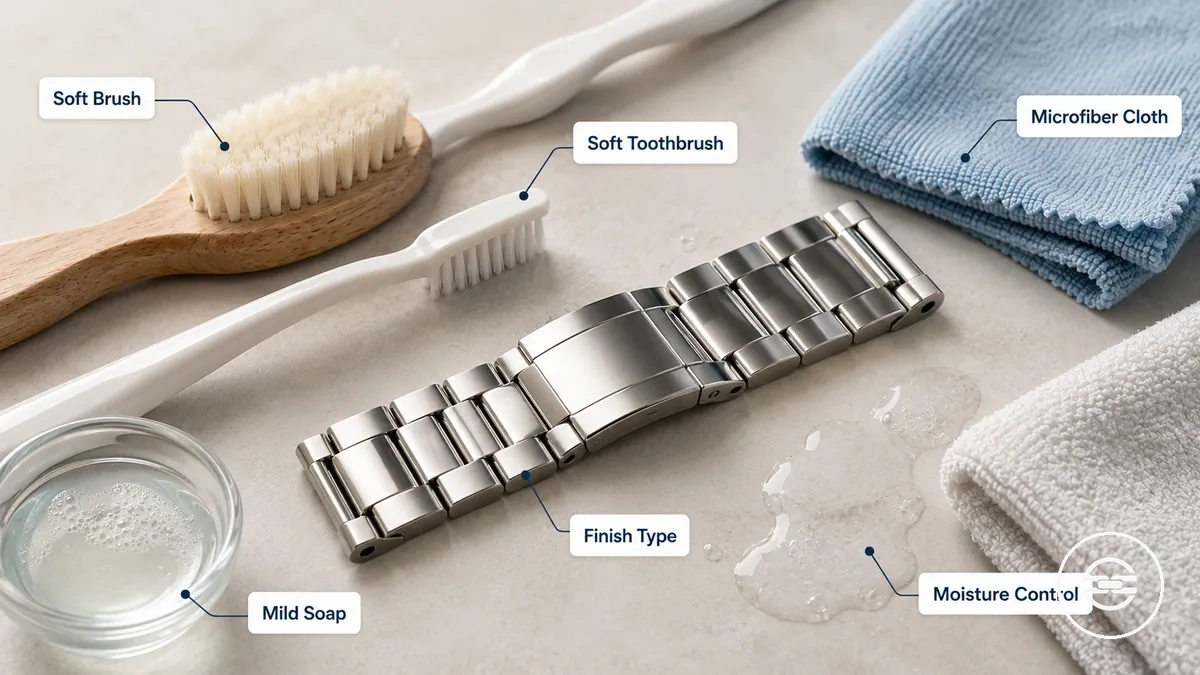
Tool selection depends on bristle softness, absorbency, cleaner strength, finish type, and moisture control. A soft brush or toothbrush can help reach link gaps with gentle pressure, while a microfiber cloth can remove residue and dry polished surfaces with fewer streaks. Mild soap diluted with warm water may suit routine care, whereas a stainless steel cleaner or cleaning kit should only be used when compatible with the band finish. The table below organizes each option by use, condition, and risk.
| Tool or cleaner | Best use | Use with caution when | Main risk to avoid |
|---|---|---|---|
| Soft brush | Cleaning links and tight gaps | The finish is delicate or worn | Scratching from stiff bristles |
| Soft toothbrush | Light brushing around the clasp | The bristles are firm or damaged | Excess pressure |
| Microfiber cloth | Drying and removing residue | The cloth is dirty or holds debris | Transferring particles to the surface |
| Mild soap | Routine cleaning with warm water | Finish sensitivity is unknown | Cleaner residue or excess moisture |
| Stainless steel cleaner | Compatible stainless steel finishes | The surface is coated or highly polished | Finish damage from an unsuitable cleaner |
| Cleaning kit | Organized routine maintenance | The included tools or cleaner do not match the finish | Using abrasive or overly strong components |
Wrong tools can increase scratch risk, leave residue, or contribute to coating wear. Cleaner strength should match the finish rather than the amount of dirt because suitable products vary across metal watch band materials. For routine maintenance, soft tools and mild cleaners are generally more suitable than abrasive pads or aggressive polishing products.
Soft Toothbrushes, Microfiber Cloths, and Cleaning Brushes
Soft toothbrushes, microfiber cloths, and cleaning brushes each suit a different cleaning task on a metal watch band. A soft toothbrush or cleaning brush can help reach narrow spaces, while a microfiber cloth is more suitable for wiping and drying exposed surfaces. Use gentle pressure because excessive force or stiff bristles can increase scratch risk, especially on polished, coated, or visibly worn finishes.
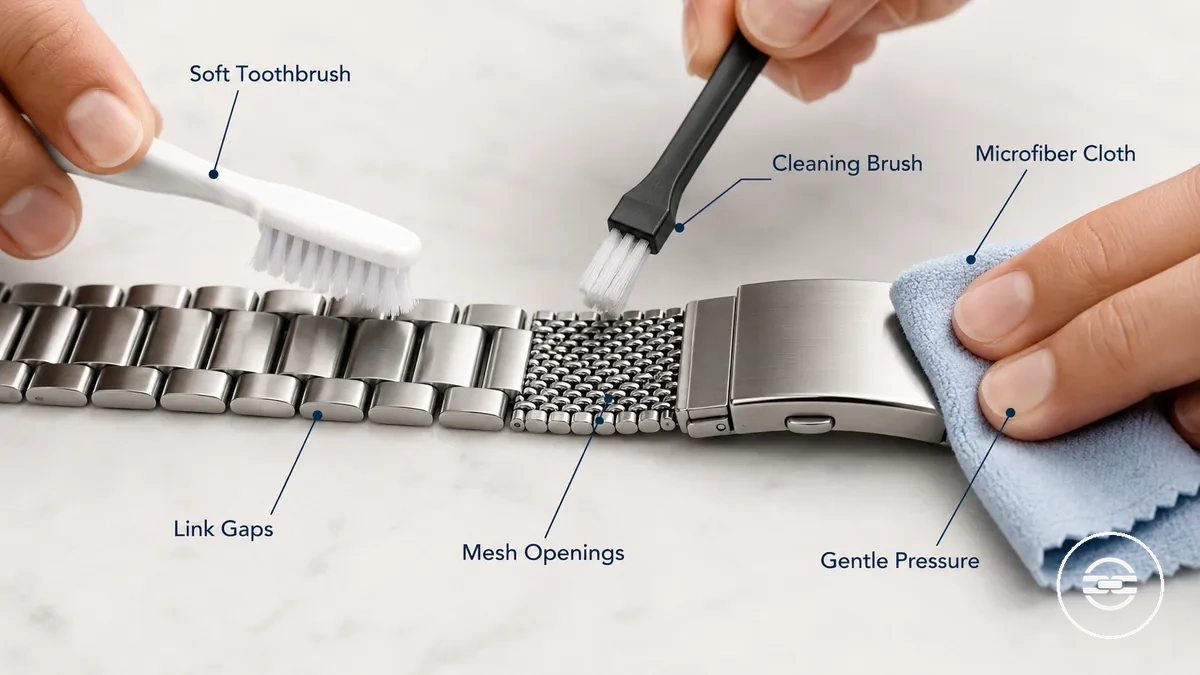
Residue often collects inside link gaps, mesh openings, and clasp folds where a wiping cloth alone may not reach. Bristle softness helps a cleaning brush or soft toothbrush loosen buildup with lighter contact, while a microfiber cloth improves residue pickup on flatter surfaces and helps reduce streaks during drying. The comparison below maps each tool to a suitable cleaning task with controlled pressure.
- Soft toothbrush: Cleans link gaps with gentle pressure and soft bristle contact, helping reduce finish damage from excessive force.
- Microfiber cloth: Wipes polished surfaces, dries moisture, and improves residue pickup with a soft cloth texture while limiting unnecessary rubbing.
- Cleaning brush: Reaches mesh openings and clasp folds with soft bristles while avoiding excessive pressure on the band.
- Surface match: Use a toothbrush or cleaning brush for narrow spaces, and a microfiber cloth for flat or polished surfaces where wiping is usually more suitable.
- Example: A soft toothbrush can help loosen residue inside clasp folds, while a microfiber cloth is often the safer choice for wiping a polished outer surface.
Mild Soap and Stainless Steel Cleaner Choices
Mild soap is the default choice for routine metal watch band cleaning because it can remove everyday residue without relying on stronger cleaners. A stainless steel cleaner may be suitable for stainless steel bands when the finish type supports its use, while coated surfaces and polished finishes often require more cautious cleaner selection. Cleaner strength should match the band material and finish rather than the amount of dirt.
Cleaner residue can remain on the band if too much product is used or if a diluted cleaner is not removed completely. Coated surfaces and polished finishes may be more sensitive to cleaner strength, so gentler handling is often more appropriate than using a stronger cleaner. The points below summarize cleaner choices based on material, finish, and residue risk.
Cleaner selection depends on the metal and finish, so use the following guidance to reduce unnecessary residue and surface risk.
- Do: Use mild soap with warm water for routine cleaning and rinse away remaining cleaner when appropriate before drying with a clean microfiber cloth.
- Do: Use a diluted cleaner only when lighter cleaner strength suits the band and remove any remaining residue after cleaning.
- Do: Use a stainless steel cleaner only on compatible stainless steel finishes and with finish-aware caution.
- Avoid: Using stronger cleaners on coated surfaces or polished finishes because increased cleaner strength may raise residue risk or affect delicate finishes.
How to Clean a Metal Watch Band Step by Step
How to clean a metal watch band step by step begins with removing loose dirt, continues with controlled wet cleaning, and ends with thorough drying and inspection. Following this cleaning sequence helps reduce scratching and unnecessary water exposure during routine home maintenance. If the watch is not water resistant or the removable band cannot be separated from the watch case, keep water exposure to a minimum throughout the process.
Dry dirt should be removed before wet cleaning because trapped grit can increase scratch risk during wiping or brushing. Gentle brushing helps clean links, mesh, and clasp gaps without forcing debris deeper into the bracelet, while rinse carefully and dry thoroughly complete the cleaning process by reducing residue and moisture. Follow the ordered steps below to keep the cleaning sequence safe and consistent.
- Prepare: Gather the cleaning supplies and inspect the band. If the bracelet has a removable band, separate it from the watch case when appropriate to improve water control.
- Wipe: Wipe loose dirt from the links and outer surfaces with a soft cloth. Removing grit first helps lower scratch risk during later cleaning.
- Brush: Brush the links, mesh, and clasp gaps with gentle pressure to loosen trapped residue. For heavy grime, use repeated light passes instead of forcing dirt out.
- Clean: Wipe the bracelet with a cloth lightly dampened with a suitable cleaning solution. Keep moisture controlled, especially when cleaning an attached band on a non-water-resistant watch.
- Rinse carefully: Use a light rinse only when appropriate for the band and watch configuration. Avoid unnecessary water around the watch case to limit moisture exposure.
- Dry thoroughly: Dry the links, mesh, and clasp gaps with a clean microfiber cloth so moisture is less likely to remain in narrow spaces.
- Inspect: Inspect the band for remaining residue or trapped moisture before wearing the watch again. Repeat only the affected cleaning step if additional dirt is still visible.
Wipe Away Surface Dirt Before Scrubbing
Surface dirt should be removed with a dry wipe before wet scrubbing begins. Use a soft cloth to lift loose grit from the band because rubbing trapped particles across polished or coated surfaces can increase scratch risk.
If dust, debris, or loose grit is visible around link edges, clasp folds, or the mesh texture, remove it before moving to the next cleaning step. A dry wipe or light dry brushing usually clears loose material without unnecessary rubbing. Use the following micro-steps to prepare the band safely.
- Dry wipe: Wipe the link edges, clasp folds, and exposed surfaces with a soft cloth using a light pressure level. This removes loose grit before it can increase scratch risk.
- Tap and inspect: Gently tap the band and check the mesh texture and clasp folds for remaining debris. Avoid rubbing areas where visible grit is still trapped.
- Dry brush: Use light dry brushing around the mesh texture and narrow spaces only if debris remains. Keep the pressure level low because trapped grit may scratch polished surfaces when rubbed aggressively.
Brush Between Links, Mesh, and Clasp Gaps
Links, mesh, and clasp gaps trap grime that should be removed with gentle angled brushing instead of heavy scrubbing. Keep the brush angle shallow so the bristles reach narrow spaces with controlled soap contact and suitable bristle softness. Use gentle pressure because excessive force can increase scratch risk.
If the band has bracelet links, brush between each gap with short strokes. If it has mesh openings or clasp folds, adjust the brush angle to follow the surface while keeping the same gentle pressure. Use the part-specific techniques below for effective residue removal.
- Links: Angle the brush into the bracelet links with soft bristles and light soap contact. Use short strokes to improve residue removal without pushing debris deeper.
- Mesh: Brush across the mesh openings with suitable bristle softness and gentle pressure. Follow the movement direction of the weave to lift trapped grime more effectively.
- Clasp gaps: Guide the brush into the clasp gaps with controlled movements. Keep the movement direction aligned with the gap to help loosen residue for easier removal.
- Stubborn grime: Repeat gentle passes rather than increasing pressure. Extra light brushing may loosen stubborn grime with less scratch risk than forcing the brush into the band.
Rinse Carefully Without Soaking the Watch Case
Rinse carefully with a light, controlled rinse that limits water exposure around the watch case. Do not soak the watch case during routine metal band cleaning because unnecessary water exposure can reach sensitive areas. Soaking the entire watch belongs outside normal band cleaning unless the watch maker specifically allows it.
If the removable band has been separated from the watch case, a light rinse is usually easier to control before immediate drying. If the band is still attached, wipe clean with minimal moisture to protect the watch case and reduce water exposure around the crown area, spring bars, and clasp joints. Finish with towel control and immediate drying.
- If the band is removable: Use a light rinse with controlled water contact, keep the watch case separate, then use towel control and complete immediate drying before reattaching the band.
- If the band is attached: Wipe clean with minimal moisture, avoid soaking the watch case, limit water around the crown area, spring bars, and clasp joints, and complete immediate drying after cleaning.
Drying and Polishing the Band After Cleaning
Dry the band thoroughly before wearing it again because drying completes the cleaning process rather than serving as a cosmetic step. Use a microfiber cloth to wipe away visible moisture, then allow any remaining damp areas to finish with air drying. This helps reduce remaining moisture that may contribute to residue or irritation.
Hidden moisture can remain inside link gaps, mesh sections, and clasp folds after rinsing. Wipe these areas dry with a microfiber cloth and inspect them again after air drying to confirm that moisture has not collected in concealed spaces. Drying and polishing the band after cleaning should include a final check for hidden moisture and surface finish before wearing the watch again.
If the band has polished surfaces, buff lightly with a clean microfiber cloth to reduce streaks. If it has brushed surfaces, wipe in the direction of the finish and avoid aggressive polishing, especially on coated or worn bands. Light polishing improves the cleaned appearance but is not intended to remove scratches or restore the finish.
Before wearing the watch again, check hidden clasp areas and nearby link gaps for any remaining moisture. If dampness is still present, continue air drying before putting the watch back on.
Drying and polishing the band after cleaning is complete when the checklist below confirms that hidden moisture has been removed and the surface has been finished gently.
- Microfiber cloth: Wipe dry all exposed surfaces to reduce streaks and remaining moisture.
- Link gaps: Inspect between the links and dry trapped moisture to help reduce irritation.
- Clasp folds: Check hidden clasp areas and wipe away moisture before fastening the clasp.
- Air drying: Allow damp areas to air dry naturally instead of using heat to finish the drying step.
- Light polishing: Buff polished surfaces lightly and wipe brushed surfaces with the finish direction without expecting finish restoration.
Removing Odour and Built-Up Grime From a Metal Watch Band
Odour usually comes from trapped residue and trapped moisture rather than the metal band itself. Sweat, skin oil, soap residue, and built-up grime can collect inside links, mesh, and clasp gaps where they are harder to remove. If odour remains after routine cleaning, repeat cleaning gently instead of using stronger cleaning methods.
If the smell returns soon after cleaning, built-up grime may still be trapped in narrow spaces such as links, mesh, or clasp gaps. For example, residue can remain inside a clasp gap even when the outer surface appears clean. Removing odour and built-up grime from a metal watch band starts with locating trapped residue before repeating the cleaning process.
Persistent odour usually means residue or trapped moisture remains after the first cleaning. Repeat cleaning with mild soap, allow brief soap contact, rinse carefully, and dry thoroughly to improve drying quality before wearing the band again. If the smell still remains after careful cleaning and drying, routine cleaning alone may not resolve the buildup.
Wearing habits can influence recurrence because sweat and moisture may collect between cleanings. Regular residue control and thorough drying can help reduce the chance of odour returning.
Removing odour and built-up grime from a metal watch band is easier when the checklist below helps identify where residue is trapped and what to check after cleaning.
- Odour near links: Likely residue location is between the links. Repeat gentle cleaning and confirm the area is dry thoroughly before wearing.
- Smell from mesh: Built-up grime may remain inside the mesh. Clean gently with mild soap and check for trapped moisture after drying.
- Odour around clasp gaps: Soap residue may remain inside clasp gaps. Rinse carefully and confirm the area is completely dry.
- Persistent smell: Repeat cleaning with gentle methods rather than increasing force, then check drying quality before wearing the watch.
- Odour returns frequently: Review wearing habits and remove residue before trapped moisture and buildup accumulate again.
Cleaning Mistakes That Can Damage Metal Watch Bands
Most cleaning damage comes from harsh chemicals, abrasion, soaking, or poor drying rather than routine maintenance itself. Harsh chemicals, abrasive pads, and unnecessary soaking can increase the risk of coating wear, tarnish, finish damage, or moisture traps in hidden joints. Stop routine cleaning if you notice rust, loose parts, or coating damage instead of applying more force.
Finish type and hidden joints can change how a metal watch band responds to cleaning. Polished surfaces may show scratches more easily, while coated finishes can wear faster if exposed to risky cleaners or abrasive scrubbing. Cleaning mistakes that can damage metal watch bands are easier to avoid when the risks and safer alternatives are compared side by side.
| Mistake | Why it can damage the band | Safer alternative | When to stop cleaning |
|---|---|---|---|
| Harsh chemicals | Can increase coating wear, tarnish, or finish damage depending on the material. | Use a mild cleaner intended for routine cleaning. | If the coating begins to lift, discolour, or change in appearance. |
| Alcohol wipes | May affect certain finishes or coatings with repeated use. | Use a damp microfiber cloth with mild soap when appropriate. | If the surface appearance changes after cleaning. |
| Abrasive pads | Can scratch polished surfaces and increase finish damage. | Use a soft cloth or soft brush with light pressure. | If scratches or finish changes become noticeable. |
| Soaking the band | Can leave moisture traps around hidden joints and increase rust risk on susceptible parts. | Use controlled cleaning followed by thorough drying. | If moisture remains trapped after drying. |
| Ultrasonic cleaning | Suitability depends on the band condition, finish, and presence of loose parts. | Use ultrasonic cleaning only when it is appropriate for the band and its condition. | If parts seem loose or movement changes after cleaning. |
| Poor drying | Can leave moisture in hidden joints and increase rust risk. | Dry thoroughly with a microfiber cloth and allow air drying if needed. | If moisture remains in concealed areas. |
| Aggressive polishing | Can increase coating wear and alter polished surfaces. | Buff lightly using a suitable cloth. | If the finish begins to wear unevenly. |
If rust, loose parts, or visible coating damage appear, routine cleaning should give way to inspection rather than repeated cleaning. These conditions may require attention beyond normal maintenance, especially when the band no longer responds to gentle cleaning. This marks the practical limit of routine cleaning.
Routine care is most effective when cleaning methods remain gentle and finish-aware. If cleaning damage or care problems extend beyond normal maintenance, see metal watch band rust and care problems.
Harsh Chemicals, Alcohol Wipes, and Abrasive Scrubbing
Harsh chemicals and abrasive scrubbing can cause finish damage or leave residue that affects a metal watch band over time. Mild cleaning is usually slower, but it is the safer choice for routine maintenance.
Risk depends on the finish, coating, cleaner strength, and the amount of pressure applied during cleaning. Alcohol wipes and polishing compounds may affect certain surfaces, while abrasive pads, hard brushes, bleach, and excessive pressure present more direct risks to surface texture or coatings. The points below pair each risky method with its likely effect and a safer routine-maintenance alternative.
- Bleach and strong degreasers: These harsh chemicals can contribute to finish damage or coating wear; use a mild cleaner for routine maintenance instead.
- Alcohol wipes: They may affect certain coatings or finishes depending on the surface; use them cautiously and prefer gentle cleaning when appropriate.
- Abrasive pads and hard brushes: These abrasive methods can scratch polished surfaces or alter surface texture; use a soft cloth or soft brush with light pressure instead.
- Polishing compounds: They may change the appearance of coated or delicate finishes; reserve them for surfaces that are suitable rather than routine cleaning.
- Excessive pressure: Heavy scrubbing increases scratch risk even with a mild cleaner; repeated gentle passes are slower but provide a safer result for routine maintenance.
Extra Care for Coated, Polished, or Tarnished Metal Bands
A coated band, polished band, or tarnished metal surface needs gentle cleaning and closer inspection because finish condition changes the risk of routine maintenance. Worn coatings, visible marks, and damaged areas should be handled with light pressure and limited cleaner contact. Routine cleaning may improve cleanliness, but it should not be treated as restoration or finish repair.
If coating wear, polished scratch visibility, tarnish, or rust spots are already present, stronger cleaning may increase the chance of further surface change. A brushed texture can become uneven if rubbed aggressively, while a plated finish may need extra caution when the coating is thin or damaged; more detail is available under metal watch band finishes. Extra care for coated, polished, or tarnished metal bands means matching the cleaning action to the finish condition, as outlined in the checklist below.
- Coated band with visible coating wear: Use gentle cleaning with minimal pressure, and do not expect routine cleaning to restore the coating.
- Polished band with high scratch visibility: Use a microfiber cloth and light pressure, and do not expect routine cleaning to remove scratches.
- Band with brushed texture: Wipe gently in a consistent direction, and do not treat cleaning as a way to recreate the original texture.
- Tarnished metal: Limit routine cleaning when tarnish is uneven or the surface looks fragile, and do not present cleaning as full tarnish restoration.
- Plated finish: Reduce cleaner strength and friction when the finish condition is uncertain, and do not imply that worn plating can be restored through cleaning.
- Rust spots or a damaged surface: Stop routine cleaning if serious rust, loose parts, or damaged coatings are visible, because these conditions should be handled as a care problem rather than normal maintenance.